
Indian Polity & Governance
NHRC Takes Cognizance of Septic Tank Deaths in Odisha:
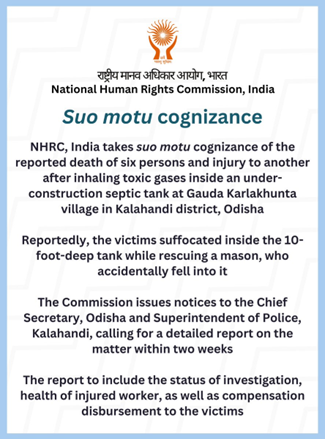
Context: The National Human Rights Commission (NHRC) stepped up its compliance tracking after taking suo motu cognizance of a tragic incident in Kalahandi district, Odisha, where six workers died from inhaling toxic gases while constructing a septic tank.
-
-
- Suo Motu Intervention: The NHRC exercised its statutory powers to intervene without a formal external complaint, issuing notices to state administrators regarding the incident.
- Accountability Demand: The Commission demanded detailed reports from the state’s Chief Secretary and District Magistrate outlining criminal investigations and compensation disbursements.
- Hazardous Environment: The incident highlights the ongoing danger of hazardous, non-mechanized cleaning and construction within confined underground chambers.
- Legal Defiance: Such incidents occur despite strict statutory prohibitions enacted under the Prohibition of Employment as Manual Scavengers and their Rehabilitation Act, 2013.
- Supreme Court Mandates: The action reinforces Supreme Court directives that mandate a minimum compensation of ₹30 Lakh for families of individuals who die during sewer or tank cleaning operations.
- The Toxic Threat: Workers in unventilated septic environments quickly succumb to lethal concentrations of gases like Hydrogen Sulfide, Ammonia, and Methane.
- NAMASTE Scheme Synergy: The central government has repeatedly pushed for the absolute implementation of the NAMASTE scheme to transition sanitation work from manual to mechanized processes.
- Local Government Accountability: Under the law, municipal engineers and private contractors face direct criminal liability under Section 304 (culpable homicide) if safety gear is withheld.
- The Equipment Deficit: Investigations frequently reveal a lack of gas detectors, oxygen apparatus, and emergency harness ropes at construction sites.
- Human Rights Redefinition: The NHRC treats these preventable asphyxiation deaths not as simple industrial accidents, but as direct violations of the Right to Life and Dignity under Article 21 of the Constitution.
National Human Rights Commission (NHRC): A statutory body established in 1993 under the Protection of Human Rights Act. It consists of a Chairperson (a retired Chief Justice of India or a Judge of the Supreme Court) and other appointed members. It possesses the powers of a civil court but cannot award financial punishments directly; its recommendations are advisory.
NAMASTE Scheme: Standing for National Action for Mechanized Sanitation Ecosystem, this joint initiative of the Ministry of Social Justice & Empowerment and the Ministry of Housing & Urban Affairs aims to achieve zero fatalities in sanitation work across India.
-
(PIB)
International Relations
India and Cambodia Operationalize Cross-Border UPI Linkage:
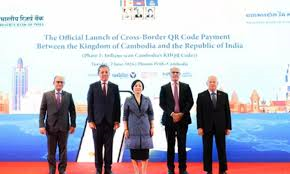
Context: The Reserve Bank of India (RBI) and the National Bank of Cambodia (NBC) officially operationalized the first active phase of their cross-border QR payment system linking India’s UPI with Cambodia’s KHQR.
-
-
- Two-Way Interoperability: The deal enables seamless digital fund pathways for tourists and businesses operating between the two nations.
- Immediate Utility: Indian travelers can now use local UPI-enabled applications to make real-time merchant payments at over 5 million KHQR merchant points across Cambodia.
- Reciprocal Phase: The second phase will allow Cambodian citizens to scan Indian UPI QR codes using local apps when traveling in India.
- Institutional Oversight: The project is executed via direct financial coordination between the NPCI International Payments Limited (NIPL) and the National Bank of Cambodia.
- De-dollarization Move: This framework permits direct exchange settlements between the Indian Rupee (INR) and the Cambodian Riel (KHR), reducing dependence on intermediate global currencies like the US Dollar.
- Lower Transaction Costs: Bypassing traditional international credit card networks eliminates steep markup fees and processing costs for small-scale merchants.
- Boost to Tourism: Tourism is a cornerstone of Cambodia’s economy. This integration simplifies travel logistics for Indian visitors to cultural sites like Angkor Wat.
- UPI’s Global Expansion: Cambodia joins a growing list of nations including Singapore, UAE, Mauritius, and Sri Lanka that have integrated with India’s digital public infrastructure.
- Strategic Act East Fit: This digital fintech link reinforces India’s Act East policy by strengthening institutional and economic integration with ASEAN member states.
NPCI (National Payments Corporation of India): An initiative of the RBI and the Indian Banks’ Association (IBA) under the Payment and Settlement Systems Act, 2008, acting as an umbrella organization for retail payments in India.
Digital Public Infrastructure (DPI): Refers to blocks of digital platforms such as digital identity (Aadhaar), data exchange systems (DigiLocker), and payment networks (UPI) built to deliver essential public and private services at a population scale.
-
(IE)
Economy
India Ranks 4th Globally in the International CHIPS AI Index:
Context: An international artificial intelligence tracking evaluation released on June 4, 2026, placed India fourth globally in the comprehensive CHIPS index for Artificial Intelligence development.
-
-
- The Index Concept: The CHIPS index measures performance across five thematic operational pillars: Connect, Harness, Innovate, Protect, and S
- Top Tier Leadership: India ranks directly behind the United States, China, and Singapore, outperforming several highly developed G7 economies.
- Massive Sample Expansion: India’s global placement climbed systematically from 8th place out of 32 nations evaluated in 2025, to 4th place within an expanded global sample of 71 nations in 2026.
- Surging User Penetration: Internet and digital application users within India expanded by a staggering 8% year-on-year, eclipsing the average 2.1% growth observed in rival top-10 nations.
- Global User Share: Reflecting its massive digital footprint, India now accounts for an estimated 9% of the entire global AI user base.
- Talent Capital Hub: The assessment highlights that India possesses the second largest structural concentration of specialized AI talent and software developers globally.
- Infrastructure Discrepancies: While India scored high in the “Connect” and “Harness” pillars, it faces minor bottlenecks in the foundational “Protect” (data privacy frameworks) and compute infrastructure indicators.
- Sovereign Digitization Policies: The ranking jump is attributed to public sector pushes like the IndiaAI Mission, Digital India, and open API frameworks.
- Commercial Integration: Domestic technology firms have accelerated the integration of generative AI models across local banking, retail, and agro-tech industries.
- Future Compute Projections: Maintaining this trajectory depends heavily on establishing indigenous graphic processing unit (GPU) supercomputing clusters to reduce reliance on foreign hardware imports.
Artificial Intelligence Mission (IndiaAI): Implemented with a budget allocation of over ₹10,300 Crore, its components include the IndiaAI Compute Capacity, IndiaAI Innovation Centre, and IndiaAI Datasets Platform to provide computational credits to startups.
Graphic Processing Units (GPUs): Unlike Central Processing Units (CPUs) designed for sequential processing, GPUs use parallel computing architectures, making them essential for training massive neural networks and deep-learning AI models.
-
(TH)
Geography
Onset of Southwest Monsoon over Kerala:
Context: The India Meteorological Department (IMD) officially declared the onset of the Southwest Monsoon over Kerala on June 4, 2026, marking the beginning of India’s vital four-month rainy season.
-
-
- Delayed Onset: The initial IMD forecast predicted the monsoon’s arrival over Kerala by late May, but it experienced a brief delay, establishing a firm onset on June 4.
- Heavy Rain Alerts: Prompted by the onset, the IMD issued immediate Orange and Yellow alerts for several southern districts of Kerala, forecasting heavy to very heavy precipitation (7–20 cm).
- Criteria for Declaration: The IMD declares a monsoon onset only when specific thresholds are met: at least 60% of available monitoring stations in Kerala and Lakshadweep record ≥2.5 mm of rain for two consecutive days, combined with specific wind depth and Outgoing Longwave Radiation (OLR)
- Wind Profile Conditions: For the formal declaration, the depth of westerly winds must extend up to the lower tropospheric levels 600 hPa, and the zonal wind speed must strengthen in the equatorial belt.
- Radiation Factor: The Outgoing Longwave Radiation (OLR) measured via satellite tracking must drop below 200 W/m² over the targeted oceanic sector, signifying dense convective cloud formations.
- Broader System Distribution: Concurrently, strong moisture-laden winds advancing over the Arabian Sea are triggering pre-monsoon and thunderstorm alerts across South Peninsular and Central India.
- Economic Core Impact: The timely arrival and progression of seasonal rains directly dictate the yield of India’s Kharif cropping cycle, as nearly half of domestic farmland relies solely on rainfed irrigation.
- Hydrological Rejuvenation: Monsoon rainfall supplies over 70% of India’s annual precipitation, directly filling key structural reservoirs and bolstering national hydropower capacities.
- INSAT-3DS Deployment: Meteorologists are monitoring this year’s precise atmospheric progression utilizing advanced thermal and infrared imagery from the newly operational INSAT-3DS weather satellite.
- Monsoon Mechanics: Driven by the differential heating of the landmass (Tibetan Plateau) and the surrounding oceans (Indian Ocean), creating a intense low-pressure zone that pulls southeast trade winds across the equator. Due to the Coriolis effect, these turn right, transforming into the Southwest Monsoon.
- Branches: It splits into the Arabian Sea Branch (hitting the Western Ghats first) and the Bay of Bengal Branch (moving up towards the Northeast and Gangetic plains).
- Cross-Country Spreads: While the West Coast receives structural surges, specific interior areas of East Uttar Pradesh and Bihar are facing brief residual heatwaves before the system expands northward.
-
(TH)
Science & Technology
MeitY Launches the VYOMA Innovation Challenge:
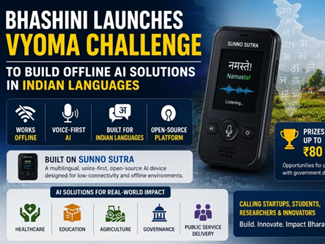
Context: The Digital India BHASHINI Division (DIBD), operating under the Digital India Corporation (DIC) of the Ministry of Electronics and Information Technology (MeitY), officially rolled out the VYOMA Innovation Challenge.
-
-
- Core Mandate: The challenge seeks to accelerate the development of open-source, voice-first, and multilingual Artificial Intelligence software solutions across Indian regional dialects.
- Edge AI Focus: A central objective is building models capable of execution in completely offline settings or low-internet environments, bypassing heavy cloud requirements.
- Collaboration Partners: The challenge is engineered in tandem with technology ecosystems, specifically partnering with Current AI and Kalpa Impact.
- The Sunno Sutra Base: The entire innovation architecture builds upon Sunno Sutra, an open-source, handheld reference AI hardware device revealed at the IndiaAI Impact Summit 2026.
- Target Audience: The platform opens competition tracks directly to Indian startups, MSMEs, academic researchers, and independent developers.
- Bridging the Digital Divide: By emphasizing voice-led AI instead of written interfaces, the program aims to provide public service accessibility to illiterate or low-digital-literacy demographics.
- Scale of Incentives: Competing teams can win structural grants and rewards totaling up to ₹80 Lakh, alongside active state deployments.
- Last-Mile Model Optimization: Entrants are tasked with optimizing AI algorithms to fit into small, low-powered edge devices with strict memory constraints.
- Public Impact Infrastructure: The initiative treats localized language AI as an element of open public infrastructure, comparable to UPI or account aggregators.
- The IndiaAI Context: This challenge aligns with the broader IndiaAI Mission, which prioritizes building sovereign datasets and language frameworks suited specifically to domestic realities.
- Bhashini Mission (National Language Translation Mission): An AI-led initiative launched to provide cloud-based open-source translation tools in 22 scheduled Indian languages, utilizing crowdsourcing (Bhasha Daan) to train diverse speech models.
- Edge Computing vs. Cloud Computing: Edge computing processes data locally on the hardware device itself (like a phone or IoT node) rather than routing it through distant centralized cloud data centers, ensuring privacy, zero latency, and offline operational continuity.
-
(PIB)
Government Schemes & Initiatives
Launch of the Prime Minister Research Chair (PMRC) Scheme 2026:
Context: The Department of Higher Education under the Ministry of Education highlighted the operational framework and evaluation structure for the recently opened Prime Minister Research Chair (PMRC) Scheme 2026.
-
-
- Core Objective: The scheme acts as a flagship intervention designed to reverse “brain drain” by attracting high-caliber researchers of Indian origin back to domestic research facilities.
- Target Demographics: Eligible applicants include Indian Nationals working abroad, Overseas Citizen of India (OCI) cardholders, and Persons of Indian Origin (PIO) settled globally.
- Structured Framework: The architecture of the program rests on three foundational pillars: Lead Institutions, Host Institutions, and PMRC Fellows.
- Three Tier Fellowships: It breaks positions down into three functional categories: Young Research Fellows (for early-career specialists), Senior Research Fellows, and Research Chairs for established veterans.
- Priority Sectors: Research mandates must align with 13 critical national sectors, including Semiconductors, Quantum Computing, Advanced Materials, Blue Economy, and Cybersecurity.
- Host Institution Benchmarks: Eligible domestic facilities must rank in the Top 100 NIRF Overall/Engineering categories or the Top 50 NIRF Research rankings, alongside premium state labs under the DST or DBT.
- Empowered Governance: Selection and resource distribution are governed by a specialized Empowered Committee chaired by the Principal Scientific Advisor to the Government of India.
- Comprehensive Financial Grants: Selected fellows are provisioned with long-term financial endowments, high-end laboratory accesses, and complete administrative autonomy.
- Global Knowledge Transfer: Host universities benefit by establishing direct academic exchange pipelines with premier international institutions and market industries.
- Vision Realization: The initiative functions as a technological catalyst to scale indigenous intellectual properties, feeding directly into the broader targets of Aatmanirbhar Bharat and Viksit Bharat.
- Principal Scientific Advisor (PSA): The Office of the PSA was set up in 1999. It acts as the premier autonomous advisory body on scientific and technological policies for the Cabinet.
- NIRF (National Institutional Ranking Framework): Launched by the Ministry of Education in 2015, it outlines a methodology to rank higher education institutions across India based on 5 parameters: Teaching/Learning, Research, Outcomes, Outreach, and Perception.
-
(TH/PIB)
Miscellaneous
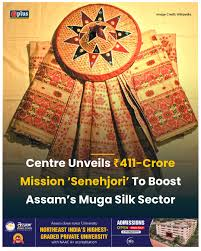
Assam Launches ‘Mission Senehjori’ to Transform Muga Silk Sector:
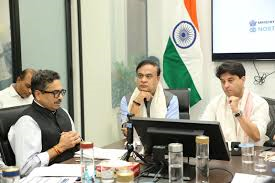
Context: The Chief Minister of Assam launched a major cluster-based sericulture initiative titled ‘Mission Senehjori’ aimed at scaling Assam’s endemic Muga silk sector into a high-value global luxury brand.
-
-
- Investment Scale: The mission is designed as a three-year cluster programme (2026–2028) backed by a total investment outlay ranging from ₹396 Crore to ₹411 Crore.
- Institutional Financing: The project is co-financed with dedicated structural grants of ₹136–151 Crore from the Ministry of Development of Northeastern Region (MDoNER).
- Core Objectives: The initiative seeks to streamline raw silk aggregation, modernize yarn-reeling infrastructure, and establish direct global market links for local weavers.
- Endemic Heritage: Muga silk is derived from the silkworm Antheraea assamensis, which is ecologically adapted almost exclusively to the Brahmaputra Valley.
- Unique Characteristics: Known for its natural shimmering golden-yellow texture, Muga silk possesses exceptional durability and becomes more lustrous with every wash.
- Geographical Indication (GI) Shield: Muga Silk was granted Geographical Indication protection, legally validating that authentic production remains confined to the specified Assamese landscape.
- Rural Livelihood Anchor: The sericulture supply chain provides vital livelihood support to thousands of indigenous tribal families, particularly women spinners and weavers.
- Climate Vulnerability Risk: The silkworm populations are sensitive to climate variations. The mission introduces climate-resilient rearing sheds to insulate crops from rising summer temperatures.
- Countering Counterfeits: A key component involves deploying secure blockchain-linked tags and Silk Marks to protect authentic buyers from cheaper tussar or synthetic alternatives.
- Value Chain Modernization: The mission transitions traditional weavers from unorganized cottage setups into structured Special Purpose Vehicles (SPVs) capable of fulfilling large international luxury orders.
- Types of Silk in India: India is the only country that produces all five commercial varieties of silk: Mulberry, Eri, Muga, Tropical Tasar, and Oak Tasar. India ranks as the world’s second-largest producer of silk after China.
- MDoNER (Ministry of Development of North Eastern Region): Established in 2001, it functions as a specialized ministry to coordinate infrastructure planning, socio-economic development, and central fund allocations for the eight northeastern states.
-
(TH/IE)
Spread the Word