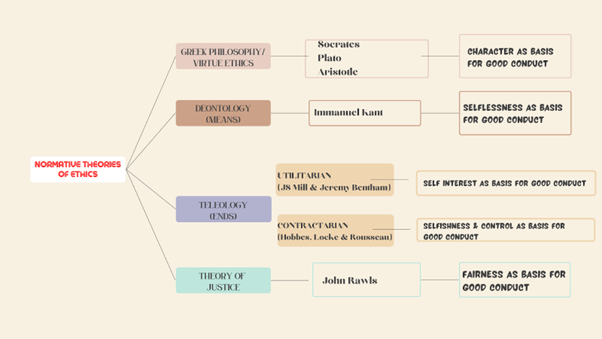
Since ethics deals with human character and conduct, it is concerned about ‘what ought to be’ of human conduct, that is, how a human is supposed to behave in ethical fashion. Since human conduct is guided by norms and standards, a branch of philosophy has emerged known as normative theory of ethics which deals with ‘what ought to be’ of human conduct.
Origin of normative theory of ethics
Although ethics in India finds its roots in ancient Vedic texts which deals with Dharma, meaning duty, obligation, and righteousness, but it was Socrates who is said to have laid down the foundation of ethics through his philosophy of ‘Art of Questioning’. He is the founder of the Greek Philosophy. His disciples Plato and Aristotle further advanced his philosophy which ultimately resulted into emergence of the normative theory of ethics.
ETHICS: DEFINITION
The term ethics is derived from Greek word ethicos/ethos, which means character and conduct. It means ethics deals with moral aspects of human conduct. It has been defined by leaders and philosophers as follows:
Aristotle: “Ethics is study of character, is built around the premise that people should achieve an excellent character by practicing virtue in order to ultimately attain happiness or well-being.”
Mahabharata: “Don’t do unto others as you won’t be done by”.
Cambridge Dictionary: A system of accepted beliefs that control behaviour, especially such a system based on morals.
Michael Sandel: Ethics is not solely about doing things right but also about doing the right things.
Spread the Word