Introduction: Bharat Audyogik Vikas Yojna (BHAVYA) is a ₹33,660 crore initiative to develop 100 plug-and-play industrial parks across India. Which is approved by the Cabinet in March 2026 and notified on 10 April 2026. It provides modern industrial infrastructure, reliable services and faster approvals to reduce the time needed to set up industries & support MSMEs.
About Manufacturing in India
-
- Manufacturing contributes about 16–17% of GDP and employs over 27 million
- National Manufacturing Mission targets a 25% share of GDP by 2035.
- Medium- and high-technology industries account for 3% of manufacturing value addition. Hence, showing a shift to higher-value, technology-intensive manufacturing.
- Industries need reliable infrastructure, efficient logistics and predictable approvals with global supply chains diversifying, well-connected industrial locations matter more.
What Are Plug-and-Play Industrial Parks?
-
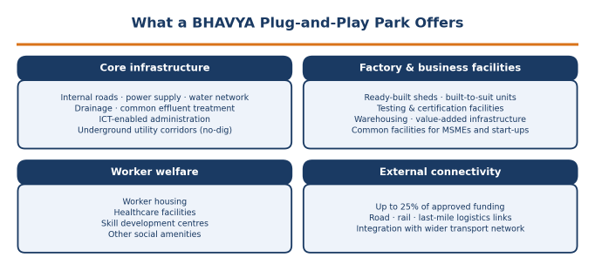
- Pre-developed industrial ecosystems where land, trunk infrastructure, utilities and common facilities are available before industries begin operations.
- Approvals and basic clearances are often streamlined through single-window systems, so enterprises move faster from investment decision to production, with lower upfront cost and delay.
- Trunk infrastructure: Higher-order infrastructure serving catchment areas shared between developments (main lines of water supply, drainage, sewerage, roads, streetlights, electricity), commonly provided by local governments.
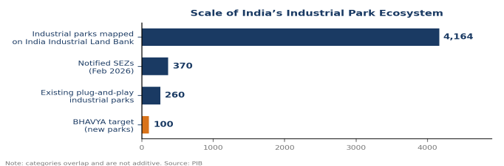
- Current status: 260 plug-and-play parks already exist; ₹2,500 crore was allocated in Union Budget 2025–26 for such parks.
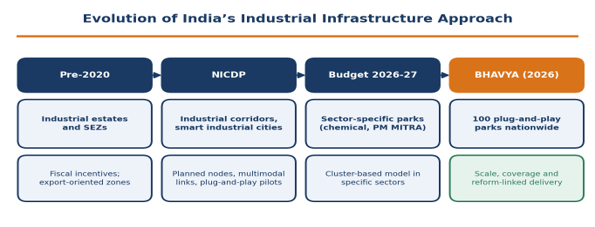
Evolution of SEZs to Plug-and-Play
-
- SEZs: 370 notified SEZs (Feb 2026) attracted ₹7.82 lakh crore investment and 7 lakh jobs.
- India Industrial Land Bank (IILB): 4,164 industrial parks mapped (14 October 2026).
- NICDP: Moved beyond land to manufacturing zones combined with utilities, logistics and urban services. Industrial nodes: Dholera SIR (Gujarat), Shendra-Bidkin (Maharashtra), Vikram Udyogpuri (Madhya Pradesh), Integrated Industrial Township Greater Noida (Uttar Pradesh).
BHAVYA Framework
| Feature | Details |
| Outlay and timeline | ₹33,660 crore; six years (FY2026–27 to FY2031–32). |
| Financial assistance | Up to ₹1 crore per acre for developing industrial parks; up to 25% of approved funding for external infrastructure (road, rail, last-mile logistics). |
| Scale and selection | 100 parks in total; up to 50 in the first phase through challenge mode in two selection rounds; criteria: project readiness, land availability, industrial potential. |
| Size | 25 to 1,000 acres per park, as per mandatory land criteria in the scheme guidelines. |
| Implementation | With States and private developers, through dedicated Special Purpose Vehicles (SPVs) for development, operations, investor facilitation and long-term maintenance. |
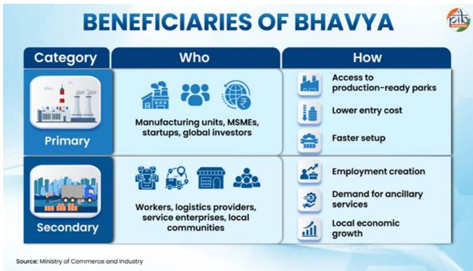
| Beneficiaries | Manufacturing firms, MSMEs, start-ups and investors get access to common facilities and streamlined approvals. |
| BHAVYA Portal (June 2026) | For project submission, appraisal and evaluation, enabling a transparent and competitive selection process. |
| Reform linkage | Emphasis on ease of doing business, single-window systems and investor-friendly reforms. |
Case Study: Dholera Special Investment Region (SIR), Gujarat
-
- New-generation industrial city planned with wide roads, reliable utilities and digital networks; power, water, gas and drainage run through a common underground network.
- Focus sectors: Semiconductors, aerospace and defence, solar manufacturing, green hydrogen, biotechnology, heavy engineering.
- Connectivity: Ports, airports, expressways and the Dedicated Freight Corridor.
- Outcomes: 495 acres allotted across 11 plots; investment potential ₹97,328 crore; employment potential 6,000+ jobs; land allotted to Tata Electronics (semiconductor) and Renew Power (solar modules).
Significance
-
- Ready land, utilities and approvals cut set-up time and cost, helping move from investment to production quickly.
- Parks create jobs, with worker housing, healthcare and skill centres improving productivity and welfare.
- Well-connected parks help India benefit as global supply chains diversify (China+1).
- Federal and private partnership as States, private developers and SPVs share responsibility, using challenge-mode competition to improve quality.
- It supports the National Manufacturing Mission (25% GDP by 2035), Make in India, Atmanirbhar Bharat and Viksit Bharat 2047.
Challenges
-
- Land acquisition, title and environmental clearances often delay projects; a 25-acre minimum requires suitable land availability.
- CAG audit of SEZs (2014) pointed to idle land and underutilisation; parks may suffer low occupancy if demand and anchor investors are not secured.
- Long-term maintenance and operations need sustainable revenue; private developers may hesitate in less-developed regions.
- Better-prepared States (such as Gujarat and Maharashtra) may win more parks in a challenge-mode selection, widening regional imbalances.
- Only up to 25% of funds is for external infrastructure; poor last-mile connectivity can reduce a park’s attractiveness.
Way Forward
-
- Adopt eco-industrial park For example Denmark’s Kalundborg industrial symbiosis, to reuse waste, water and energy within parks.
- Link BHAVYA with PM GatiShakti and ITLA for external connectivity planning, using the India Industrial Land Bank for site selection.
- Use outcome-linked disbursal (occupancy, investment, jobs) with public reporting on the BHAVYA Portal.
- Follow Singapore’s JTC Corporation model of ready-built factories and long-term estate management for SPV design.
- Learn from China’s Suzhou Industrial Park and Shenzhen SEZ, Korea’s industrial complex authority (KICOX) and Vietnam’s industrial parks on anchor industries and one-stop services.
- Provide rental and lease models for MSMEs, skilling through ITIs and worker housing to ensure inclusivity.
Conclusion
BHAVYA marks a shift from isolated industrial estates and zones to a nationwide network of investment-ready parks. Its success will depend on timely land and approvals, strong SPVs, balanced participation of States and sustainable design. So that manufacturing rises towards 25% of GDP by 2035 and India strengthens its role in global manufacturing.
Spread the Word