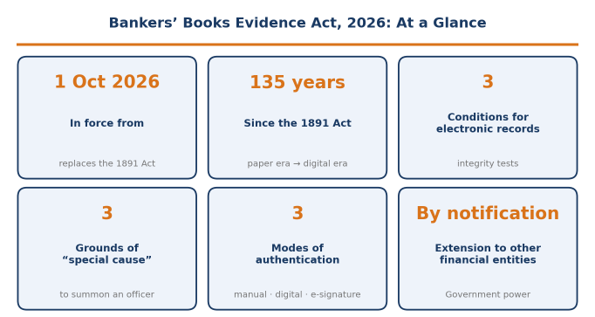
Introduction: The Bankers’ Books Evidence Act, 2026 came in force from 1 October 2026 by replacing the colonial-era Bankers’ Books Evidence Act, 1891. It creates a technology-neutral framework for admitting physical, electronic and digital banking records as evidence with standardised authentication and protection for bank officials from routine court appearances where the bank is not a party.
What Are Bankers’ Books?
-
- Bank / Banker: Any company or corporation carrying on banking business, any post office savings bank or money order office, and any financial sector entity to which the Act is extended.
- Bankers’ books: Ledgers, day-books, cash-books, account books and all other records used in the ordinary course of business, kept in written, physical or any data-storage form.
- Applicability: Any legal proceeding, arbitration, investigation or inquiry (under the Bharatiya Nagarik Suraksha Sanhita (BNSS), 2023 or any other law) where evidence is or may be taken.
Why Was a New Act Needed?
-
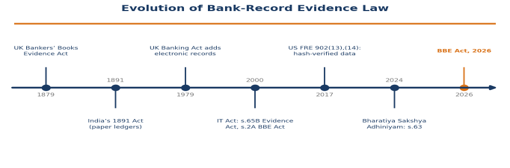
- The 1891 Act was framed in a colonial, entirely paper-based banking era. Today, banking is driven by digital platforms and mobile phones.
- Courts, investigators and arbitrators increasingly need electronic bank records. So the law had to be updated to keep pace with digital banking.
- Part of the Government’s drive to modernise laws, strengthen the banking and financial sector and improve ease of doing business.
Key Features
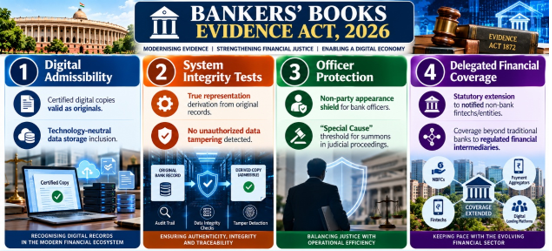
1. Contemporary evidentiary framework covering records in physical and digital banking systems.
2. Standardised authentication and certification of physical and electronic books through manual, digital and electronic signatures.
3. Stringent safeguards for secure handling and verification of electronic records as a precondition for admissibility.
4. Protection of bank officials from being routinely required to produce records or testify when the bank is not a party.
5. Flexible extension to other financial sector entities by notification.
Major Changes under the 2026 Act
1. Recognition of Electronic Records as Evidence
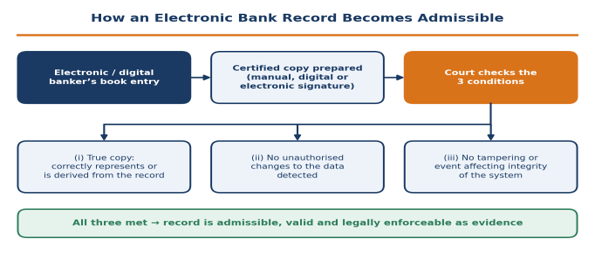
An electronic or digital record of a banker’s book is admissible, valid and legally enforceable if the following conditions are met:
i. The copy is a true copy and correctly represents or is appropriately derived from the record.
ii. No unauthorised changes to data are detected.
iii. No tampering or other event affecting the integrity and accuracy of the system is detected.
2. Compelling Production of Bankers’ Books
-
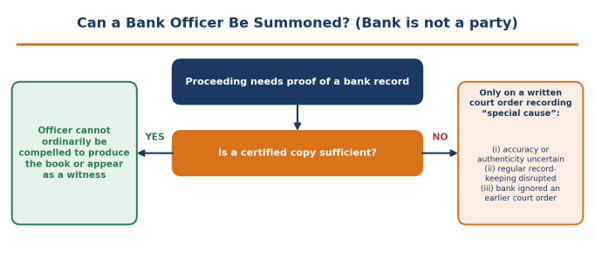
- Contents can be proved by a certified copy, without producing the original book.
- A bank officer cannot ordinarily be compelled to produce the book or appear as a witness, especially where the bank is not a party.
- An officer may be required only under a written court order recording a “special cause”, defined as:
i. Accuracy or authenticity of the entry is uncertain.
ii. Regularity of record-keeping is interrupted by any event.
iii. The bank did not comply with an earlier court order on inspection or production of the certified copy.
3. Extension to Other Financial Sector Entities
-
- The 1891 Act covered banking entities, post office savings banks and money order offices; the 2026 Act retains this.
- The Government can now extend the Act by notification to any entity or class of entities in the financial sector, with conditions, exceptions or modifications.
Comparison: 1891 Act vs 2026 Act
| Aspect | Bankers’ Books Evidence Act, 1891 | Bankers’ Books Evidence Act, 2026 |
|---|---|---|
| Era / context | Paper-based colonial banking. | Digital banking and online platforms. |
| Mode of proof | Certified copies of entries. | Retained, now with physical and electronic certification. |
| Electronic records | No technology-neutral framework (computer printouts added later through the IT Act, 2000). | Technology-neutral; admissible if 3 integrity conditions are met. |
| Authentication | Mainly manual certification. | Manual, digital and electronic signatures. |
| Officer’s appearance | Not compellable if bank is not a party, unless the court orders for special cause (term not elaborated). | Same principle, but written order and 3 specified circumstances of special cause. |
| Coverage | Banks, post office savings bank, money order office. | Same, plus notified financial sector entities. |
Note: The 1891 column is partly based on general knowledge of the old Act
Comparison with Other Countries
-
- India follows the common-law approach (UK, Canada, Singapore): certified copies plus officer protection unless “special cause” is shown.
- India goes further than UK/Canada by listing the grounds of special cause, reducing judicial uncertainty.
- The US relies on custodian certification and hash-value verification, a useful model for digital integrity
- India’s notification-based extension gives flexibility for fintechs, NBFCs and payment entities.
Significance
-
- Aligns evidence law with digital banking; complements the Bharatiya Sakshya Adhiniyam, 2023 (s.63 on electronic records) and BNSS, 2023.
- Certified copies and fewer witness summons reduce adjournments and save court and bank time.
- Banks are relieved of routine appearances and can focus on core operations.
- The three-condition test guards against tampering and manipulated records, strengthening trust in digital evidence.
- Reliable bank records help in fraud, money laundering and cyber-financial crime
Challenges
i. Easier production of records must be balanced with customer privacy (Puttaswamy, 2017) and Digital Personal Data Protection Act, 2023.
ii. Limiting officers’ appearances may restrict cross-examination on how records were generated, especially in criminal cases.
iii. Wide power to extend the Act by notification raises questions of excessive delegation and parliamentary oversight.
iv. Courts, investigators and smaller banks need digital forensic capability to verify tampering and system integrity.
v. Interaction with BSA 2023 certification, IT Act, 2000 and banking regulations may cause procedural confusion.
vi. Greater reliance on electronic records increases exposure to hacking and data manipulation.
Way Forward
i. Adopt the US practice of hash-value-based authentication and prescribe standard certificate formats and audit logs for electronic records.
ii. Issue clear rules and SOPs for certification, and integrate with BSA 2023 to avoid duplicate procedures.
iii. Train judges, prosecutors and police in digital forensics, through e-Courts and judicial academies.
iv. Ensure privacy-by-design, with data minimisation and access logs, in line with the DPDP Act, 2023.
v. Strengthen bank cybersecurity standards (RBI) so that digital books remain tamper-proof.
Conclusion
The Bankers’ Books Evidence Act, 2026 success will depend on fair implementation, strong digital safeguards and a careful balance between efficiency, privacy and the right to a fair trial. Thereby strengthening trust in India’s financial system and ease of doing business.
Spread the Word