Introduction:
Data centres are the invisible engines powering India’s digital life. They support banking, e-Governance and online services every second. Government is building a supportive policy ecosystem. Infrastructure status, fiscal incentives and clean energy adoption are strengthening India’s data centre ecosystem.
Inside a Data Centre:
A data centre is a secure facility housing computing, storage and networking equipment that stores, processes and distributes digital information. Four systems work together non-stop:
1. Power: Uninterruptible Power Supplies (UPS) give instant backup. Generators and distribution systems handle longer outages. Data centre computers cannot switch off, not even for a millisecond.
2. Cooling: HVAC systems regulate temperature, advanced liquid and immersion cooling improve efficiency as AI workloads push up heat output.
3. IT infrastructure: Servers process data, HDDs and SSDs store it. Security systems guard against physical and digital threats.
4. Networking and management: Routers and fibre-optic links move data in and out; virtualisation lets one physical server run many ‘virtual’ computers, like dividing one house into several apartments; automation monitors and optimises the whole system.
How a Data Centre Actually Works:
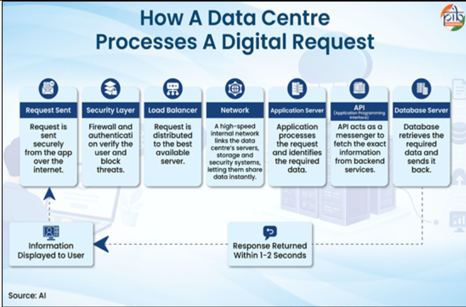
On every digital request like opening an app to check a bank balance. It follows same chain in just 1-2 seconds: Connect → Receive → Network → Process → Store → Secure → Respond.
-
- Network = The Corridors & Intercom, the internal hallways that connect the whole team so they can pass information to each other instantly.
- Security Layer= The Security Guard, inspects your request at the entrance for safety.
- Load Balancer= The Traffic Cop, directs incoming digital traffic so no single server gets overwhelmed
- Application Server= The Chef, takes your order, figures out what information or recipe is needed.
- API= The Waiter, acts as a messenger.
- Database Server= The Digital Vault, where details are locked away and retrieved when needed.
Status of Data Centres in India
-
- NIC runs National Data Centres at Delhi, Pune, Hyderabad and Bhubaneswar, plus 37 smaller centres in state capitals, supporting government digital services round the clock.
- Installed power capacity rose from 375 MW in 2020 to 1.57 GW by August 2026 — and is projected to reach nearly 8 GW by 2030.
- Around US$70 billion is already invested, with a further US$90 billion in announced projects.
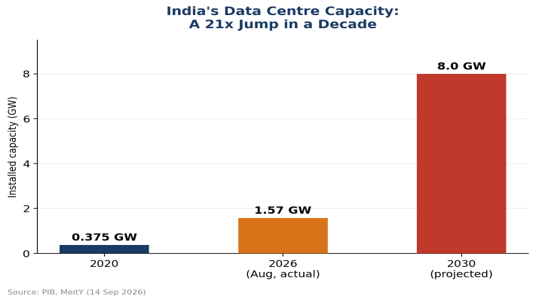
Fig. 1 – India’s data centre capacity is set to grow more than 20-fold between 2020 and 2030.
Enabling Policy Environment
-
- Infrastructure status (Budget 2022-23): Data centres were added to Harmonized List of Infrastructure i.e. treating them like highways or power grids, unlocking access to cheaper, longer-term credit.
- Tax holiday (Budget 2026-27): A tax holiday for eligible foreign cloud service providers using India-based data centres, running from Tax Years 2026-27 to 2046-47, i.e. until 2047.
- Linked schemes: Semicon 2.0 (₹1,27,500 crore), IndiaAI Mission (₹10,371.92 crore), Electronics Components Manufacturing Scheme (raised from ₹22,000 crore to ₹40,000 crore), and PLI 2.0 for IT Hardware all feed the same ecosystem like chips, AI models and servers all need data centres to run on.
- Demand outlook: The Central Electricity Authority projects data centre power demand could reach 17 GW by 2031-32.
- Clean power push: Green Energy Open Access Rules, Green Energy Corridor Scheme, National Green Hydrogen Mission and solar PV programmes aim to feed this growth with cleaner electricity.
- The SHANTI Act: India’s new nuclear law explicitly supports Small Modular Reactors and Micro Nuclear Reactors as future clean, round-the-clock power sources for AI and data centres.
How Big Is India’s Data Centre Sector?
Global installed data centre capacity stood at about 122 GW in 2024, with the US and China alone accounting for roughly 70% of it. India’s capacity, even after its rapid growth, remains a small fraction of the global total.
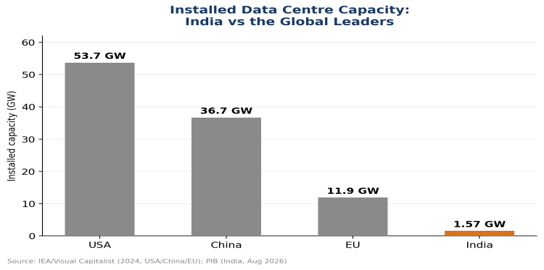
Fig. 2 – India’s data centre capacity is still a fraction of the US and China’s, even after rapid growth.
-
- Even at 8 GW by 2030, India’s projected capacity would still be smaller than the EU’s capacity in 2024 alone.
- Global Data names India among key APAC growth markets alongside Russia, Japan, South Korea and Australia.
- Singapore’s being one of the world’s most water-stressed nations has still built a globally significant data centre industry. Thus, showing that water stress does not have to be a hard ceiling if siting and cooling technology are managed well.
Challenges
-
- A CEEW report on scaling India’s data centres (2026) found that more than half of India’s data centres are located in water-stressed regions (per a WRI India map) and that most of the 15 state-level data centre policies lack basic performance standards like PUE or WUE.
- Field reporting from Andhra Pradesh (Mongabay-India, May 2026) found that the environmental clearance issued for a 1 GW data centre park in Tarluvada did not disclose water usage during the operational phase.
- Ministry of Power and CEA data notes that India curtailed 300 GWh of renewable energy in just Q1 2026 because the grid could not carry it, having met only about 80% of its annual transmission targets over the past five years — even as AI alone is expected to add 26.3 GW of new demand by 2031-32.
- State-level water stress data shows Rajasthan extracting 147% of its annual groundwater recharge (among the highest in India) and Hyderabad’s surface water supply falling 20% in the 2024 summer.
- MeitY’s confirmed that groundwater extraction limits and CPCB discharge standards already apply to data centres and said it has not received many complaints about unsustainable water use at the central level.
Way Forward
-
- State governments should adopt binding, uniform PUE and WUE performance standards in their data-centre policies.
- Environmental clearance authorities should mandate the disclosure of projected operational-phase water usage for all data-centre projects.
- CEA and power ministry should prioritise transmission and grid-evacuation investment specifically for data-centre and AI demand. Since curtailed renewable power shows generation capacity is outpacing the grid’s ability to deliver it.
- Ministry of Jal Shakti and state water boards should integrate data-centre siting decisions into local water-stress assessments before granting clearances rather than treating each project in isolation.
- MeitY and CEA should publish a regular, transparent national dashboard of data-centre water and energy use, so the aggregate, reassuring national figures and the more alarming local, cluster-level figures can both be tracked and reconciled publicly.
Conclusion:
India’s data centre sector has grown over four-fold since 2020 but still India remains a small player next to US and China. The real test for India’s data-centre policy is not whether it can attract capacity but whether it can grow this capacity without quietly exporting stress onto local grids and groundwater.
Spread the Word