INDIAN POLITY & GOVERNANCE
Supreme Court Invokes Article 142 to Quash Protest FIRs Against Students and Youth:
The Supreme Court has invoked its plenary powers under Article 142 of the Constitution to quash all First Information Reports (FIRs) registered against student and youth protesters, ruling that peaceful democratic participation should not result in lifelong criminal taint or jeopardize future educational and employment prospects.
-
- Plenary Jurisprudence (Article 142): Under Article 142(1), the Supreme Court is vested with expansive plenary powers to pass any decree or order necessary for doing complete justice in any cause or matter pending before it.
- Blanket Quashing of Protest FIRs: The Court directed the immediate quashing of all FIRs, charge-sheets, and non-bailable warrants registered by law enforcement agencies against student demonstrators participating in public examinations reform agitations.
- Safeguarding Youth Career Trajectories: The Bench noted that young citizens exercising democratic rights should not suffer indelible criminal records that trigger automatic disqualifications during government background verifications, university admissions, or passport processing.
- Right to Peaceful Assembly (Article 19(1)(b)): Reaffirmed that the fundamental right to assemble peaceably without arms under Article 19(1)(b), along with freedom of speech and expression under Article 19(1)(a), forms an indispensable bedrock of constitutional democracy.
- High Court Inherent Powers vs Article 142: Clarified the jurisdictional distinction between the High Courts’ statutory inherent powers under Section 528 of the Bharatiya Nagarik Suraksha Sanhita, 2023 (BNSS) / Section 482 CrPC and the Supreme Court’s constitutional plenary power under Article 142 to pass pan-India orders.
- Constitutional Limitations of Article 142: Reiterated established jurisprudence (*Supreme Court Bar Association v. Union of India, 1998* and *Prem Chand Garg, 1962*) holding that Article 142 powers cannot be used to directly override express statutory prohibitions or violate fundamental rights in Part III.
- Executive Compliance Timelines: Directed State Police authorities and the Ministry of Home Affairs to issue automated, unconditional police clearance certificates to all affected youth within a strict 15-day compliance window.
- Proportionality in Public Order Maintenance: Cautioned police commissioners against routine invocation of severe penal charges (such as unlawful assembly under Section 189 BNS or obstructing public servants under Section 221 BNS) against student rallies lacking violent intent.
- Institutional Justice Balance: Maintains an equitable equilibrium between the state’s legitimate interest in maintaining civic public order and the democratic protection of youth agency and civic voice.
(TH)
SOCIETY & SOCIAL JUSTICE
Ministry of Women and Child Development Launches ‘Rashtriya Poshan Maah 2026’ Across 14 Lakh Anganwadis:
The Ministry of Women and Child Development (MWCD) has commenced the 9th edition of the nationwide ‘Rashtriya Poshan Maah’ (National Nutrition Month) from 1st to 30th September 2026, focusing on maternal-infant health, indigenous dietary diversity, and technology-driven growth monitoring under Mission Saksham Anganwadi and Poshan 2.0.
-
- Campaign Launch: The nationwide month-long campaign was launched across 14 lakh Anganwadi Centres (AWCs) nationwide, targeting severe acute malnutrition (SAM) and moderate acute malnutrition (MAM) in children aged 0-6 years.
- Mission Saksham Anganwadi & Poshan 2.0: Functions as an integrated nutrition support programme merging the erstwhile POSHAN Abhiyaan, Scheme for Adolescent Girls, and Anganwadi Services into an overarching welfare umbrella.
- Core Thematic Pillars: Focuses on four key themes: Exclusive Breastfeeding in the first 6 months, Complementary Feeding, Anemia Prevention through iron-folic acid supplementation, and Promotion of Indigenous Millets (*Shree Anna*).
- Poshan Tracker Technological Grid: Deploys the digital ‘Poshan Tracker’ mobile application across all Anganwadi workers to record real-time anthropometric measurements (height and weight), enabling automated identification of stunted and wasted children.
- Aadhaar Verification & Migration Portability: Enables biometric verification of beneficiaries and nationwide inter-state migration portability, ensuring pregnant women and migrant children receive uninterrupted supplementary nutrition anywhere in India.
- Nutri-Gardens (*Poshan Vatikas*): Establishes community kitchen gardens across rural school premises and AWCs to cultivate nutrient-rich indigenous green leafy vegetables, medicinal herbs, and seasonal fruits.
- Convergence Architecture: Implements inter-ministerial convergence across the Ministries of Health and Family Welfare, Panchayati Raj, Rural Development, and Jal Jeevan Mission to ensure clean drinking water and sanitation.
- Constitutional Mandate (Article 47): Article 47 of the Directive Principles of State Policy directs the State to regard the raising of the level of nutrition and the standard of living of its people as among its primary duties.
(PIB)
INTERNATIONAL DEVELOPMENTS
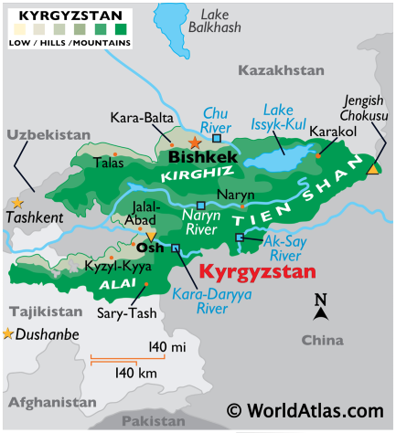
India and Kyrgyz Republic Elevate Bilateral Partnership in Bishkek: Mountain Warfare, Trade, and Energy Cooperation:
Concluding the second leg of his Central Asian diplomatic tour in Bishkek, Prime Minister Narendra Modi and President Sadyr Japarov signed bilateral agreements to deepen the India-Kyrgyz Republic Strategic Partnership, emphasizing joint special forces mountain training, critical mineral exploration, and digital payments integration.
-
- Summit Level Dialogue: The bilateral summit in Bishkek resulted in the adoption of the Joint Statement on ‘Deepening Strategic Partnership for Peace and Prosperity’, reinforcing India’s Connect Central Asia Policy.
- Defense Cooperation & Exercise KHANJAR: Reiterated institutional defense collaboration through the annual India-Kyrgyzstan Joint Special Forces Exercise ‘KHANJAR’, focusing on high-altitude counter-terrorism and mountain warfare tactics.
- Joint Mountain Training Centre: Agreed to upgrade the Joint Mountain Training Centre in Balykchy, Kyrgyzstan, enhancing tactical interoperability in glaciated and extreme high-altitude terrain.
- Critical Minerals & Hydroelectric Potential: Signed preliminary memoranda on geological exploration for critical rare earth minerals (rare earths, antimony) and explored Indian public sector investments in Kyrgyz small-scale hydroelectric power projects.
- INSTC & Chabahar Integration: Agreed to integrate Kyrgyzstan into the International North-South Transport Corridor (INSTC) and utilize the multimodal connectivity provided by India’s operations at Chabahar Port’s Shahid Beheshti Terminal.
- Digital Public Infrastructure (DPI): Finalized technical agreements to deploy India’s Unified Payments Interface (UPI) technology framework to facilitate low-cost cross-border remittances and bilateral trade settlements in national currencies.
- Regional Security & Shanghai Cooperation Organisation (SCO): Exchanged views on regional stability in Central Asia and Afghanistan within the multilateral frameworks of the SCO, UN, and the India-Central Asia Dialogue.
- Cultural & Medical Education Hub: Lauded the role of over 15,000 Indian medical students pursuing higher studies across Kyrgyz universities, establishing a bilateral joint working group on consular protection and educational standards.
(PIB)
ECONOMY
Gross GST Collections for August 2026 Reach ₹1.86 Lakh Crore: Domestic Consumption Buoyancy and E-Way Bill Velocity:
Official revenue figures released by the Ministry of Finance indicate that Gross Goods and Services Tax (GST) collections for August 2026 stood at ₹1,86,420 crore, registering a robust 9.8% year-on-year growth driven by sustained domestic transaction volumes and enhanced compliance measures.
-
- Revenue Breakdown: The total gross collection of ₹1,86,420 crore comprises Central GST (CGST) of ₹33,850 crore, State GST (SGST) of ₹41,600 crore, Integrated GST (IGST) of ₹93,270 crore (including ₹44,100 crore on imported goods), and Compensation Cess of ₹17,700 crore.
- Year-on-Year Trajectory: August 2026 collections represent a 9.8% growth over the ₹1.69 lakh crore collected in August 2025, marking the sixth consecutive month where gross monthly GST receipts exceeded the ₹1.80 lakh crore benchmark.
- Domestic Transactions Driver: Revenues from domestic transactions (excluding imports) grew by 10.5% year-on-year, reflecting strong economic activity in manufacturing, construction, and consumer services.
- E-Way Bill Generation Velocity: E-way bill generation crossed 102 million in July/August 2026, pointing to robust inter-state freight movement and sustained logistical supply chain fluidity.
- Automated Scrutiny & E-Invoicing: The Goods and Services Tax Network (GSTN) attributed revenue buoyancy to automated systemic data-matching between GSTR-1 and GSTR-3B and mandatory e-invoicing for B2B transactions above ₹5 crore.
- Compensation Cess Rationalization: Collections under the GST Compensation Cess continue to be utilized for servicing the repayment of principal and interest on back-to-back market loans raised during the pandemic, scheduled to conclude by FY 2026-27.
- GST Council & Rate Rationalization: The upcoming GST Council meeting is slated to review Group of Ministers (GoM) recommendations on multi-slab rate rationalization (merging 12% and 18% slabs into a revenue-neutral rate).
- Fiscal Federalism & State Transfers: High GST collections provide fiscal headroom for States to maintain capital expenditure momentum while keeping their gross fiscal deficit within the 3% GSDP FRBM limits.
(BS)
GEOGRAPHY
Cryospheric Instability and Geomorphic Hazards of Hanging Glaciers in the Alaknanda Basin (Garhwal Himalayas):
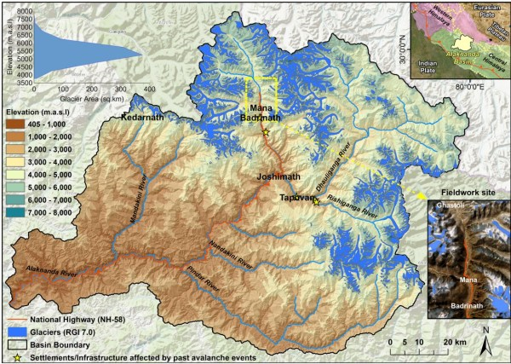
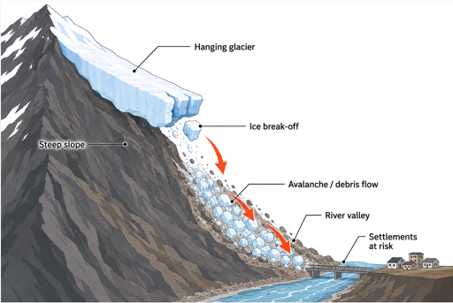
A glaciological assessment published in Down To Earth highlights the acute cryospheric hazard posed by 219 newly inventoried ‘hanging glaciers’ perched on steep precipices across the Alaknanda river basin, where accelerating thermal degradation elevates the risk of massive ice detachments and cascading debris flows.
-
- Geomorphological Definition: Hanging glaciers are glacier bodies perched abruptly along steep mountain slopes (>30-45 degrees) and rock precipices, discharging mass primarily through periodic structural ice avalanches and calving rather than snout melting.
- Alaknanda Basin Inventory: Satellite mapping and field glaciology identified 219 hanging glaciers across the upper catchments of the Alaknanda River and its glacierized tributaries (Rishiganga, Dhauliganga, and Bhyundar Ganga) in the Garhwal Himalayas.
- Basal Thermal Regime Shifts: Climate warming penetrates cold-based hanging glaciers, warming the basal ice layer to its pressure-melting point; the resulting subglacial meltwater film acts as a frictionless shear layer, drastically triggering catastrophic slab failure under gravity.
- Cascading Multi-Hazard Process: Detached hanging glacier slabs undergo high-velocity vertical impacts, pulverizing into pulverized ice-rock avalanches that dam narrow river gorges, unleash breach flash floods, and entrain millions of tonnes of paraglacial moraine debris.
- Fluvial Sediment Dynamics: The surge of glacial till and boulders dramatically elevates downstream riverbed aggradation, amplifying flood heights and threatening key confluence nodes (*Panch Prayags*: Vishnuprayag, Nandaprayag, Karnaprayag, Rudraprayag, and Devprayag).
- Structural Geology & Tectonic Control: The upper Alaknanda catchment lies in close proximity to the Main Central Thrust (MCT) and the South Tibetan Detachment System (STDS), where neo-tectonic joint fractures and seismic tremors intensify rock-ice destabilization.
- InSAR & Acoustic Early Warning: Recommends establishing continuous satellite-based Interferometric Synthetic Aperture Radar (InSAR) surface creep monitoring paired with high-altitude seismic-acoustic geophone sensors for real-time avalanche early warnings.
- Infrastructure & Pilgrim Corridor Vulnerability: Highlights the direct hazard to downstream run-of-the-river hydroelectric projects (Tapovan-Vishnugad, Vishnuprayag), high-altitude road networks, and pilgrimage routes to Badrinath and Hemkund Sahib.
(DTE)
SCIENCE & TECH
How a Star with an Extreme Magnetic Field Proves Space Is Not Empty: The Phenomenon of Vacuum Birefringence:
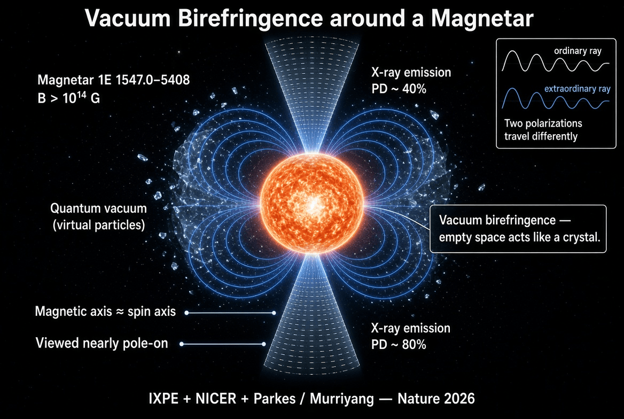
As explained in The Hindu Science section, astronomers studying X-rays from an ultra-magnetic collapsed star (magnetar) have discovered empirical proof that the quantum vacuum is not empty void, confirming that extreme magnetic fields transform empty space into a light-splitting crystal.
-
- The Dead Star (Magnetars): When a massive star runs out of fuel, its core collapses into an ultra-dense neutron star. A ‘magnetar’ is a specialized neutron star possessing the strongest magnetic fields in the universe (~88 trillion times stronger than Earth’s magnetic field).
- The Quantum Vacuum (Virtual Particles): According to Quantum Electrodynamics (QED), ’empty space’ is not empty void; it is continuously bubbling with microscopic ‘virtual particles’ (pairs of electrons and positrons) that pop into existence and vanish almost instantaneously.
- The Magnetic Alignment: Under normal conditions, these fleeting virtual particles have no noticeable effect on passing light. However, near a magnetar, the colossal magnetic field forces the charged virtual particles to line up and move in specific directions.
- The ‘Calcite Crystal’ Effect (Vacuum Birefringence): Because the virtual particles are aligned, the magnetized empty space acts like a calcite crystal. As X-ray light passes through it, it splits into different paths and its electric field vibrations are forced into specific directions—a process called ‘polarisation’.
- Telescope Observations (Magnetar 1E 1547.0-5408): An international research team analyzed X-rays emitted from magnetar 1E 1547.0-5408 (located 14,700 light-years away) and confirmed that the outgoing X-rays were strongly polarized along the star’s magnetic field lines.
- Energy-Dependent Polarisation Drop: Conforming precisely to QED predictions, telescope observations revealed that the degree of X-ray polarisation dropped systematically as the energy of the X-ray photons increased.
- The Spinning Top Geometry: Geometric modeling showed that the magnetar rotates on an axis almost perfectly aligned with its magnetic poles (like an upright spinning top), and computer models including vacuum birefringence matched the telescope data far better than classical empty-space models.
- Natural Cosmic Laboratory: Producing magnetic fields strong enough to observe vacuum birefringence requires fields over 500 million times stronger than the superconducting magnets at CERN’s Large Hadron Collider, making magnetars irreplaceable natural laboratories for testing quantum physics.
- Fundamental Scientific Value: The discovery provides direct empirical proof that the quantum vacuum possesses measurable physical properties and deepens understanding of cosmic energetic phenomena like Fast Radio Bursts (FRBs).
(TH)
INTERNAL SECURITY
Indian Cyber Crime Coordination Centre (I4C) Tightens Security Grid Against Mule Accounts and Transnational Cyber Fraud:
The Indian Cyber Crime Coordination Centre (I4C), operating under the Ministry of Home Affairs (MHA), has launched a multi-agency crackdown to freeze over 2.5 lakh illicit ‘mule accounts’ used by transnational cyber-fraud syndicates to launder defrauded digital financial assets.
-
- Institutional Mandate of I4C: Established by the Ministry of Home Affairs in 2018 as the apex national nodal coordination centre to handle all matters related to cybercrime across India in a structured and unified manner.
- Mule Accounts Operation: Mule accounts are bank accounts opened using stolen, forged, or purchased KYC identities, or operated by compromised third parties, utilized by cyber syndicates to quickly layer and withdraw proceeds of digital fraud.
- Citizen Financial Cyber Fraud Reporting System (1930 Helpline): Integrated with the National Cyber Crime Reporting Portal (cybercrime.gov.in) and the ‘1930’ national helpline, enabling immediate freezing of defrauded funds within the banking system during the critical ‘golden hour’.
- CFCFRMS Real-Time Integration: Connects over 280 banks, payment aggregators, financial intermediaries, and state law enforcement agencies on a single real-time API-driven interdiction platform.
- Seven Verticals of I4C: I4C functions through seven specialized verticals: National Cybercrime Threat Analytics Unit (NTAU), National Cybercrime Reporting Portal (NCRP), Platform for Joint Cybercrime Operations, Cyber Hygiene, National Cyber Forensic Laboratory (NCFL), Training & Research, and Ecosystem Development.
- SIM & Device Blocking Framework: Collaborates with the Department of Telecommunications (DoT) via the Sanchar Saathi portal to block millions of fraudulent IMEI device identifiers and unauthorized spoofed international incoming calls.
- Legal Framework (IT Act & BNS): Offenses are prosecuted under Sections 43, 66, 66C, and 66D of the Information Technology Act, 2000, read alongside Section 318 (Cheating) and Section 111 (Organised Crime) of the Bharatiya Nyaya Sanhita, 2023 (BNS).
- Cross-Border Financial Crime Linkages: Combats sophisticated organized cyber syndicates operating from Southeast Asian scam hubs, tracing illicit funds diverted through peer-to-peer (P2P) crypto trading and Hawala networks.
(IE)
Spread the Word