
Indian Polity & Governance
Enforcement Directorate (ED) & PMLA Case Trends:
Context: Recent Parliamentary disclosures showcased a multi-year surge in the registration of cases under the Prevention of Money Laundering Act (PMLA).
-
- Enacting Legislation: The Prevention of Money Laundering Act (PMLA), 2002, which came into effect from July 2005.
- Nodal Agency: Enforced by the Directorate of Enforcement, an anti-financial crime agency under the Department of Revenue, Ministry of Finance.
- Scheduled Offence Requirement: PMLA jurisdiction is triggered only if there is a predicate/scheduled offence investigated by a competent law enforcement agency (like CBI or State Police).
- Burden of Proof: Section 24 of PMLA places the onus on the accused to prove that proceeds of crime are untainted.
- Admissibility of Statements: Statements made to ED officers during investigation hold specific evidentiary value under statutory provisions.
- Financial Intelligence Unit (FIU-IND): Central national agency responsible for receiving, processing, and analyzing suspicious financial transaction data.
- Attachment of Property: ED possesses powers to provisionally attach properties believed to be derived from criminal activity before trial conclusions.
- Special Courts: Trials under PMLA are conducted exclusively by designated Special Sessions Courts.
- Global Compliance: Aligns India’s domestic legal architecture with recommendations prescribed by the Financial Action Task Force (FATF).
- Bail Provisions: Section 45 of PMLA sets stringent twin conditions for the grant of bail to an accused.
(TH)
Supreme Court’s Gender Sensitivity Handbook:
Context: Highlighted guidelines emphasizing compassionate court approaches, avoiding secondary victimization, and eliminating gender stereotypes in legal trials.

-
- Judicial Objectivity: Directs judges to combine formal legal knowledge with empathetic handling of vulnerable victims and witnesses.
- Core Purpose: Rooted in eliminating archaic language, patriarchal idioms, and prejudicial stereotyping from judicial pronouncements.
- Fair Trial Norms: Restricts irrelevant and humiliating cross-examinations concerning a survivor’s past sexual or personal history.
- Basic Infrastructure: Recommends accessible courtroom environments including seating and drinking water facilities for witnesses.
- Constitutional Basis: Aligns with Article 14 (Equality before law) and Article 21 (Right to life with dignity) of the Constitution.
- Access to Justice: Strengthens institutional confidence for women, children, and marginalized sections.
- Precedent: Builds upon earlier judicial circulars advising against victim-blaming vocabulary in rape and assault judgments.
- Administrative Reach: Circulated across high courts down to district and subordinate judiciary levels.
- Sensitization Training: Often integrated into judicial academy curricula across state training centers.
- Epistemic Justice: Seeks to correct systemic bias within courtroom narratives during evidence appraisal.
(TH)
Indian Statistical Institute (ISI) Bill, 2026:
Context: The ISI Bill, 2026 sought incorporation of the institute as a body corporate to overhaul governance structures and replace legacy frameworks.

-
- Statutory Conversion: Transforms ISI from a registered society into a statutory body corporate under parliamentary legislation.
- Role of the President: Designates the President of India as the Visitor of the institute, akin to central universities and IITs.
- Board of Governors: Establishes a Board of Governors headed by an eminent academic or industry chairperson as its principal policy executive body.
- Roots of ISI: Founded by Prof. Prasanta Chandra Mahalanobis (P.C. Mahalanobis) in Kolkata in 1931.
- Mahalanobis Connection: He is also the architect of India’s Second Five-Year Plan and the founder of the National Sample Survey (NSS).
- Institution of National Importance (INI): An esteemed status granted by Parliament to key institutes conferring self-governing academic powers.
- Core Fields: Specializes in statistics, mathematics, quantitative economics, computer science, and data sciences.
- Statistical Milestone: ISI historically anchors India’s national statistical framework and large-scale sample methodologies.
- Funding Structure: Substantially financed and overseen via grants routed through the central government.
- Autonomy: Balances modernized administrative decision-making with academic freedom in higher education and research.
(TH)
Economy
Monetary Policy Committee (MPC) Repo Rate Decision:
Context: The Reserve Bank of India’s MPC kept the policy repo rate unchanged at 5.25% under the liquidity adjustment facility (LAF).
-
- Repo Rate Definition: The rate at which the central bank lends money to commercial banks against government securities.
- MPC Composition: Statutory body under Section 45ZB of the RBI Act, 1934 comprising 6 members (3 from RBI, 3 external members appointed by the government).
- Voting Power: The RBI Governor holds a casting vote in the event of a tie; decisions are otherwise determined by majority consensus.
- Inflation Targeting: The primary statutory mandate of the MPC is to maintain consumer price index (CPI) inflation at 4% with a band of +/- 2%.
- Standing Deposit Facility (SDF): Maintained at 5% as RBI’s primary tool to absorb excess liquidity without collateral requirements.
- MSF and Bank Rate: Retained at 5.50% following the bi-monthly monetary policy review.
- Reverse Repo Rate: The rate at which RBI borrows funds from commercial banks.
- Liquidity Adjustment Facility (LAF): The core framework through which RBI implements daily monetary policy adjustments.
- Statutory Liquidity Ratio (SLR): Commercial banks must maintain a prescribed percentage of deposits in liquid assets before lending.
- Cash Reserve Ratio (CRR): The share of a bank’s total deposit that must be maintained with RBI in liquid cash form.
(TH)
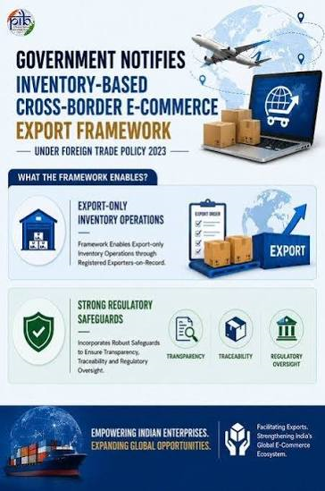
Inventory-based Cross-border E-Commerce Export Framework:
Context: The Government of India operationalised the Inventory-based Cross-border E-Commerce Export Framework under the Foreign Trade Policy (FTP) 2023.
-
- Enabling Policy: Rooted in the amendment to the Foreign Direct Investment (FDI) Policy via Press Note No. 3 (2026 Series), allowing inventory-based e-commerce exclusively for exports.
- Exporter-on-Record (EOR): Eligible e-commerce entities operate through a registered EOR who manages procurement and shipping.
- Operational Scope: The registered EOR assumes total liability for customs documentation, destination-country compliance, and reverse logistics.
- Target Beneficiaries: Designed explicitly to scale up global market access for Indian MSMEs, artisans, and local manufacturers.
- Foreign Trade Policy (FTP) 2023: Administered by the Directorate General of Foreign Trade (DGFT), Ministry of Commerce and Industry.
- Order Requirement: Export inventory must be procured only against confirmed export orders; speculative inventory build-up is prohibited.
- Traceability: Incorporates mandatory digital repository safeguards to ensure complete traceability and segregation from domestic stock.
- FDI Norms Distinction: Traditional retail e-commerce with foreign investment restricts inventory ownership, which is relaxed solely for export hubs under this mechanism.
- Pass-Through Benefits: Export rebates and refunds must be apportioned and passed through to the Sellers-on-Record (SORs) proportionally.
- Digital Public Infrastructure: Connects seamlessly with India’s broader push for cross-border digital trade facilitation.
(PIB)
Environment & Ecology
Forest Diversion Trends & Van (Sanrakshan Evam Samvardhan) Adhiniyam:
Context: Official data highlighted high rates of national forest land diversion for infrastructure projects alongside wildlife corridor pressures.
-
- Statutory Name Change: The original Forest (Conservation) Act, 1980 was amended and renamed as the Van (Sanrakshan Evam Samvardhan) Adhiniyam, 1980 in 2023.
- Approval Mechanism: Diversion of forest land for non-forestry use requires prior central clearance via the Ministry of Environment, Forest and Climate Change (MoEFCC).
- Godavarman Judgment (1996): Landmark Supreme Court ruling that expanded the definition of ‘forest’ to include any tract of land conforming to the dictionary meaning, regardless of ownership.
- Compensatory Afforestation Fund (CAMPA): Established under the Compensatory Afforestation Fund Act, 2016 to manage funds collected for forest land diversion.
- Ecological Impact: Threatens critical wildlife corridors—such as those vital for big cats and elephants.
- Advisory Role: The Forest Advisory Committee (FAC) evaluates proposals seeking forest diversion.
- Net Present Value (NPV): A monetary value calculated and levied on user agencies diverting forest land to offset ecological loss.
- Exemptions Controversy: Recent amendments exempted certain categories of lands (like security infrastructure near international borders) from stringent FCRA approvals.
- Green Credit Programme: Market-based mechanism introduced to incentivize voluntary plantation and water conservation to counter diversion impacts.
- Federal Dynamics: State governments act as the primary processing tier before forwarding proposals to the central MoEFCC.
(TH)
Science & Technology
Neutrino Detectors and Nuclear Non-Proliferation (Spent Fuel Tracking):
Context: Breakthrough studies demonstrated the use of neutrino tracking systems to monitor nuclear reactor spent fuel and non-proliferation compliance.

-
- Nature of Neutrinos: Subatomic particles with nearly zero mass and no electric charge that interact very weakly with matter, earning them the moniker “ghost particles”.
- Anti-neutrinos: Nuclear fission reactors naturally emit massive fluxes of electron anti-neutrinos, serving as a unique signature of reactor operations.
- Non-Proliferation Utility: Allows remote, non-intrusive monitoring of nuclear reactors to detect unauthorized diversion of spent fuel or covert plutonium production.
- IAEA Safeguards: Complements International Atomic Energy Agency (IAEA) verification protocols without requiring physical intrusive inspections inside core containment zones.
- India-Specific Context: Connects conceptually with India’s long-term aspirations under the India-Based Neutrino Observatory (INO) project.
- Detection Medium: Typically captured using ultra-pure liquid scintillators housed deep underground to shield against cosmic ray interference.
- Nuclear Non-Proliferation Treaty (NPT): International treaty (opened 1968, in force 1970) aimed at preventing the spread of nuclear weapons technology; India remains a non-signatory.
- Inverse Beta Decay (IBD): The primary detection reaction used by low-energy anti-neutrino detectors.
- Astrophysical Sources: Beyond reactors, neutrinos originate from the Sun, supernovae, and cosmic accelerators.
- Remote Verification: Offers a fail-safe technological layer for international disarmament treaties and strategic arms control.
(TH)
National Centre for Cell Science (NCCS) & Microbiome Research:
Context: Policy reviews spotlighted NCCS contributions to gut health, cell-line repositories, and national biotechnology capacity.
-
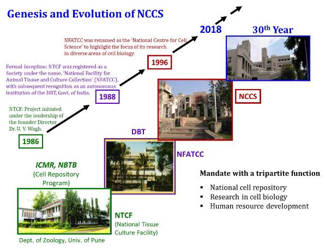
- Origin: Commenced originally as the National Tissue Culture Facility in 1986 before transitioning to its present autonomous shape.
- Administrative Control: An autonomous research institution aided by the Department of Biotechnology (DBT), Ministry of Science and Technology.
- Location: Situated within the Savitribai Phule Pune University campus, Maharashtra.
- Core Mandate: Research in cell biology, gene expression, stem cell biology, and infectious diseases.
- Cell Repository: Serves as a national depository for maintaining and supplying standard cell lines to academic and research labs across India.
- Microbiome Initiative: Key player in mapping human gut microbial diversity and its correlation with metabolic disorders.
- Personalised Medicine: Provides foundational research data enabling targeted therapies and regenerative medicine.
- Global Collaboration: Coordinates with international bio-banks and genomics networks.
- Biosafety Standards: Operates under strict containment protocols for handling live animal and human cell lines.
- Autonomy: Governed by its own independent governing body under the umbrella of DBT guidelines.
(TH)
Government Schemes & Initiatives
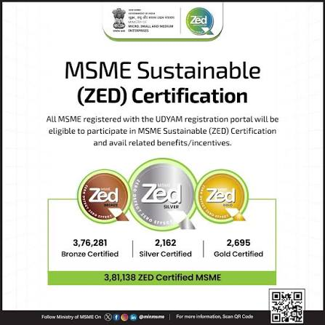
MSME Sustainable ZED (Zero Defect Zero Effect) Certification Scheme:
Context: Implementation updates highlighted the ZED scheme’s role in driving cleaner manufacturing technologies and financial subsidies for MSMEs.
-
- Nodal Ministry: Implemented under the Ministry of Micro, Small and Medium Enterprises (MSME).
- Twin Pillars: Focuses on “Zero Defect” (quality, safety, reliability) and “Zero Effect” (environmental sustainability, minimal ecological footprint).
- Certification Tiers: Structured into distinct graduation levels- Bronze, Silver, and Gold- based on process maturity and environmental parameters.
-
- Subsidy Structure: Provides financial assistance for technology upgradation, testing, and environmental compliance, including a 100% subsidy on certification costs for women-owned MSMEs.
- Cleaner Technologies: Encourages adoption of energy-efficient systems, waste reduction, and pollution-control measures.
- Global Competitiveness: Helps domestic manufacturers meet stringent international quality and carbon-neutral benchmarks.
- Credit Facilitation: Certified MSMEs often receive preferential treatment, lower interest rates, or collateral concessions from participating commercial banks.
- Digital Integration: Entirely digital application and assessment process hosted through a centralized web portal.
- Quality Council of India (QCI): Acts as the primary national accreditation and implementing body for assessments.
- Mission LiFE Alignment: Directly operationalizes lifestyle-for-environment objectives at the grassroots industrial manufacturing level.

(PIB)
Miscellaneous
Stricter Rules under Drugs and Cosmetics Act (Debarment for Fake Data):
Context: The Union Ministry of Health and Family Welfare notified amendments to the Drugs Rules, 1945, empowering authorities to penalize applicants submitting fabricated data.

-
- Legal Backing: Notifications executed under the overarching framework of the Drugs and Cosmetics Act, 1940.
- Punitive Action: Beyond simple rejection or license cancellation, applicants submitting fake data face formal debarment from filing future applications for a specified period.
- Jurisdiction: Applies uniformly to applications processed by both Central and State regulatory licensing authorities.
- Due Process: Mandates the issuance of a show-cause notice and includes provisions for appeals before any punitive debarment action is finalized.
- Drugs Rules, 1945: Formulates the operational rules governing the import, manufacture, distribution, and sale of drugs in India.
- Central Drugs Standard Control Organization (CDSCO): Headed by the Drugs Controller General of India (DCGI), the apex national regulatory body.
- Statutory Body Context: CDSCO functions under the Directorate General of Health Services, Ministry of Health and Family Welfare.
- Public Safety Impact: Designed to prevent sub-standard or fraudulent medical formulations from compromising public health.
- Scientific Integrity: Protects the credibility of clinical trial datasets and safety evaluations required for drug approvals.
- Global Standing: Strengthens India’s regulatory reliability as a major pharmaceutical exporter by cracking down on data manipulation.
(PIB)
Spread the Word