TOPIC-1: First Session of India–Rwanda Joint Trade Committee (JTC)
-
- GS Paper 2 (Bilateral, regional and global groupings and agreements involving India and/or affecting India’s interests; Effect of policies and politics of developed and developing countries on India’s interests – Africa Policy);
- GS Paper 3 (Indian Economy – International Trade, Critical Minerals, and Investment Frameworks).
Overview: The inaugural session of the India–Rwanda Joint Trade Committee (JTC) was held in New Delhi on 30–31 July 2026. The landmark meeting established a permanent, structured apex mechanism to review bilateral commerce, diversify the trade basket, resolve market access barriers, and expand mutual investments.
Strategic Importance of Rwanda
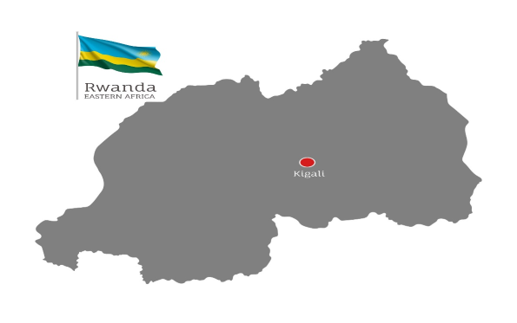
Gateway to African Trade Regimes: Beyond bilateral ties, Rwanda serves as a strategic economic gateway for Indian businesses accessing broader regional markets through the East African Community (EAC), the Common Market for Eastern and Southern Africa (COMESA), and the African Continental Free Trade Area (AfCFTA).
Core Trade Dynamics & Market Access Basket
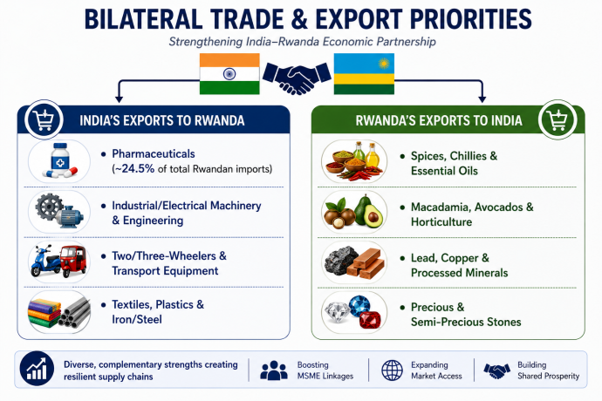
1. Pharmaceutical Leadership & Health Cooperation
-
- Market Share: India is currently Rwanda’s largest supplier of pharmaceuticals, accounting for 24.5% of its total medicine imports.
- Institutional Alignment: MoUs between health authorities are in advanced stages. India proposed formal recognition of the Indian Pharmacopoeia and joint expansion in traditional medicine (Ayush).
2. Critical Minerals Collaboration
-
- 3Ts Supply Chain: India targeted strategic collaboration on Rwanda’s rich reserves of 3T minerals: Tin, Tungsten, and Tantalum.
- Geological Ties: Envisages institutional ties between the Geological Survey of India (GSI) and the Rwanda Mines, Petroleum and Gas Board.
3. Investment Frameworks & Focal Institutions
-
- Foreign Direct Investment (FDI): India stands as Rwanda’s second-largest foreign investor (as of 2025).
- Institutional Partners: Designated Invest India and the Rwanda Development Board (RDB) as primary investment focal points under the JTC framework.
Sectoral Priorities & Capacity Building Support
-
- Digital Infrastructure & Services: Joint cooperation in Digital Public Infrastructure (DPI), Fintech, Cybersecurity, Green Mobility, and Renewable Energy.
- Standards Harmonization: Partnership between the Bureau of Indian Standards (BIS) and the Rwanda Standards Board for technical alignment.
- Development Assistance: India offered continued capacity building under:
- ITEC Programme (Indian Technical and Economic Cooperation)
- Study in India Initiative
- Skill India Mission (supporting Rwanda’s TVET – Technical and Vocational Education & Training framework).
UPSC Quick Reference Table
| Feature / Metric | Detailed Specification |
| Nodal Body | Department of Commerce, Ministry of Commerce & Industry |
| Session Venue | New Delhi, India (30–31 July 2026) |
| Target Critical Minerals | Tin, Tungsten, and Tantalum (3Ts) |
| Investment Status | India is 2nd Largest FDI Provider to Rwanda |
| Investment Agencies | Invest India & Rwanda Development Board (RDB) |
| Regional Trade Blocs | Gateway to EAC, COMESA, and AfCFTA |
| Next JTC Meeting | Scheduled in Rwanda (2027) |
Conclusion:
The establishment of the India–Rwanda Joint Trade Committee deepens India’s broader Africa outreach under its South-South Cooperation framework. Aligning trade in critical minerals, healthcare, digital public infrastructure, and vocational education positions India to expand its trade presence across East Africa via Rwanda.
TOPIC-2: Samudra Manthan – National Offshore Exploration Scheme
-
- GS Paper 2 (Government policies and interventions for development in various sectors);
- GS Paper 3 (Indian Economy – Energy Security, Infrastructure, Hydrocarbon Exploration, Import Substitution, and Offshore Development).
Overview of the Scheme: The Union Cabinet chaired by Prime Minister Shri Narendra Modi approved “Samudra Manthan” – The National Offshore Exploration Scheme. Implemented as a Central Sector Scheme under the Ministry of Petroleum & Natural Gas, it carries a Phase-I outlay of ₹84,084 crore up to 31 March 2031. It represents India’s largest and most ambitious offshore hydrocarbon exploration mission to date.
Strategic Rationale & Energy Context
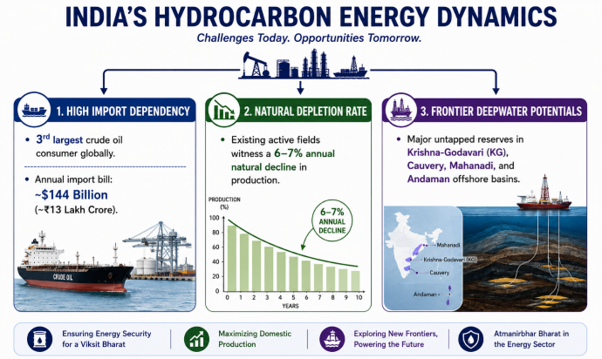
Core Components
| Component / Sub-Activity | Financial Outlay (₹ in Cr) | Operational Objectives |
| 1. Offshore Seismic Data Acquisition | 28,534 |
• 2D Seismic Data: ₹12,000 Cr (basin-wide coverage) • 3D Seismic Data: ₹12,534 Cr (advanced tech) • NDR & AI Implementation: ₹4,000 Cr (National Data Repository AI reprocessing) |
| 2. Deepwater Exploration Drilling | 43,200 |
• Co-finances 60 deepwater exploration wells. • Government provides risk-sharing financial support of up to 50% of drilling costs (capped at ₹675 crore per well). |
| 3. Shared Offshore Infrastructure Hubs | 10,000 | • Establishes common offshore infrastructure hubs to enable faster commercialization and tie-back of new discoveries. |
| 4. Oil & Gas Manufacturing & Services Zones | 2,000 | • Promotes domestic manufacturing, technology localization, and indigenization of critical equipment/services. |
| 5. Monitoring, Digital & Support Activities | 350 | • Digital tracking, evaluation, human resources, and outreach. |
Key Reforms Supporting Offshore Exploration
1. Opening Up EEZ Acreage: Reclassified and removed over 99% of earlier “No-Go” zones, making over 1 million square kilometers of India’s Exclusive Economic Zone (EEZ) available for exploration.
2. Contractual Transition: Shifted from Production Sharing Contracts (PSC) to Revenue Sharing Contracts (RSC) under HELP/OALP frameworks.
3. Statutory Architecture: Supported by the Oilfields (Regulation and Development) Amendment Act, 2025 and the Petroleum and Natural Gas Rules, 2025 to ensure contractual stability, dispute resolution, and ease of doing business.
Expected Macroeconomic Impact
-
- Resource Base Expansion: Expands India’s total hydrocarbon resource base from 1.6 billion TOE to 2.2 billion TOE (Tonnes of Oil Equivalent).
- Production Augmentation: Increases domestic oil and gas production from 62 MMTOE to 80 MMTOE annually.
- Import Substitution: Potential to save nearly ₹1 lakh crore annually in foreign exchange by substituting crude oil imports.
UPSC Quick Reference Table
| Feature | Detailed Specification |
| Nodal Ministry | Ministry of Petroleum & Natural Gas |
| Scheme Category | Central Sector Scheme |
| Approved Outlay | ₹84,084 Crore (FY 2025–26 to FY 2030–31) |
| Deepwater Subsidy | Up to 50% of drilling cost or ₹675 Cr/well (Target: 60 Wells) |
| Acreage Unlocked | >99% of EEZ No-Go zones cleared (>1 million sq. km) |
| Target Forex Savings | ~₹1 Lakh Crore annually in crude oil import substitution |
Conclusion:
The “Samudra Manthan” scheme addresses the high-risk, capital-intensive nature of deepwater and ultra-deepwater exploration through risk-sharing subsidies, shared offshore infrastructure, and AI-driven seismic data processing. De-risking offshore drilling and expanding domestic production across the KG, Cauvery, and Andaman basins advances India’s broader goals of energy security and self-reliance.
Spread the Word