
Society & Social Justice
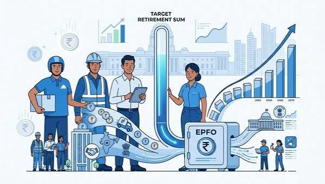
Government Prepares New Pension Plan for All Via EPFO Reforms:
Context: The Ministry of Labour and Employment is framing structural reforms within the Employees’ Provident Fund Organisation (EPFO) to introduce a new comprehensive pension plan for the workforce.
-
- Objective: The plan aims to build a comprehensive, universal social security safety net covering both formal and unorganized workers.
- Target Auditing: The project focuses on expanding coverage to workers who fall outside the safety net of the existing Employees’ Pension Scheme (EPS-95).
- Settlement System: Simultaneously, the government unveiled an automated digital scheme aimed at rapid settlement of disputed provident fund claims.
- Fiscal Sustainability: The reforms balance defined contributions with market-linked returns to avoid ballooning state fiscal deficits.
- Portability: The new model allows seamless account transitions when workers switch between unorganized, gig-economy, and formal employment roles.
- What is EPFO? The EPFO is a statutory body established under the Employees’ Provident Funds and Miscellaneous Provisions Act, 1952, operating under the Ministry of Labour and Employment.
- Three Core Schemes of EPFO: EPFO administers three schemes: The Employees’ Provident Funds Scheme, 1952; the Employees’ Deposit-Linked Insurance Scheme, 1976; and the Employees’ Pension Scheme, 1995.
- Constitutional Directive: Social security and public assistance find expression under Article 41 of the Directive Principles of State Policy (DPSP) in the Constitution of India.
- Seventh Schedule Status: Social security and social insurance fall under Entry 23 of the Concurrent List (List III) of the Seventh Schedule.
- Gig-Economy Inclusion: The reform incorporates legal mandates from the Code on Social Security, 2020, to cover gig and platform workers.
(IE/TH)
International Relations
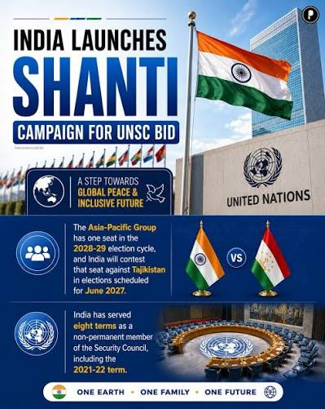
Launches “SHANTI” Campaign for UNSC Seat (2028-29):
Context: External Affairs Minister Dr. S. Jaishankar launched India’s official campaign for election as a non-permanent member of the United Nations Security Council (UNSC) for the 2028–29 term.
-
- Campaign Theme: The official theme is “SHANTI: Securing Holistic Advancement through Norms, Trust and Integrity”.
- Location: The high-level launch occurred at the United Nations Headquarters in New York, USA.
- Core Objective: India aims to push for reformed multilateralism, counter-terrorism frameworks, and equitable Global South representation.
- Prior Tenures: If elected, this will mark India’s 9th term as a non-permanent member of the apex global security body.
- Targeted Term: The campaign specifically targets the two-year non-permanent window spanning 2028 and 2029.
- Strategic Focus: The narrative centers on acting as a “Bridging Power” in a deeply polarized geopolitical environment.
- UNSC Structure: The UNSC consists of 15 members: 5 permanent veto-wielding members (P5: US, UK, France, Russia, China) and 10 non-permanent members elected for two-year terms.
- Election Process: Non-permanent members are elected by a two-thirds majority vote of the UN General Assembly via a secret ballot.
- G4 Nations: India is part of the G4 alliance (alongside Brazil, Germany, and Japan) supporting each other’s bids for permanent seats on the UNSC.
- Uniting for Consensus (Coffee Club): This group, led by countries like Pakistan and Italy, strongly opposes the expansion of permanent seats in the UNSC, countering the G4 proposals.
(TH/PIB)
Economy
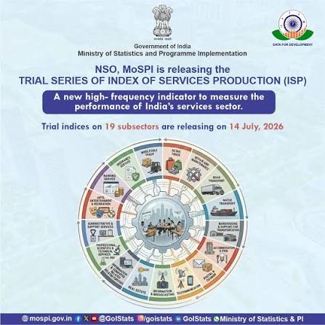
NSO Launches First Trial Index of Services Production (ISP):
Context: The National Statistical Office (NSO) launched the first sub-sectoral “Index of Services Production (ISP)” to map short-term economic changes in India’s services sector.
-
- Purpose: It acts as the first official monthly indicator tracking output volume variations within the country’s massive services domain.
- Complementary Role: The index acts as a direct counterpart to the Index of Industrial Production (IIP), which maps the industrial/manufacturing output.
- Nodal Body: The tracker has been prepared by the National Statistical Office (NSO) under the Ministry of Statistics and Programme Implementation (MoSPI).
- Trial Phase: The initial launch is on a trial basis to standardise data collection, refine weights, and eliminate discrepancies prior to its full statistical roll-out.
- Coverage: It assesses major service indicators including trade, hotels, transport, communication, and financial services.
- Data Policy Shift: The ISP addresses a long-standing gap in high-frequency data for India’s services sector, which accounts for over 50% of the Gross Value Added (GVA).
- NSO Formation: The NSO was formed by merging the Central Statistical Office (CSO) and the National Sample Survey Office (NSSO) following the recommendations of the Rangarajan Commission.
- Index of Industrial Production (IIP): IIP is a composite indicator measuring growth in the eight core industries and general manufacturing, using a base year of 2011–12, and is published monthly.
- Gross Value Added (GVA): The economic relationship between GVA and Gross Domestic Product (GDP) is formulated as:
- Policy Value: The ISP will serve as an essential empirical tool for the Reserve Bank of India’s Monetary Policy Committee (MPC) during inflation-growth target calculations.
(PIB)
NITI Aayog Releases the Investment Friendliness Index (IFI):
Context: NITI Aayog officially released its landmark report titled “Investment Friendliness Index (IFI 2026)” evaluating the capabilities of States and UTs to attract capital.
-
- Core Principle: The index promotes Competitive and Cooperative Federalism by analyzing ease of doing business variables across states.
- Major Finding: Across a scale of 1 to 100, no Indian state managed to cross the score threshold of 60, exposing persistent structural bottlenecks.
- Overall Leader: Gujarat topped the index with a score of 56.6, followed by Maharashtra and Tamil Nadu.
- Hilly States Category: Uttarakhand led the rankings among Hilly and North-Eastern States with a score of 47.5.
- UTs and City States: Goa claimed the pole position in the Union Territories and small city-states cohort with a score of 53.1.
- Pillar-wise Breakdown: Gujarat excelled in Infrastructure & Financial Health, Maharashtra in Business Climate, and Odisha in Resource availability.
- ESG Integration: The inclusion of an Environmental Resilience pillar explicitly links state policy evaluations with green capital flows.
- NITI Aayog Structure: Formed via a Cabinet Resolution on January 1, 2015, replacing the Planning Commission. It is a non-constitutional, advisory body with the Prime Minister as its Chairperson.
- Governing Council: NITI Aayog’s Governing Council includes the Prime Minister, Chief Ministers of all States, and Lieutenant Governors of Union Territories, embodying cooperative federalism.
- Policy Mandate: The framework acts as an empirical dashboard designed to remove local regulatory delays down to the district level.
(IE)
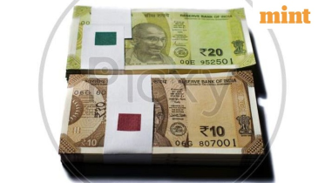
RBI Explores Polymer Currency Notes to Replace Paper Currency:
Context: A wholly-owned subsidiary of the Reserve Bank of India (RBI) floated an initial tender to source raw materials for polymer currency notes.
-
- Material Transition: The shift moves currency production from traditional cotton-rag paper to synthetic biaxially oriented polypropylene (BOPP) polymer substrates.
- Durability Multiplier: Polymer banknotes possess an average lifespan that is 3 to 5 times longer than standard paper money, reducing frequent replacement costs.
- Counterfeit Prevention: The material enables the integration of advanced security features, including clear optical windows and complex holographic foils.
- Environmental Impact: Despite being plastic, polymer notes require less energy to produce, are highly recyclable at the end of their lifecycle, and remain clean by resisting moisture and soil.
- Subsidiary in Focus: The procurement is handled through the Bharatiya Reserve Bank Note Mudran Private Limited (BRBNMPL).
- BRBNMPL: Established in 1995 as a wholly-owned subsidiary of the RBI, it manages the printing presses located at Mysore (Karnataka) and Salboni (West Bengal).
- Security Printing Centers: The other two printing presses are owned directly by the Government of India through SPMCIL (Security Printing and Minting Corporation of India Limited) at Nashik (Maharashtra) and Dewas (Madhya Pradesh).
- Legal Tender Power: Section 22 of the Reserve Bank of India Act, 1934, gives the RBI the sole authority to issue banknotes in the country.
- Coinage Act: The minting of coins is governed by the Coinage Act, 2011, where the power to design and mint coins rests exclusively with the Government of India, not the RBI.
- Machine Compatibility: The phase-in strategy includes modifying automated teller machines (ATMs) to accommodate the new notes’ thickness and mechanical properties.
(IE)
Geography
Demands for Revision of the Indus Waters Treaty (IWT):
Context: Strategic policy experts and government reports emphasized the pressing legal and environmental arguments for updating the decades-old Indus Waters Treaty (IWT).
-
- Climate Instability: The push to review the treaty is driven by changes in glacial runoff patterns, shifting monsoon distributions, and siltation challenges in the Indus basin.
- India’s Standing Demand: India has formally issued notices to Pakistan seeking a comprehensive modification of the dispute resolution mechanism under Article XII(3) of the treaty.
- The Core Dispute: Friction centers on the execution of India’s run-of-the-river hydroelectric projects, specifically Kishenganga and Ratle.
- Institutional Overlap: India objects to Pakistan parallelly approaching both a Neutral Expert and the Permanent Court of Arbitration, calling it a violation of the treaty’s structured dispute ladder.
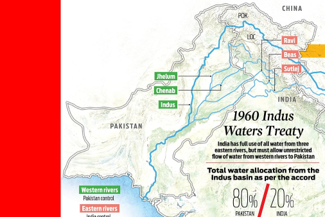
- River Allocation: Under the IWT, the three Eastern Rivers (Sutlej, Beas, Ravi) are allocated to India, while the three Western Rivers (Indus, Jhelum, Chenab) are allocated largely to Pakistan.
- The IWT Signatories: Signed on September 19, 1960, in Karachi by Indian Prime Minister Jawaharlal Nehru and Pakistani President Ayub Khan, brokered by the World Bank.
- Dispute Resolution Steps: The treaty outlines a distinct three-step mechanism: First, the Permanent Indus Commission; second, reference to a Neutral Expert; and third, escalation to a Court of Arbitration.
- India’s Western River Rights: India is permitted defined uses of the Western Rivers, including domestic consumer use, non-consumptive infrastructure use, and generation of hydroelectric energy via run-of-the-river designs.
- Run-of-the-River Definition: These are power stations that utilize the natural flow and elevation of the river to turn turbines, without requiring extensive reservoir water storage.
- Geopolitical Lever: Reassessing the treaty allows India to align its water policy with contemporary ecological challenges and clean energy goals in Jammu & Kashmir.
(IE)
Environment & Ecology
Surge in Asiatic Lion Conflicts Causes Relocation in Gujarat:
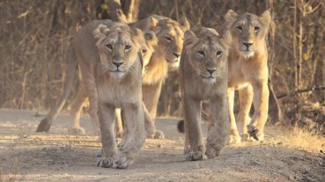
Context: The Gujarat Forest Department captured 31 Asiatic lions following a sharp rise in human–wildlife conflict incidents around the peripheries of the Gir sanctuary zone.
-
- The Intervention: Following behavioural assessments by wildlife experts, 7 of the captured lions were classified as “man-eaters” and permanently moved out of free-ranging habitats.
- Core Driver: The primary cause of the conflict is territorial saturation within the Gir core area, forcing younger prides out into agricultural landscapes and revenue areas.
- Habitation Shift: Over half of the total Asiatic lion population now ranges outside the boundaries of the designated Protected Area (PA) network.
- Conservation Status: The Asiatic Lion (Panthera leo persica) is listed as Endangered on the IUCN Red List and is under Schedule I of the Wildlife (Protection) Act, 1972.
- Distribution Limitation: The entire global population of wild Asiatic lions is restricted to the Gir National Park and Wildlife Sanctuary and its surrounding landscapes in Gujarat.
- Morphological Distinction: Asiatic lions are generally smaller than African lions and feature a distinct, longitudinal fold of skin running along their belly, which is rarely seen in African lions.
- Alternative Habitat Project: The Union Government has pursued projects to prepare the Kuno National Park (Madhya Pradesh) and Barda Wildlife Sanctuary (Gujarat) as alternative safe havens to mitigate catastrophic disease outbreaks.
- Wildlife Protection Act Amendments: The Wildlife (Protection) Amendment Act restructured schedules down to four key classes, keeping the highest level of legal security reserved for Schedule I species.
- Community Conservation: The Maldhari tribal pastoralists play a key role in local conservation efforts through co-existence traditions inside the Gir forest ecosystems.
- Technological Tracking: The forest department is expanding its use of satellite-telemetry collars and automated thermal cameras to monitor pride movements across human-dominated landscapes.
(IE/TH)
Science & Tech
Flagging Off of India’s First Hydrogen-Powered Train:
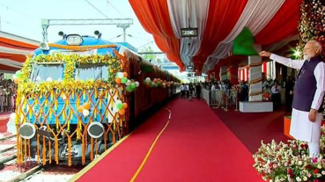
Context: PM Modi flagged off India’s first-ever indigenous hydrogen fuel cell-powered passenger train on the Jind–Sonipat section of the Northern Railway.
-
- Core Technology: The train operates on a Proton Exchange Membrane Fuel Cell (PEMFC), which generates electricity by reacting hydrogen and oxygen across an electrolyte membrane.
- Byproducts: The reaction leaves zero harmful carbon emissions, generating only water vapor and heat.
- Elite Club: India joins Germany, Japan, China, and the United States in deploying hydrogen-based rail mobility.
- Energy Density: Hydrogen boasts a high gravimetric energy density of , significantly higher than diesel’s .
- Infrastructure Hub: The country’s largest railway hydrogen storage and refuelling facility (3,000 kg capacity) has been established at Jind, Haryana.
- Regulatory Approval: The storage facility has been fully licensed by the Petroleum and Explosives Safety Organisation (PESO).
- Indigenous Framework: The project guidelines were mapped out by the Research Designs and Standards Organisation (RDSO) under Atmanirbhar Bharat.
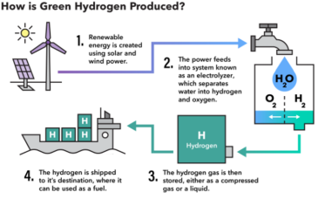
- What is Green Hydrogen? It is hydrogen produced by spliting water via electrolysis powered exclusively by renewable energy sources, unlike Grey hydrogen (fossil fuels) or Blue hydrogen (fossil fuels with carbon capture).
-
- National Green Hydrogen Mission: Launched to make India a global hub for green hydrogen production, targeting 5 MMT (Million Metric Tons) per annum capacity by 2030.
- PESO: Functioning under the Department for Promotion of Industry and Internal Trade (DPIIT), Ministry of Commerce and Industry, PESO is the nodal statutory body regulating safety regarding explosives, compressed gases, and petroleum.
(TH/PIB)
White Rabbit Technology Deployed for Indian Standard Time:
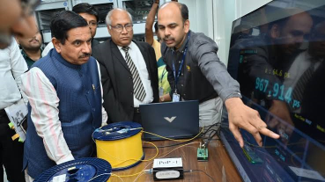
Context: The Ministry of Science & Technology announced the operational integration of ‘White Rabbit Technology’ across the Indian Standard Time (IST) distribution network based out of Bengaluru.
-
- Definition: White Rabbit (WR) is an open-source technology developed to provide sub-nanosecond accuracy in data transfer and time synchronization over Ethernet networks.
- Implementation: The deployment ensures hyper-precise time distribution across crucial national infrastructures like power grids, telecom networks, and financial data centers.
- Nodal Scientific Lab: The framework operates in coordination with the National Physical Laboratory (NPL), which is the custodian of India’s time and frequency standards.
- Strategic Autonomy: By utilizing WR networks, India significantly reduces its reliance on satellite-based GPS common-clocks for critical grid synchronization.
- Robustness: The technology provides highly resilient immunity against GPS spoofing and electronic warfare vulnerabilities targeting civilian grids.
- Custodian of IST: The CSIR-National Physical Laboratory (NPL), located in New Delhi, maintains the Indian Standard Time (IST) using a suite of Atomic Cesium clocks.
- Standard Meridian of India: IST is calculated on the basis of the longitude line, which passes through Mirzapur in Uttar Pradesh.
- Atomic Clock Science: Caesium atomic clocks use the exact resonant frequency of the ground-state hyperfine transition of the Cesium-133 atom, mathematically constant at exactly .
- Industrial Application: Useful for high-frequency algorithmic financial trading where microsecond transaction delays can impact market values.
- Network Medium: It functions effectively over existing optical fiber communication (OFC) setups without requiring completely new physical wiring structures.
(PIB)
Miscellaneous
4th Convocation of Gati Shakti Vishwavidyalaya (GSV):
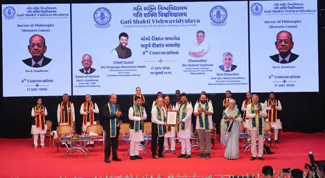
Context: The Fourth Convocation of Gati Shakti Vishwavidyalaya (GSV) was conducted at Vadodara, featuring the awarding of India’s first MBA degrees in Metro Rail Management.
-
- Honorary Doctorate: GSV conferred its first-ever Honorary Ph.D. degree on Sreedharan (the “Metro Man of India”) for his pathbreaking infrastructural contributions.
- Nodal Central Ministry: The university is structurally sponsored and managed by the Ministry of Railways, Government of India.
- Specialised Curriculum: It is the first university in India to roll out specialized academic degrees tailored strictly for Metro Rail Management and transport systems.
- Strategic Focus: The university follows the “Three Ms” formula outlined by the government: Movement, Momentum, and Mission.
- Institutional Mandates: GSV focuses on bridging skills deficits across logistics, aviation, highways, and railway transport operations.
- GSV Genesis: Originally founded as the National Rail and Transportation Institute (NRTI), it was elevated to a Central University status in 2022 via an Act of Parliament and renamed Gati Shakti Vishwavidyalaya.
- PM Gati Shakti Scheme: Launched in 2021, the PM Gati Shakti National Master Plan is a digital platform bringing 16 ministries together for integrated planning and coordinated implementation of infrastructure connectivity projects.
- Central Universities: Central Universities in India are established by an Act of Parliament under the administrative purview of the Department of Higher Education. The President of India acts as the Visitor to all Central Universities.
- Corporate Tie-Ups: The university works in active collaboration with leading manufacturing firms like Tata Advanced Systems and global transport conglomerates.
- Apprenticeship Model: The curricula are fully integrated with real-time field training across major rail divisions and aviation sites.
(PIB)
Spread the Word