Topic-1: India-Mali Bilateral Trade Expansion & West African Diplomacy
GS Paper 2: Bilateral, regional, and global groupings and agreements involving India and/or affecting India’s interests; Effect of policies of developing countries on India’s interests.
GS Paper 3: Indian Economy (International Trade, Exports, and Bilateral Investment Frameworks).
Context: India and Mali institutionalized their commercial ties by organizing the inaugural India–Mali Forum for the Promotion of Exports in Bamako. The forum marks a strategic push to position Mali as India’s primary trade and investment hub in West Africa under the country’s Vision Mali 2063 roadmap.
Current Trade Dynamics and Growth Trajectory
-
- The Trade Surge: Driven by India’s supportive trade policies, bilateral trade surged to USD 326.61 million in FY 2025–26, registering a 55% annual growth compared to the previous fiscal year.
- The Trade Basket Matrix:
- India’s Core Exports to Mali: Pharmaceuticals, cotton fabrics, automobiles (two- and three-wheelers by Tata, Mahindra), and industrial Sonalika tractors.
- Mali’s Core Exports to India: Raw cotton, finished leather, cashew nuts, lead, gum arabic, and sesame seeds.
- Catalyst Framework: India’s Duty-Free Tariff Preference (DFTP) Scheme for Least Developed Countries (LDCs) has been the primary driver of this trade surge. Mali holds an estimated untapped export potential of nearly USD 3.96 billion in the Indian market.
Key Strategic and Sectoral Priorities
The forum concluded with concrete agreements across B2B, B2G, and G2G channels, identifying several priority areas for deep economic cooperation:
-
- Pharmaceutical Regulatory Alignment: Mali committed to the fast-tracked, prompt registration of approved Indian pharmaceutical products to bolster its public health delivery networks.
- Digital Public Infrastructure (DPI): Mali requested technical support from India to digitize its Certificate of Origin system, a move aimed at cutting down customs delays and modernizing its cross-border trade administration.
- Resource and Agrarian Interventions: India urged Mali to reconsider its current export ban on shea-nuts. Both nations agreed to establish joint processing units for textiles, cotton, and mining.
- Securing Investments: Amid regional transitions, Mali’s Prime Minister, Major General Abdoulaye Maïga, assured India of a safe, stable business environment to protect Indian nationals and private capital investments.
UPSC Prelims Fodder: Fact-Check
| Feature | Details |
| Inaugural Summit | India–Mali Forum for the Promotion of Exports (Held in Bamako). |
| Bilateral Volume | USD 326.61 Million achieved in Financial Year 2025–26. |
| Growth Rate Baseline | 55% growth recorded over the previous financial year. |
| Primary Trade Enabler | India’s Duty-Free Tariff Preference (DFTP) Scheme. |
| Malian Long-Term Goal | Operates under the umbrella of the Vision Mali 2063 roadmap. |
| Upcoming Milestone | Mali to host a dedicated global Investment Forum in December 2026. |
Conclusion:
The inaugural India–Mali Forum highlights India’s focus on diversifying its trade footprint within the West African sub-region. By offering digital public infrastructure assistance and leveraging the DFTP scheme, India is opening up multi-billion-dollar trade opportunities in textiles, mining, and pharmaceuticals, while securing a critical developmental foothold in the Global South.
Topic-2: 16th Finance Commission Devolution & Rural Local Body Empowerment
GS Paper 2: Welfare schemes for vulnerable sections; Decentralization of powers and finances up to local levels and challenges therein; Panchayati Raj Institutions (PRIs).
GS Paper 3: Issues relating to planning, mobilization of resources, and public financial management.
Context: The Ministry of Panchayati Raj hosted a National Workshop of State Panchayati Raj Ministers in New Delhi to coordinate the rollout of the Sixteenth Finance Commission (16th FC) recommendations for the award period spanning 2026-27 to 2030-31.
The 16th Finance Commission Devolution Architecture
The 16th Finance Commission has introduced a historic fiscal expansion for India’s 2,76,901 Local Bodies (which includes 2,62,738 PRIs and other Traditional Local Bodies):
-
- The Macro Allocation: A total devolution of ₹4,35,236 crore has been assigned exclusively to Rural Local Bodies (RLBs). This marks a massive 84% increase over the ₹2,36,805 crore allocated under the 15th Finance Commission.
- Per Capita Record: The per capita structural funding for rural citizens has climbed from a meager ₹176 under the 13th Finance Commission (2010–15) to an unprecedented ₹953 per capita under the current 16th FC block.
Breakdown of the Grand Corpus (2026-2031)
The funding model blends assured baseline survival capital with performance incentives to drive strict local accountability:
The Core Shift: Mobilizing Own Source Revenue (OSR)
A central directive issued during the workshop was the reduction of panchayat dependency on central/state grants by actively building Own Source Revenue (OSR) options.
-
- The Model Rules: The Ministry is deploying a Model OSR Rules Framework to help Panchayats legally levy local property taxes, market fees, and commercial usage charges.
- The SAMARTH Panchayat Portal: This specialized, independent financial dashboard has been introduced to fully digitize local asset listings, track real-time tax collection collections, and secure rural ledger accounting.
UPSC Prelims Fodder: Fact-Check
| Feature | Details |
| Summoned Workshop | National Workshop of State Panchayati Raj Ministers on 16th FC. |
| Award Period Span | Five Years: 2026-27 to 2030-31. |
| Total Devolution Corpus | ₹4,35,236 Crore (An 84% jump over the 15th FC allocation). |
| Per Capita Peak | Reached ₹953 per individual (the highest allocation in Indian history). |
| Basic Grant Formula | Split 50:50 into Tied (Sanitation/Water) and Untied categories. |
| Performance Multiplier | ₹87,048 Crore kept aside to reward high-performing local bodies. |
| Core Digital Portal | SAMARTH Panchayat Portal for financial and OSR administration. |
Conclusion:
The 16th Finance Commission’s massive 84% funding increase offers a unique opportunity to build self-sustaining rural communities (Viksit Panchayats) by splitting funds between basic civic needs and performance markers, and backing this up with the SAMARTH digital ecosystem.
Topic-3: Modified UDAN Scheme & Regional Aviation Infrastructure Expansion
GS Paper 2: Government policies and interventions for development in various sectors.
GS Paper 3: Infrastructure: Energy, Ports, Roads, Airports, Railways etc.; Growth and development indicators (Viksit Bharat 2047).
Context: Prime Minister Narendra Modi launched the next phase of India’s regional connectivity scheme, titled “Viksit UDAN” (Modified UDAN Scheme), and inaugurated the New Terminal Building (NTB) at Jodhpur Airport, Rajasthan. The policy introduces a massive ten-year financial extension to democratize Indian airspace.
The Modified UDAN Scheme (2026–2036)
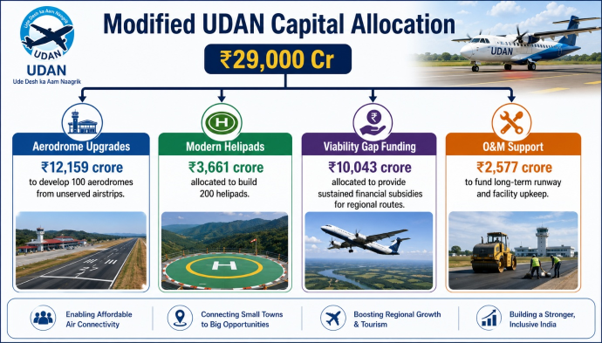
Approved by the Union Cabinet with a historic outlay of approximately ₹29,000 crore over the next ten years, the Modified UDAN scheme transitions from a short-term connectivity project into a decadal infrastructure development program.
Financial Allotment Breakup
The ₹29,000 crore corpus is strategically ring-fenced across four key operational vectors:
Strategic Focus on Aatmanirbhar Aviation
A major highlight of this phase is the mandatory promotion and induction of indigenously manufactured aircraft and helicopters for remote regional routes. The scheme provides special incentives to fleet operators deploying home-grown platforms such as the HAL Dhruv Advanced Light Helicopter and the Dornier Do-228 light transport aircraft.
Jodhpur Airport’s New Terminal Building (NTB)
Developed by the Airports Authority of India (AAI) at a cost of ₹480 crore, the new terminal updates the aviation footprint of western Rajasthan:
-
- Capacity Scaling: Expands the airport’s capacity from the saturated baseline of 4 lakh passengers to 20 lakh passengers annually (handling 1,500 peak-hour flyers).
- Technical Footprint: Spread across 23,342 square meters, it integrates 20 check-in counters, 6 aerobridges, and an expanded apron capable of parking 11 Airbus A-321 aircraft and one ATR-72 simultaneously.
- Sustainability Metric: Built using green construction techniques to achieve a 5-Star GRIHA rating (Green Rating for Integrated Habitat Assessment), incorporating advanced solar arrays, water harvesting, and energy-efficient climate control systems.
UPSC Prelims Fodder: Fact-Check
| Feature | Details |
| Scheme Phase | Modified UDAN / Viksit UDAN (Extended for a 10-year term). |
| Financial Outlay | ~₹29,000 Crore (With ₹10,043 Crore dedicated to Viability Gap Funding). |
| Infrastructure Targets | Build/upgrade 100 aerodromes and 200 modern helipads across Tier-2/3 areas. |
| Indigenous Focus | Promotes domestic platforms: HAL Dhruv and Dornier aircraft. |
| Historical Baseline | Launched in October 2016; has connected 669 routes and 95 airports so far. |
| New Infrastructure | Jodhpur Airport NTB (Built at ₹480 Crore with a 5-Star GRIHA target). |
Conclusion:
The launch of the Modified UDAN scheme with a ₹29,000 crore outlay changes India’s regional aviation strategy from an incentive-led model into a long-term infrastructure program. By focusing on indigenous aircraft manufacturing and investing heavily in unserved airstrips and helipads, the policy strengthens last-mile connectivity, supporting economic growth and tourism on the road to Viksit Bharat 2047.
Topic-4: India-Israel Bilateral Investment Agreement (BIA) & International Investment Law
GS Paper 2: Bilateral, regional, and global groupings and agreements involving India and/or affecting India’s interests; Effect of policies of developed/developing countries on India’s economy.
GS Paper 3: Indian Economy and issues relating to planning, mobilization of resources, growth, development, and investment models.
Context: The landmark Bilateral Investment Agreement (BIA) between India and Israel officially entered into force on July 4, 2026. The pact was originally signed on September 8, 2025, in New Delhi and has now completed all institutional and diplomatic ratifications.
Core Principles of the India-Israel BIA
The agreement moves away from old-style, investor-centric treaties to reflect modern principles of international investment law. It strikes a balance between protecting private capital and maintaining state regulatory rights:
-
- Investor and Investment Protection: It establishes a secure, transparent, and predictable legal climate for cross-border investments. This setup protects foreign businesses from arbitrary, discriminatory state actions or unlawful expropriation.
- Retention of Sovereign Policy Space: A key feature of the text is its flexibility. It explicitly retains sovereign policy space, allowing both governments to pass laws for legitimate public policy objectives—such as national security, public health, labor standards, and environmental conservation—without triggering investor lawsuits.
- Alignment with Modern Indian BIT Model: The BIA aligns with India’s revised strategy on Bilateral Investment Treaties (BITs), which uses strict definitions of “investment” and requires foreign investors to exhaust local legal remedies before seeking international arbitration.
Strategic Geopolitical and Economic Value
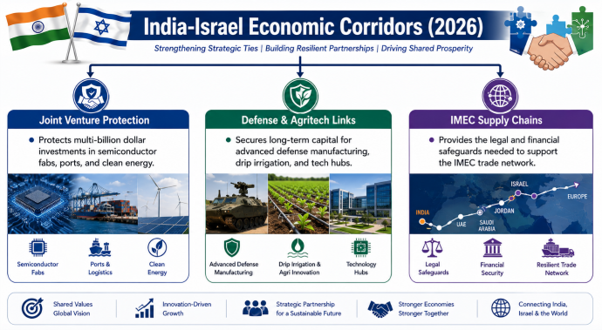
The activation of this treaty underpins a deep financial and high-tech corridor between the two nations:
UPSC Prelims Fodder: Fact-Check
| Feature | Details |
| Agreement Title | India-Israel Bilateral Investment Agreement (BIA). |
| Signing Date & Venue | September 8, 2025, in New Delhi. |
| Enforcement Date | July 4, 2026 (Official entry into force). |
| Nodal Ministry | Ministry of Finance (Department of Economic Affairs – DEA). |
| Legal Baseline | Balances Investor Protection with Sovereign Policy Space. |
| Strategic Links | Connects directly with the India-Middle East-Europe Corridor (IMEC). |
Conclusion:
The enforcement of the India-Israel Bilateral Investment Agreement marks an important step forward in India’s global investment strategy. By balancing investor protections with the state’s right to regulate, the treaty secures critical investments in high-tech manufacturing, defense, and infrastructure while preserving the country’s sovereign policy space.
Spread the Word