Introduction:
India’s technology framework has undergone a profound structural transformation by matching massive infrastructure updates with mission-mode initiatives across semiconductors, Artificial Intelligence (AI), and quantum computing has shifted its focus toward tech-driven sovereign capacity building.
Key Takeaways
-
- Connectivity and Data Densification: Fiber optic infrastructure expanded from 19.35 lakh route km in 2019 to 42.36 lakh route km, lowering mobile data costs to ₹8–10 per GB while boosting average monthly consumer usage to 24.01 GB.
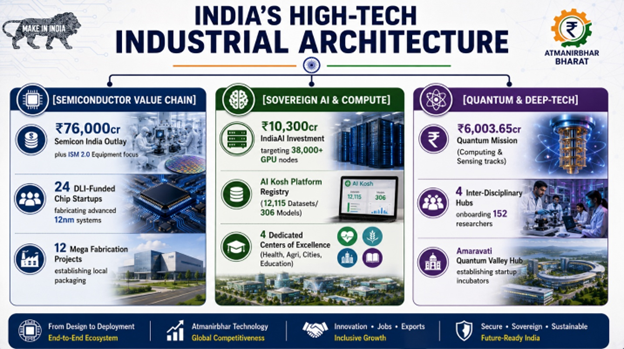
- The Semiconductor Manufacturing Base: The India Semiconductor Mission (ISM) has cleared 12 projects worth ₹1.64 lakh crore, placing a commercial semiconductor fab, two compound fabs, and nine advanced packaging units under construction.
- The Sovereign AI Grid: The ₹10,300 crore IndiaAI Mission is deploying a centralized computing infrastructure featuring over 38,000 GPUs alongside the AI Kosh platform, which hosts 12,115 datasets and 306 foundation models.
- Quantum Infrastructure Scaling: The ₹6,003.65 crore National Quantum Mission has deployed a 1,000-km secure quantum communication link six years ahead of schedule, supported by the construction of India’s first Quantum Valley in Amaravati.
Sectoral Matrix of Emerging Technological Frontiers
Phase 1: High-Performance Compute and Semiconductor Sovereignty:
To insulate the domestic industrial grid from global supply chain distortions, the state has built a multi-layered hardware manufacturing and engineering design ecosystem:
-
- The Fabless Design Pipeline: The Design Linked Incentive (DLI) Scheme has provided capital tools and Electronic Design Automation (EDA) infrastructure to 24 fabless hardware firms, resulting in 16 tape-outs including advanced 12 nm custom microprocessors.
- High-Performance Compute Depletion: Guided by the National Supercomputing Mission (NSM), India has deployed 38 clustered supercomputers across elite academic institutions with a combined capacity of 47 Petaflops, anchored by the indigenous PARAM Rudra series.
- Talent Pipelines (The ChipIN Initiative): The Chips to Start-up (C2S) Programme has provided shared wafer runs and national EDA software access to 100,000 engineers across 400 organizations, building an industry-ready pool of Very Large-Scale Integration (VLSI) technicians.
Phase 2: Next-Generation Distributed Innovations and Data Center Scaling:
The deployment of enterprise-grade security protocols across e-governance assets relies on the structural growth of localized storage networks and cryptographic ledgers:
-
- The National Blockchain Architecture: Powered by the National Blockchain Framework (NBF), the Vishvasya Blockchain Stack and the NBFLite sandbox provide interoperable Blockchain-as-a-Service (BaaS) configurations through national data centers, verifying over 3 crore property records to eliminate land-title duplication.
- Hyperscale Cloud Modernization: The MeghRaj 2.0 hybrid cloud platform has expanded its integration to 2,323 government departments, providing secure storage for critical citizen services like DigiLocker and MyGov.
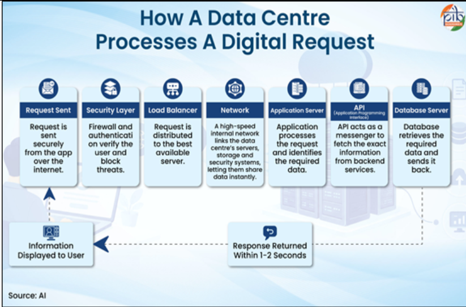
- AI-Focused Data Infrastructures: Supported by Union Budget tax holidays and an increased safe harbor eligibility threshold of ₹2,000 crore, India’s data center footprint expanded from 375 MW in 2020 to 1,500 MW. Hyperscale facilities are clustered in Mumbai, Hyderabad, Noida, and Jamnagar.
Phase 3: Applied Bio-Manufacturing and Human Capital Ecosystems:
The integration of life sciences with digital computation forms a central column of India’s multi-sector industrial competitiveness:
-
- The Bioeconomy Momentum: India’s biotechnology footprint crossed USD 190 billion, supported by the BioE3 Policy and the National Biopharma Mission. This network is accelerated by 94 specialized bioincubators managed via the DBT-BIRAC framework.
- The Anusandhan Funding Rails: Higher translational research is driven by the Anusandhan National Research Foundation (ANRF) through dedicated platforms like the Partnerships for Accelerated Innovation and Research (PAIR) scheme, backed by the ₹1 lakh crore Research Development and Innovation (RDI) corpus providing long-term private R&D credit.
- Industrial Skilling Inflection: Technical training has been modernized via programs like FutureSkills PRIME (onboarding 27.53 lakh candidates across deep-tech certifications) and the Indian Institutes of Skills (IIS), running public-private partnerships to build an Industry 4.0 labor force.
Phase 4: Technology Diplomacy, Alliances, and Global Infrastructure Exports:
India has used its expanding software and hardware depth to reshape its international relations, converting its domestic technology architecture into global governance standards:
-
- The Silicon Stack Coalition: Moving beyond traditional trade agreements, India formally joined Pax Silica, a strategic coalition of democratic nations working to secure the full silicon stack—ranging from critical mineral access to advanced AI deployment frameworks.
- Technology Diplomacy Foundations: Coordinated by the NEST (New, Emerging and Strategic Technologies) Division under the Ministry of External Affairs, India has institutionalized bilateral research frameworks, including the Bharat 6G Alliance and strategic tech dialogues via events like the AI Impact Summit 2026.
- Global Digital Public Infrastructure (DPI) Footprint: The India Stack framework (Aadhaar, UPI, DigiLocker) has become a global benchmark for inclusive governance, with India signing formal cooperation treaties with 23 countries while expanding operational UPI payment links to nations like France, Singapore, and the UAE.
Challenges
-
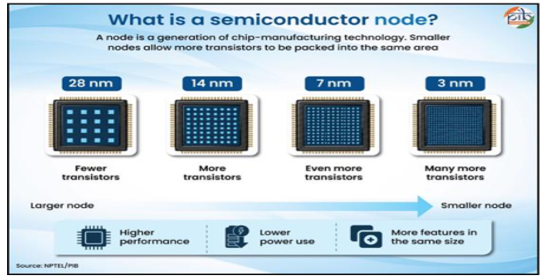
- The Hindu (The Advanced Lithography and Equipment Monopoly Layer): While the semiconductor framework successfully cleared ₹1.64 lakh crore in packaging and compound fab projects, entering sub-7nm advanced node fabrication is constrained by extreme global monopolies over extreme ultraviolet (EUV) lithography equipment, maintaining a structural technology gap.
- Indian Express (The High-End GPU Scarcity and Sovereign Compute Drag): The IndiaAI Mission’s target of deploying 38,000 GPUs faces friction from severe global supply limitations and export controls on advanced processing units. This drag slows down compute availability for early-stage deep-tech startups.
- Observer Research Foundation (The Bioeconomy Capital Lifecycle and Incubation Valley): Scaling the national biotech sector to its next target requires massive, high-risk capital injections. The domestic venture ecosystem remains hesitant to fund high-gestation clinical trials, leaving deep-tech biostartups reliant on limited public grants.
- PRS Legislative Research (The Statutory Deficit in Data Sovereignty Legislation): The rapid deployment of distributed platforms like the Vishvasya Blockchain and MeghRaj 2.0 highlights the absence of an independent statutory authority to manage automated smart-contract liabilities, creating regulatory uncertainty across multi-state transactions.
- Government Audit Portals (The Geographic Digital Divide in Industry 4.0 Skilling): While platforms like SIDH process over 1.5 crore candidates, a structural skills gap persists. Advanced technical training remains clustered around Tier-1 educational centers, limiting the technical capability of candidates in rural and aspirational districts.
Way Forward
-
- Acquiring Niche Intellectual Property via Sovereign Wealth Funds (PRS Approach): To bypass equipment bottlenecks, the Ministry of Electronics and IT should establish targeted investment consortia to acquire international fabless design firms and co-develop foundational intellectual property (IP).
- Implementing Federated Compute Clusters and AI Sandboxes (Indian Express Option): To address GPU scarcity, the IndiaAI Mission should coordinate a national federated cloud architecture, pooling the idle computing power of existing supercomputing centers into a unified startup sandboxing environment.
- Deploying Blended Capital Windows at GIFT City (ORF Strategy): To support the bioeconomy and deep-tech startups, the government should introduce customized, tax-exempt venture debt windows within the GIFT International Financial Services Centre, de-risking long-term private capital investments.
- Enacting a Comprehensive National Smart-Contracts and Blockchain Act: In line with the legislative upgrades suggested by PRS, Parliament should pass a legal framework to standardize distributed ledger compliance, define automated liability limits, and clarify algorithmic audit metrics.
- Decentralizing Advanced Tech Training through Hub-and-Spoke NIELIT Models: Utilizing the expanded network of 56 NIELIT university hubs to deploy standardized micro-credentials in mechatronics, edge computing, and chip design down to aspirational districts, closing the geographic skills divide.
Conclusion:
The evolution of India’s technology ecosystem over the past decade highlights a successful transition from a passive consumer market into a self-reliant, globally competitive technology powerhouse by matching absolute indigenization targets in chip design and sovereign AI infrastructure with open-protocol digital public goods.
Spread the Word