
Indian Polity & Governance
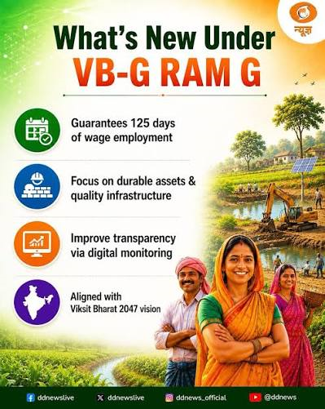
Nationwide Rollout of the VB-GRAM G Act, 2025:
Context: The historic Viksit Bharat – Guarantee for Rozgar and Ajeevika Mission (Gramin) [VB-GRAM G] Act, 2025, has officially come into force across rural India on July 1, 2026, replacing and significantly upgrading previous rural livelihood employment frameworks.
-
- The Act legalizes a robust statutory framework aimed at strengthening rural employment, livelihood security, and comprehensive village development.
- It enhances the guaranteed wage employment limit from the previous standard of 100 days to 125 days per fiscal year for every eligible rural household.
- The strategic vision behind the Act is to systematically accelerate the transformation of rural infrastructure to meet the national goals of Viksit Bharat @2047.
- The Ministry of Rural Development has declared a zero-tolerance policy for work pendency, ensuring that no eligible rural worker remains without employment for even a single day.
- Interim financial backing: To ensure a frictionless launch, the Central Government has disbursed an initial interim allocation of ₹95,692.31 crore directly to States and Union Territories.
- Asset creation mandate: Unlike purely consumption-driven wage schemes, the Act places strict emphasis on creating durable community and rural economic assets (e.g., check dams, minor irrigation systems, and rural roads).
- Cooperative federalism: The execution architecture relies heavily on close trilateral coordination between the Centre, State Governments, and Panchayati Raj Institutions (PRIs).
- Art 41 of DPSP: This Act directly fulfills the mandate of Article 41 of the Directive Principles of State Policy, which directs the State to secure the right to work, to education, and to public assistance in cases of unemployment.
- Gram sabha empowerment: In line with the 73rd Constitutional Amendment Act, the social audit and selection of permissible works remain strictly within the purview of the local Gram Sabha.
- Uninterrupted transition protection: A dedicated financial cushion has been built into the rollout to ensure that ongoing work projects seamlessly transfer into the VB-GRAM G ledger without stopping daily wage payments.
(PIB)
Aadhaar email update to be free via mobile app from July 1; UIDAI waives Rs 75 fee for six months:
Context: The Unique Identification Authority of India (UIDAI) announced a total waiver of the ₹75 processing fee for updating email identifications linked to Aadhaar cards for a six-month window beginning July 1, 2026.
-
- The UIDAI is an explicit statutory authority established under the provisions of the Aadhaar (Targeted Delivery of Financial and Other Subsidies, Benefits and Services) Act, 2016.
- UIDAI operates under the administrative jurisdiction of the Ministry of Electronics and Information Technology (MeitY).
- Digital Public Infrastructure (DPI): Aadhaar forms the absolute foundation of India’s JAM Trinity (Jan Dhan-Aadhaar-Mobile), which powers the nation’s Direct Benefit Transfer (DBT) social welfare architecture.
- The fee waiver on email linkage aims to enhance security by ensuring users receive real-time authentication alerts, reducing identity fraud.
- Puttaswamy judgment: In the landmark S. Puttaswamy v. Union of India (2017) case, the Supreme Court declared the Right to Privacy a fundamental right under Article 21, forcing UIDAI to implement rigorous data minimization and security measures.
- Aadhaar is Not Proof of Citizenship: Legally, an Aadhaar card serves strictly as a proof of identity and residency within the territory of India; it does not confer any legal rights to Indian citizenship.
- Resident definition: Under the Aadhaar Act, an individual who has resided in India for a period or periods amounting in all to 182 days or more in the 12 months immediately preceding the date of application is eligible to get an Aadhaar.
- Consolidated fund links: Section 7 of the Aadhaar Act mandates that the government can make Aadhaar verification compulsory for any subsidy or service funded directly out of the Consolidated Fund of India.
- CIDR security: The physical and digital biometric data collected is stored securely within the Central Identities Data Repository (CIDR), which is legally protected against unauthorized third-party commercial data-mining.
- Demographic vs biometric separation: The system segregates basic demographic details (name, gender, email) from core biometrics (iris scans, fingerprints), ensuring deep cryptographic protection during multi-factor authentication cycles.

(ET)
International Relations
Freedom of Navigation in the Strait of Hormuz:
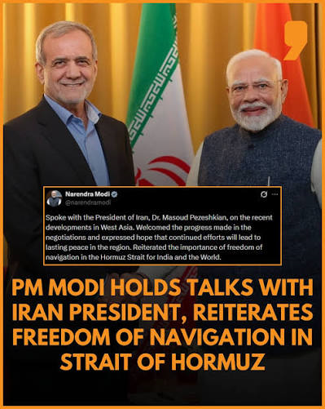
Context: In a high-level diplomatic dialogue, Prime Minister Narendra Modi spoke with Iran’s President Masoud Pezeshkian, strongly emphasizing the preservation of “freedom of navigation” through the vital Strait of Hormuz.
-
- The Strait of Hormuz is globally recognized as one of the world’s most strategically sensitive maritime chokepoints, separating the Persian Gulf from the Gulf of Oman and the Arabian Sea.
- Indian Energy Security: Over 60% of India’s crude oil imports pass directly through this region, making its stability absolute to India’s macroeconomic health and energy price stability.
- Global Transit Share: Approximately one-fifth (20%) of the world’s total petroleum liquids consumption passes through this narrow strait daily, emphasizing its global economic centrality.
- The northern coast of the Strait of Hormuz is controlled by Iran, while the southern coast is bordered by Oman (specifically the Musandam enclave) and the United Arab Emirates.
- UNCLOS Rules: Under the United Nations Convention on the Law of the Sea (UNCLOS), foreign vessels enjoy the right of transit passage through such international straits, a rule India strongly advocates for.
- The Chabahar Dimension: The maritime safety of this zone directly impacts India’s strategic investments in Iran’s Chabahar Port, which bypasses Pakistan to provide access to Central Asia and Afghanistan.
- INSTC Intersect: The region serves as the maritime entry point for the International North-South Transport Corridor (INSTC), an Indian-backed multi-modal transport network linking India to Russia.
- De-escalation Efforts: The talks come amidst ongoing diplomatic efforts in Doha (mediated by Qatar) involving regional powers to ensure a lasting de-escalation of West Asian friction points.
- Operation Sankalp Linkage: To protect Indian-flagged merchant vessels transiting through the Gulf region and the Strait of Hormuz, the Indian Navy continues to maintain a persistent presence via Operation Sankalp.
- Diplomatic Neutrality: India’s engagement highlights its delicate balancing act in West Asia maintaining robust ties with Iran while protecting strategic economic partnerships with Israel and Gulf Cooperation Council (GCC) states.
(TH)
Economy
RBI’s Anti-Mis-selling Directives for Financial Products:
Context: The Reserve Bank of India (RBI) has implemented stringent new regulations effective July 1, 2026, aimed at curbing the practice of bank-led mis-selling of third-party financial products like mutual funds and insurance.
-
- Under the new rules, customers who are proven to have been mis-sold a financial product are legally entitled to a full refund of their principal capital.
- Banks are now liable to compensate the aggrieved consumer for any quantifiable financial losses or opportunity costs incurred due to the mis-selling.
- This directly targets the Bancassurance model, where banks act as corporate agents for insurance companies to leverage their vast depositor base.
- Fiduciary Duty: Legally, banks owe a fiduciary duty to depositors. The RBI rules reiterate that prioritizing commission revenues over customer financial safety violates core banking principles.
- The guidelines enforce stricter audits on cross-selling targets given to bank employees, which frequently incentivize unethical push-marketing tactics.
- Redressal via Banking Ombudsman: Consumers can appeal directly to the Integrated Ombudsman Scheme of the RBI if the commercial bank fails to resolve a mis-selling complaint within 30 days.
- The Consumer Protection Link: This regulatory upgrade aligns with the statutory provisions of the Consumer Protection Act, 2019, protecting individuals against unfair trade practices in financial services.
- Audit Trail Enforcement: Banks must now maintain comprehensive digital audit trails and voice recordings of financial advisory sessions that result in high-value third-party product sales.
- Systemic Financial Risk: The RBI highlighted that mis-selling erodes public trust in formal banking channels, potentially triggering sudden outflows from hybrid deposit-investment products.
- Joint Regulatory Scrutiny: The enforcement involves coordinated surveillance between the RBI, SEBI (for mutual funds), and IRDAI (for insurance products) to prevent jurisdictional overlaps or loopholes.
(TH)
NITI Aayog’s Report on Tourism and Hospitality Constraints:
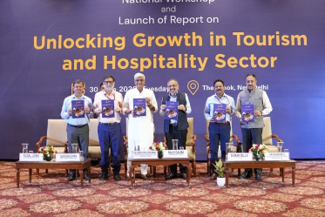
Context: The Union Ministry of Tourism alongside NITI Aayog released a joint comprehensive report titled “Unlocking Growth in the Tourism and Hospitality Sector”, identifying severe regulatory fragmentations holding back India’s hospitality investments.
-
- The report identifies that a primary barrier to tourism infrastructure expansion is the presence of duplicate approvals and overlapping multi-agency compliance norms.
- Supply-Side Bottlenecks: High compliance burdens severely delay infrastructure execution, preventing Indian hospitality projects from scaling up to match global quality standards.
- Google-India Strategic MoU: Concurrent with the report, the Tourism Ministry signed an MoU with Google India to deploy Artificial Intelligence (AI) and data-driven insights for targeted digital promotion of Indian destinations.
- Service Sector GDP Weight: The tourism and hospitality sector contributes roughly 8% to India’s GDP and serves as a vital generator of foreign exchange reserves and net employment.
- NITI Aayog Structure: NITI Aayog operates as India’s premier policy think tank. It is structured with the Prime Minister as Chairperson, a Governing Council comprising all State Chief Ministers, and a team of sectoral domain experts.
- The Multiplier Effect: Tourism possesses one of the highest employment multiplier effects among all economic sectors, meaning an investment in tourism generates a high ratio of secondary jobs in transport, retail, and agriculture.
- International Accessibility Frictions: The report highlights that easing visa bottlenecks (like expanding e-Visa facilities) and streamlining airport immigration clearances are crucial to improving international arrival counts.
- Infrastructure Status Demand: The hospitality industry has consistently demanded full Infrastructure Status for hotel projects below the ₹200 crore threshold to unlock lower-cost, long-term commercial loans.
- Swadesh Darshan 2.0 Integration: The joint report advocates aligning investment frameworks with the existing Swadesh Darshan 2.0 scheme, which focuses on developing sustainable, theme-based tourism circuits across India.
- Capacity Building Directive: A core pillar of the Google partnership is to train local micro-entrepreneurs and hospitality workers in digital tourism management, ensuring grass-roots economic integration.
(TH)
Geography,
IMD’s Orange Alert and Monsoon Mechanics in Kerala
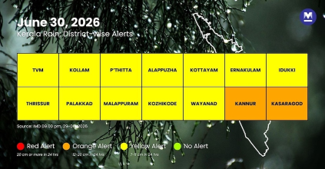
Context: The India Meteorological Department (IMD) issued a severe three-day Orange Alert for northern districts of Kerala (Kannur and Kasaragod) on July 1, 2026, forcing local administrations to suspend educational activities due to extreme rain forecasts.
-
- IMD Color-Coding Scale: The IMD uses four distinct colour codes for weather warnings: Green (No action), Yellow (Be updated), Orange (Be prepared), and Red (Take action).
- Orange alert threshold: An Orange Alert signals a high probability of extremely bad weather, with rainfall totals generally expected to range anywhere from 6 mm to 204.4 mm within a 24-hour period.
- Southwest monsoon dynamics: This phenomenon is a direct manifestation of the active Southwest Monsoon (Arabian Sea branch) hitting the windward side of the Western Ghats.
- Orographic precipitation: The heavy downpours are intensely augmented by orographic rainfall, caused when moisture-laden monsoonal winds are forced to rise abruptly over the steep topography of the Western Ghats.
- Disaster risk management: Under the Disaster Management Act, 2005, the district collectors act as heads of District Disaster Management Authorities (DDMAs) to enforce preventative steps like school closures based on IMD alerts.
- Ecological vulnerability: The targeted region falls under the ecologically sensitive zones of the Western Ghats, making it highly prone to sudden landslides and flash floods when soils saturate.
- The El Nino/La Nina Factor: The strengthening monsoon currents in mid-2026 align with a transitioning equatorial Pacific toward La Nina conditions, which historically enhance Indian monsoon precipitation.
- The Indian Ocean Dipole (IOD): A positive phase of the Indian Ocean Dipole (differential sea surface temperature between western and eastern Indian Ocean) acts constructively to boost these rainfall events along India’s west coast.
- IMD infrastructure: The IMD relies on specialized Doppler Weather Radars (DWR) positioned along the coastline to track precipitation intensity and wind velocity profiles in real-time.
- Impact on Agro-Ecology: While heavy rain causes temporary urban disruptions, it provides the critical water baseline required for the transplantation of the water-intensive Kharif paddy crops across the coastal plains.
(TH)
Ecology & Environment and DM
India adds 709 new species to its faunal database in 2025, 353 taxa to its flora:
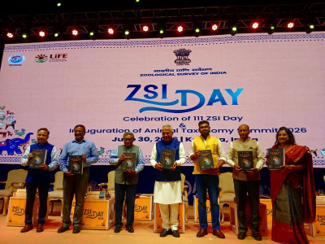
Context: On June 30, 2026, the Union Ministry of Environment, Forest and Climate Change officially released the “Animal Discoveries 2025” and “Plant Discoveries 2025” repositories during the 111th Foundation Day of the Zoological Survey of India (ZSI) in Kolkata, marking a major update to India’s national biodiversity database.
-
- Faunal additions: India officially added 709 new species to its faunal database over the past year, which includes 483 species completely new to science and 226 species recorded as new distributional records within Indian borders.
- Floral additions: The country added 353 plant taxa to its floristic database, which comprises 221 taxa entirely new to science and 132 taxa representing new distributional records for the country, alongside 14 infra-specific taxa.
- Nodal Agencies: The extensive faunal mapping and documentation were executed by the Zoological Survey of India (ZSI, est. 1916), while the systematic floral compilation was spearheaded by the Botanical Survey of India (BSI, est. 1890).
- Faunal Hotspot Leaders: A statewide geographical analysis reveals that Kerala recorded the highest number of new animal discoveries with 98 species, followed closely by West Bengal with 76 species, Karnataka with 67 species, and Arunachal Pradesh with 65 species.
- Floral Hotspot Leaders: Arunachal Pradesh emerged as the leading state for botanical discoveries, contributing 49 new plant taxa, followed by Uttarakhand with 39 records and Kerala with 37 records.
- Taxonomic Composition (Flora): The 353 newly recorded plant taxa are explicitly split into 154 angiosperms (flowering plants), 93 fungi, 62 lichens, 22 algae, 13 bryophytes, 3 pteridophytes, and 6 microbes.
- The Primitive Plant Pivot: Non-vascular plants and lower organism groups (such as fungi, lichens, and algae) accounted for a significant 57% of the total botanical discoveries, while vascular plants made up the remaining 43%.
- Invertebrate Dominance: Reflecting a massive wave of insect documentation, the order Hymenoptera (bees, wasps, and ants) contributed the highest number of faunal additions (106), followed by Lepidoptera (moths and butterflies: 65) and Diptera (true flies: 64).
- Notable Vertebrate Innovations: High-profile vertebrate discoveries include a new species of Himalayan bat (Myotis himalaicus), Irwin’s wolf snake (Lycodon irwini), and two green fan-throated lizards named Ptyctolaemus namdaphaensis and Ptyctolaemus siangensis.
- Megadiverse Aggregate Tally: With these newly approved entries, India’s total documented faunal diversity has officially reached 1,05,953 species indexed under Version 3.0 of the Fauna of India Checklist, cementing India’s global standing as one of the world’s 17 premier megadiverse nations.
(TH)
Science & Technology
LPG Composition & Pricing Economics:
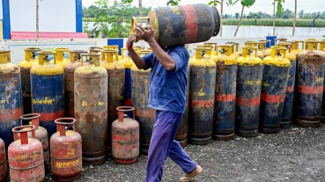
Context: On July 1, 2026, state-run Oil Marketing Companies (OMCs) slashed the price of 19 kg commercial Liquified Petroleum Gas (LPG) cylinders by ₹183.50 in Delhi, marking the first rate drop in 2026 driven by cooling West Asian energy markets.
-
- Chemical composition: LPG is a flammable mixture of hydrocarbon gases, predominantly consisting of Propane () and Butane ().
- Odour mechanism: Naturally, LPG is completely odorless. To ensure immediate detection of dangerous gas leaks, a pungent chemical compound called Ethyl Mercaptan () is mixed during bottling.
- Physical state: It is stored under moderate pressure as a liquid inside cylinders but vaporizes into a gas immediately upon release at atmospheric pressure.
- Density characteristics: LPG gas is heavier than air, meaning that in the event of a leak, it tends to accumulate in low-lying areas, floors, and basements, creating a severe fire hazard.
- Pricing determinant: Domestically, LPG pricing in India is calculated based on the Import Parity Price (IPP), which mimics international prices as India imports a significant portion of its LPG consumption.
- The under-recovery concept: When OMCs sell domestic cylinders below international parity costs due to government mandates, the difference is termed an “under-recovery,” which is later settled via state subsidies.
- Differential pricing structure: The government maintains separate pricing tiers for domestic use (14.2 kg cylinders) and commercial/industrial use (19 kg cylinders) to prevent industrial diversion of subsidized domestic fuel.
- Environmental profile: LPG burns cleanly with no soot generation and minimal sulfur emissions, making it a critical bridge fuel under India’s clean cooking energy matrix.
- PMUY: Clean cooking adoption is driven by the state’s flagship Pradhan Mantri Ujjwala Yojana (PMUY), which targets deposit-free LPG connections for women from BPL households.
- Storage physics: The pressure inside a standard domestic cylinder is roughly 5 to 7 bar (), which keeps the hydrocarbons in a highly compact liquid form.
(IE)
History, Art & Culture
President of India graces first convocation ceremony of the central tribal university of Andhra Pradesh:
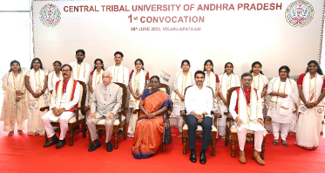
Context: President Droupadi Murmu visited Andhra Pradesh to grace the maiden convocation ceremonies of the Central Tribal University of Andhra Pradesh at Vizianagaram and the Central University of Andhra Pradesh at Ananthapuramu.
-
- Statutory origin: The Central Tribal University of Andhra Pradesh (CTUAP) was established under the Central Universities (Amendment) Act, 2019.
- Andhra pradesh reorganisation link: The setup fulfills a mandatory commitment explicitly detailed in the Thirteenth Schedule of the Andhra Pradesh Reorganisation Act, 2014.
- Constitutional authority: The President of India serves as the Visitor of all Central Universities under standard central legislative statutes.
- Target demographic: The university is strategically located in Vizianagaram to cater directly to the socio-educational development of large tribal populations residing along the Eastern Ghats.
- Focus on Indigenous Knowledge: Beyond standard curricula, the university is mandated to conduct research on preserving tribal languages, tribal medicine, forest-based livelihoods, and indigenous art forms.
- Article 46: This step implements Article 46 of the Constitution, which obligates the State to promote with special care the educational and economic interests of Scheduled Tribes (STs).
- Fifth schedule connection: Large parts of the tribal belts in neighboring regions fall under the Fifth Schedule, giving the Governor special regulatory responsibilities over tribal land and education.
- Particularly Vulnerable Tribal Groups (PVTGs): Andhra Pradesh houses several key PVTGs (like the Chenchus and Kondareddis). The educational framework aims to design customized skill-development tracks for these highly vulnerable groups.
- Funding mechanism: Central Universities receive their primary developmental and operational funding directly from the Central Government via the University Grants Commission (UGC).
- National Education Policy (NEP) 2020: The multi-disciplinary structure of these newly set up central institutions incorporates the NEP 2020 mandates, emphasizing regional languages and flexible entry-exit academic frameworks.
(PIB)
Regional tribal art forms:
Context: During the high-profile presidential visits to tribal educational institutions in Andhra Pradesh, emphasis was placed on setting up institutional departments dedicated to documenting regional tribal art forms like Savu and Dhimsa.
-
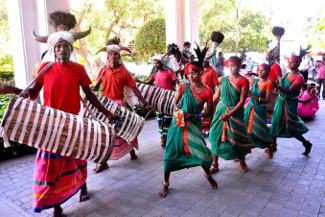
- Dhimsa dance origins: Dhimsa is an ancient, tribal folk dance performed primarily by the Porja tribe in the Araku Valley region of Visakhapatnam and Vizianagaram districts.
-
- Cultural occasions: The dance is standard during the Chaitra mass (March/April) and major festivals to pray for a bountiful harvest, domestic peace, and successful marriages.
- Instrumental accompaniment: Traditional instruments utilized include the Mori (a wind instrument), Dappu (drum), and Tudumu, giving the performance a distinct rhythmic acoustic pattern.
- Community structure: Dhimsa is inherently a community dance where women form a chain by locking arms and dancing in synchronized circular movements, reflecting deep egalitarian societal setups.
- Sangeet natak akademi: This apex central body under the Ministry of Culture handles the documentation, preservation, and financial support of such tribal and folk performing art heritages.
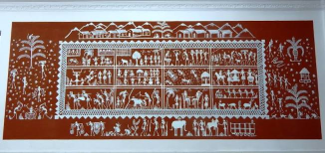
- Savu art forms: Savu ritualistic art practices are linked with the Savarad or Saora tribes, known historically for their highly detailed wall murals called Idital.
- The saora pictograms: Similar to Warli paintings, Saora paintings use geometric patterns, stick-like figures, and natural dyes to illustrate forest biodiversity, tribal folklore, and cosmological myths.
-
- GI tag significance: Several tribal art forms in India are securing Geographical Indication (GI) Tags to protect indigenous artisans from commercial counterfeit products.
- UNESCO intangible heritage: India’s safeguarding programs actively map tribal performances to nominate them for inclusion in the UNESCO Representative List of the Intangible Cultural Heritage of Humanity.
- TRIFED commercialization: The Tribal Cooperative Marketing Development Federation of India (TRIFED) provides the structural marketplace to sell tribal arts and crafts globally, linking heritage preservation directly to economic sustainability.
(PIB)
Spread the Word