Topic-1: Value-Added Poultry Exports & Agro-Processing Growth
GS Paper 2: Government Policies & Interventions for Development.
GS Paper 3: Supply Chain Management & Food Processing; Technology Applications in Agriculture.
Context: The Agricultural and Processed Food Products Export Development Authority (APEDA) facilitated India’s first-ever commercial export consignment of dried whole egg powder from Balangir, Odisha, to Austria, signaling the entry of Indian value-added poultry items into the European Union.
The Agro-Processing Infrastructure in Balangir
The historic 22.6 metric tonne export shipment was manufactured by OVO Farm Pvt. Ltd. at its state-of-the-art facility set up in Balangir in 2025.
-
- Advanced Processing Technology: The facility converts fresh liquid eggs into stable powder through a specialized spray-drying method. This process significantly extends the shelf life, simplifies mass shipping logistics, and ensures high microbial safety.
- Global Food Certifications: To pass strict European border regulations, the facility operates in high-clean zones and holds a series of international food safety badges, including FSSC 22000 Version 6, Export Inspection Council (EIC) clearances, and Halal/Kosher approvals.
- Industrial Utility: Dried egg powder serves as a vital component for global food sectors, heavily utilized in bakeries, commercial confectionery manufacturing, cloud kitchens, and premium pharmaceutical formulations.
Strategic Impact of the Export
-
- Odisha’s Industrial Shift: Balangir, historically a migration-prone area, is emerging as an advanced poultry-processing hub, generating local jobs and establishing high-tech rural industries.
- APEDA’s Financial Backing: APEDA supported the deployment through targeted financial aid programs designed to upgrade cold chain logistics, modernize industrial laboratories, and improve food tracking.
- Diversifying the EU Basket: Successfully entering Austria’s premium food grid demonstrates that Indian processed animal products can clear strict European hygiene barriers, paving the way for larger global trade.
UPSC Prelims Fodder: Fact-Check
| Feature | Details |
| Export Item | Dried Whole Egg Powder (First-ever shipment from Odisha). |
| Destination Country | Austria (European Union market). |
| Facilitating Nodal Body | APEDA under the Ministry of Commerce & Industry. |
| Consignment Volume | 22.6 Metric Tonnes virtually flagged off in June 2026. |
| Manufacturing Node | OVO Farm Pvt. Ltd. facility in Balangir, Odisha (est. 2025). |
| Core Process Tech | Industrial Spray-Drying of pasteurized liquid eggs. |
Conclusion
The first-ever export of egg powder from Odisha to Austria marks a big step forward in transforming India’s poultry sector from supplying raw items to high-value processed goods. Supported by APEDA infrastructure funding and top global food safety badges, this milestone positions India as a trusted supplier of complex food products to strict Western markets.
Topic-2: Nirbhay Chetna Initiative for Gender-Responsive Grassroots Governance
GS Paper 2: Welfare schemes for vulnerable sections; Panchayati Raj Institutions (PRIs); Devolution of powers and local governance.
GS Paper 3: Role of external state and non-state actors in creating challenges to internal security (Safety Infrastructure).
Context: The Ministry of Panchayati Raj organized a three-day national Training of Trainers (ToT) program in New Delhi (June 17–19, 2026) to roll out Nirbhay Chetna. This first-of-its-kind national initiative aims to sensitize over 17.5 lakh male elected local representatives on women’s safety and gender equality.
The Architecture of the ‘Nirbhay Raho’ Umbrella Scheme
Launched on March 11, 2026, and funded through the national Nirbhaya Fund, the parent Nirbhay Raho initiative addresses rural safety through three interconnected, complementary strategies:
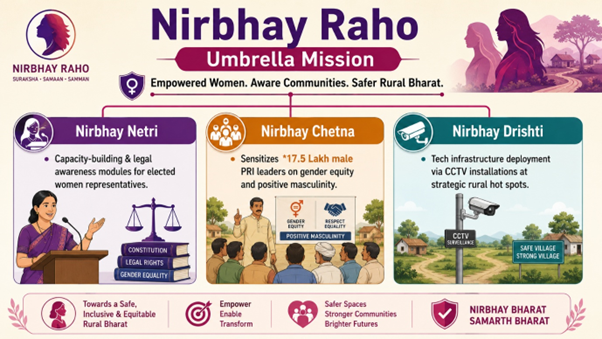
Core Framework of Nirbhay Chetna
The initiative addresses the critical gap of engaging men in local leadership roles to champion women’s safety and institutional equity:
-
- The Training Module: Developed in partnership with the development organization Transform Rural India, the training module focuses on positive masculinity, breaking social stereotypes, and ensuring community safety.
- The Cascading Scale: The initiative is creating a massive network of 28,500 Master Trainers across state, district, and block levels. These trainers are tasked with educating 17.5 lakh male elected representatives nationwide.
- The Pilot Phase: The initial training batch drew 40 master trainers from six geographically diverse states: Assam, Chhattisgarh, Himachal Pradesh, Maharashtra, Odisha, and Uttarakhand. This group forms the foundation before the program expands nationwide.
UPSC Prelims Fodder: Fact-Check
| Feature | Details |
| Initiative Name | Nirbhay Chetna (Under the Nirbhay Raho umbrella campaign). |
| Nodal Ministry | Ministry of Panchayati Raj, Government of India. |
| Funding Vector | Funded entirely through the central Nirbhaya Fund allocation. |
| Knowledge Partner | Transform Rural India (Developed the core training modules). |
| Target Audience | Over 17.5 Lakh male Elected Representatives in rural local bodies. |
| Human Resource | Training a baseline network of 28,500 Master Trainers. |
| Pilot Phase States | Assam, Chhattisgarh, Himachal Pradesh, Maharashtra, Odisha, Uttarakhand. |
Conclusion:
The launch of Nirbhay Chetna introduces a structural shift in local governance by actively engaging male Panchayat leaders to protect women’s safety and rights. By combining behavioral training under the Nirbhaya Fund with technological safety upgrades like Nirbhay Drishti, the initiative lays a secure social foundation for gender-responsive governance at the grassroots level.
Spread the Word