Introduction:
India’s governance model has transitioned toward a comprehensive framework aimed at enhancing public dignity, choice, and economic empowerment. By scaling up basic public goods such as permanent housing, clean energy grids, piped water networks, and digital financial channels, national planning has shifted its core focus toward improving everyday ease of living. This systematic intervention creates a foundational baseline for inclusive economic growth, formalizing the domestic economy while narrowing regional development gaps.
Key Takeaways
-
- Saturation of Core Utilities: Piped water access under the Jal Jeevan Mission expanded to 81.94% by June 2026, delivering treated water to over 15.86 crore rural households.
- Mass Transit Expansions: India’s active metro rail network expanded to 1,155 km across 26 cities, positioning the country as the third-largest global metro system with a daily ridership exceeding 1.15 crore.
- Welfare Capital Re-engineering: The financial inclusion ecosystem handles unprecedented transfer volumes, with the Pradhan Mantri Jan Dhan Yojana (PMJDY) base expanding past 58 crore accounts, holding ₹3 lakh crore in core deposits.
- The Jan Vishwas Trust Model: The Jan Vishwas Act of 2026 modernized the domestic corporate terrain by decriminalizing 717 provisions across 79 central laws, substituting minor procedural errors with rationalized monetary penalties.
-
- Transforming Public Infrastructure: The physical landscape of urban and rural housing has been fundamentally re-engineered to replace temporary dwellings with durable assets that support generational wealth creation. The Pradhan Mantri Awas Yojana (PMAY) architecture has sanctioned over 25 crore permanent urban homes, alongside registering a conTtruction target of 3.98 crore rural dwellings, with over 75% of properties safely secured under solo female or joint gender ownership.
- This massive housing push is closely synchronized with the urban renewal mandates of AMRUT 2.0, which deploys an intensive ₹2.99 lakh crore capital outlay across 4,800 statutory towns to optimize sewage handling, stormwater drains, and open green spaces.
Universal Access to Clean Cooking Fuel
To eliminate the severe public health and environmental hazards associated with traditional biomass cooking
-
- The state expanded clean energy access, driving national LPG coverage to an absolute 107.2% by April 2026 via the Pradhan Mantri Ujjwala Yojana. This energy push operates alongside the rapid development of the Swachh Bharat Mission, which achieved a nationwide open-defecation-free status by constructing over 14 crore household latrines and implementing solid and liquid waste management systems across 5.69 lakh villages.
- A professional infographic mapping the national transition toward sustainable household utilities would ideally display the parallel growth lines of LPG saturation, ODF Plus village modeling, and automated tap water connectivity across varying state terrains.
Decoupling Energy Vulnerability through Consumer Generation
The domestic power grid has successfully doubled its total installed capacity over the past twelve years, crossing 532 GW by March 2026, with renewable energy sources actively commanding more than half of the aggregate generation mix.
-
- This energy expansion effectively stabilized daily supply metrics, raising average rural power availability to 22.6 hours and urban centers to 23.4 hours. To sustain this momentum, the PM Surya Ghar Muft Bijli Yojana assists households in transitioning from passive energy consumers into active power producers by providing direct subsidies of up to ₹78,000 for rooftop solar installations, allowing over 40 lakh homes to lower their monthly utility bills while feeding surplus clean power back into the national synchronized grid.
Financial Inclusion
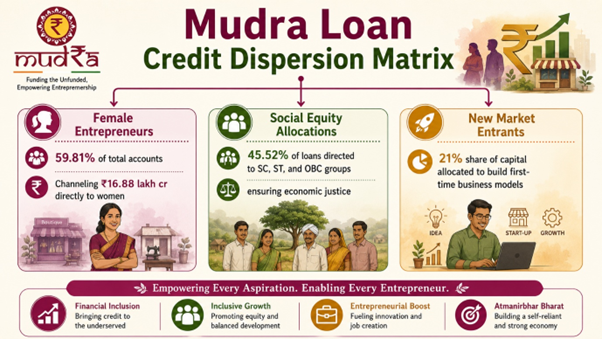
The integration of the JAM Trinity (Jan Dhan, Aadhaar, and Mobile) functions as the core data engine enabling leak-proof social security distribution, channeling over ₹6.9 lakh crore in direct transfers in a single fiscal year. This baseline deposit banking framework is supported by the Pradhan Mantri Mudra Yojana, which has sanctioned over 57.7 crore collateral-free institutional loans worth ₹40 lakh crore to formalize micro-enterprises.
High-Capacity Logistic Corridors
Modern spatial connectivity has scaled up through targeted capital outlays across highways, aviation lanes, and high-speed rail lines, expanding the national highway network to 1,46,572 km by March 2026.
-
- Long-distance rail travel has been upgraded by the rollout of 162 semi-high-speed Vande Bharat services alongside sixty high-capacity non-AC Amrit Bharat lines, with passenger safety protected by the Kavach automatic train collision avoidance system across 3,103 route kilometers.
- Regional aviation has been democratized under the UDAN scheme, which revived unserved local airstrips to expand India’s operational airport portfolio to 165, while inner-city transit relies on automated networks like the Namo Bharat Regional Rapid Transit System (RRTS) running at 160 km/h.
Challenges
-
- The Hindu (The “Deemed Approval” and Urban Friction): The implementation of large-scale affordable urban housing under PMAY-U 2.0 faces friction due to skyrocketing land prices in peri-urban corridors, creating last-mile affordability issues for economically weaker segments despite central subsidies.
- Indian Express (The Resource Depletion Layer): While the Jal Jeevan Mission has achieved remarkable connection density, sustaining water quality remains a critical challenge, as localized groundwater contamination and drying aquifer sources frequently compromise piped supply consistency.
- PRS Legislative Research (The Regulatory Overlap and State Lag): Despite the successful passage of the Jan Vishwas Act of 2026, the complete removal of regulatory duplication is limited by slow state-level compliance modifications, leaving multi-state businesses exposed to conflicting municipal guidelines.
- Observer Research Foundation (The Solar Grid and Fiscal Impact): The rapid expansion of rooftop solar under the PM Surya Ghar scheme is putting structural pressure on state-level distribution companies (DISCOMs), as the loss of high-paying residential consumers creates revenue imbalances that distort local tariff management.
- Government Audit Portals (The Digital Divide): While digital feedback systems like CPGRAMS have accelerated public grievance resolution speeds, a significant digital divide persists in remote tribal and aspirational districts, where low internet density limits independent public access to tech-driven governance.
Way Forward
-
- Standardizing Urban Land Banks (PRS Approach): State administrations should adopt the land pooling strategies recommended by PRS Legislative Research, integrating digitized cadastral maps with municipal zoning templates to counter speculative land inflation in peri-urban zones.
- Decentralized Water Testing and Source Rejuvenation (Indian Express Option): Addressing water security concerns requires adopting sustainable aquifer management models that combine localized rainwater harvesting infrastructure with continuous water-quality testing labs managed directly by village panchayats.
- Uniform State-Level Legislative Decriminalization (Government Portal Goal): State legislatures must pass matching regional amendments to mirror the central Jan Vishwas mandates, ensuring uniform decriminalization of technical errors across all provincial business jurisdictions.
- Dynamic Time-of-Day Tariff Implementation (ORF Strategy): To stabilize local distribution company balance sheets, the Observer Research Foundation recommends developing flexible peer-to-peer green energy trading models, allowing state utilities to manage rooftop solar feeds through dynamic tariff structures.
- Grassroots DPI Access Nodes: Maximizing the reach of digital public infrastructure requires utilizing localized information centers, such as the Common Service Centers (CSCs) framework, to bridge the digital access gap for citizens in remote areas, ensuring uniform access to CPGRAMS and digital welfare portals.
Conclusion:
India’s structural transition from basic social welfare to data-rich, inclusive ease of living represents a milestone in citizen-centric governance by replacing old administrative bottlenecks with digital public infrastructure and high-speed multi-modal logistics, recent policy interventions have successfully enhanced public dignity and financial self-reliance.
Spread the Word