
International Relations
The India-Russia Reciprocal Exchange of Logistics Agreement (RELOS):
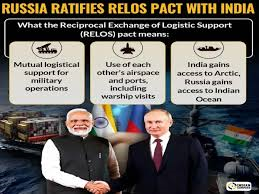
Context: The Reciprocal Exchange of Logistics Agreement (RELOS) between India and Russia has been officially operationalized, allowing the armed forces of both nations reciprocal access to military bases, ports, and airfields for refuelling and logistical support.
-
- What is RELOS? RELOS is a bilateral administrative arrangement that simplifies and expedites logistical operations, allowing warships, military aircraft, and personnel to replenish supplies during joint exercises, humanitarian relief operations, or transit.
- Operational Safeguards: The agreement sets a strict operational cap, explicitly stating that no more than 3,000 troops from either nation can be deployed or utilizing the partner’s facilities at any given single point in time.
- Strategic Arctic & Maritime Access: For India, RELOS opens strategic pathways to utilize Russian naval ports in the Arctic region and the Russian Far East (such as Vladivostok), matching India’s growing focus on the Northern Sea Route (NSR).
- Reciprocal Indian Facilities: In return, Russian naval vessels can seamlessly use Indian deep-water ports along the Indian Ocean rim for replenishment, repair, and rest, lowering the operational friction of long-range deployments.
- The Indo-Pacific Pivot: The activation of RELOS balances India’s strategic autonomy. India has already operationalized similar foundational logistics pacts with all Quad partners (the USA, Australia, and Japan) as well as France, Singapore, and South Korea.
- LEMOA Analogy (Static Link): RELOS functions almost identically to the Logistics Exchange Memorandum of Agreement (LEMOA) signed between India and the United States in 2016 but is custom-tailored to the specific defense equipment synergy of India and Russia.
- Exclusion of Automatic Basing: The agreement is strictly logistical; it does not imply the establishment of permanent foreign military bases on Indian soil, nor does it establish a mutual defense alliance pact.
- Payment and Clearing Integration: To sidestep active Western financial sanctions (like SWIFT exclusions), operations under RELOS are settled via a designated Rupee-Ruble alternative mechanism or bilateral accounts.
- Boost to Joint Operations: It directly scales up the institutional complexity and coordination of long-running bilateral defense maneuvers, such as the tri-service INDRA exercises.
- Geopolitical Balancing Act: The operationalization occurs at a critical juncture, proving that New Delhi remains committed to its long-term strategic partnership with Moscow while continuing its active defense convergence with Western powers.
(IE/TH)
Geography
Dhaka’s New Padma Barrage and the Ganges Water Sharing Treaty:
Context: Bangladesh’s plan to advance the construction of the massive 2.1 km long Padma Barrage project has brought transboundary river governance back into focus, specifically impacting the upcoming renewal negotiations of the historic 1996 Ganges Water Sharing Treaty.
-
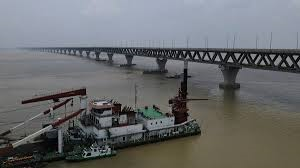
- The Project Structure: The proposed Padma Barrage is a 2.1-kilometer-long concrete structure designed to hold 2,900 million cubic meters of water, built entirely across the main channel of the Padma River in Bangladesh.
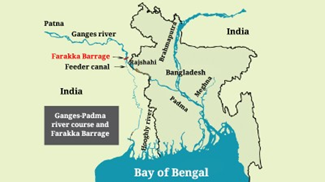
- Geographical Location: The barrage is situated roughly 180 km downstream of India’s operational Farakka Barrage in West Bengal, placing its vast ecological impact zone very close to the India-Bangladesh international border.
- The Padma River Hydrography (Static Link): The Padma is the primary downstream distributary of the Ganges River. The Ganges enters Bangladesh from India near Shibganj, where it immediately takes the name Padma before converging with the Jamuna (the Brahmaputra’s main channel).
- The Farakka Barrage Context: Built by India in the 1970s, the Farakka Barrage uses a 38-km long feeder canal to divert water from the Ganga into the Bhagirathi-Hooghly river system. Its purpose is to flush silt and maintain navigation depths at the Kolkata Port.
-
- The 1996 Ganges Treaty: This landmark bilateral treaty established a strict 30-year water-sharing formula during the lean season (January to May). Crucially, the treaty is legally set to expire in late 2026, making current developments highly time-sensitive.
- Ecological Role of Freshwater: The Padma Barrage aims to counter dry-season water scarcity and prevent seawater intrusion from the Bay of Bengal into Bangladesh’s southwestern agricultural plains.
- Impact on the Sundarbans: Alterations in river flow patterns directly threaten the delicate salinity balance of the Sundarbans delta, the world’s largest mangrove forest, which relies on a constant mix of fresh water and sediment from the Ganga-Brahmaputra-Meghna system.
- The Teesta River Contrast: Unlike the Ganges, which has a functional treaty, water sharing on the Teesta River (a major tributary of the Jamuna/Brahmaputra flowing from Sikkim and West Bengal) remains stalled due to internal hydro-political disagreements within India.
- Joint Rivers Commission (JRC): Established back in 1972, the JRC is the apex bilateral institutional mechanism tasked with managing water deployment, flood forecasting, and resolving disputes across the 54 shared transboundary rivers between India and Bangladesh.
- Basin-Scale Management: International hydro-policy experts argue that both nations must move away from isolated mega-barrages toward a collaborative, basin-scale ecosystem management model to survive climate-induced monsoon shifts.
(TH)
Total Fertility Rate (TFR) Shifts and Demographic Dynamics in Southern States:
Context: Public debates have intensified regarding legislative incentives announced by states like Andhra Pradesh aimed at encouraging larger family sizes, shedding light on India’s rapidly falling Total Fertility Rate (TFR) and its long-term demographic and political consequences.

-
- Defining Total Fertility Rate (TFR): TFR represents the average number of children that would be born alive to a woman during her lifetime, assuming she passes through her childbearing years conforming to age-specific fertility rates.
- Replacement Level Fertility: Globally, a TFR of 1 is considered the exact “replacement level.” This is the specific fertility rate at which a population exactly replaces itself from one generation to the next without any migration.
- India’s Macro TFR Status: According to recent National Family Health Surveys (NFHS), India’s national TFR has already dropped below the replacement baseline, currently sitting at approximately 0.
- The Demographic Divide: While northern states like Bihar and Uttar Pradesh are closer to or just above replacement levels, several southern states have seen their TFR plummet well below replacement levels, to ranges between 1.5 and 1.7.
- Implications for Population Growth: A below-replacement TFR does not cause an immediate drop in total population due to “population momentum” (a high concentration of youth currently in reproductive age groups) but ensures long-term population contraction and aging.
- The Aging Challenge: Southern states are entering a demographic phase characterized by a rapidly greying population and a shrinking local workforce, increasing the fiscal pressure on senior care, healthcare infrastructure, and pension payouts.
- UNFPA State of World Population Report (Static Link): The United Nations Population Fund (UNFPA) is the primary international agency tracking these demographic transformations, regularly compiling data on global reproductive choices and gender parity indicators.
- The Delimitation Dilemma: Political analysts link these local fertility incentives to the upcoming boundary delimitation of Lok Sabha constituencies. States that successfully implemented population control fear losing political representation relative to states with higher fertility.
- The 15th Finance Commission Approach: To address these concerns, the 15th Finance Commission included “demographic performance” (rewarding states that lowered fertility rates) with a 12.5% weight in its horizontal tax devolution formula.
- Gender and Care Burden: Demographers warn that pushing for higher fertility without investing heavily in formal care infrastructure disproportionately increases the burden of unpaid domestic care work on women, potentially depressing female labour force participation.
(TH)
Ecology & Environment and DM
Biological Oxygen Demand (BOD) and Inter-State Yamuna River Rejuvenation:
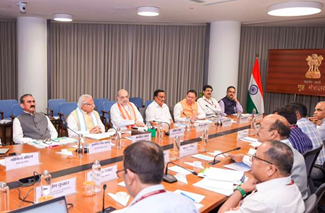
Context: In a high-level meeting coordinated by the Ministry of Home Affairs, six northern states Himachal Pradesh, Uttarakhand, Delhi, Uttar Pradesh, Haryana, and Rajasthan signed a comprehensive Memorandum of Understanding (MoU) regarding the execution of the Kishau project and joint water pollution controls to lower the Biological Oxygen Demand (BOD) of the Yamuna River.
-
- Defining Biological Oxygen Demand (BOD): BOD is a critical chemical index measuring the exact amount of dissolved oxygen required by aerobic microorganisms to completely break down and decompose organic waste matter present in a water body at a specific temperature.
- BOD as a Pollution Indicator: A high BOD value signifies a heavily polluted water body, because massive amounts of organic waste (like untreated sewage) trigger rapid microbial growth that depletes the dissolved oxygen vital for aquatic life.
- Chemical Oxygen Demand (COD) Contrast (Static Link): Unlike BOD, which measures only biologically degradable organic matter, COD measures all chemically oxidizable matter in the water, including non-biodegradable industrial toxins, utilizing strong chemical oxidants.
- The Water Allocation Deal: The newly signed multi-state MoU permits Himachal Pradesh to allocate its surplus water share to water-stressed Delhi and Rajasthan. In exchange, these beneficiary states will co-share the financial costs of the power generation component.
- The Yamuna Hydro-System: The Yamuna originates from the Yamunotri glacier in the Himalayas and flows past multiple states. The 22-km stretch passing through Delhi represents less than 2% of its total length but contributes over 70% of its total pollution load.
- The Kishau Project Factor: The Kishau project is a massive, multi-purpose dam venture proposed on the Tons River (the largest tributary of the Yamuna, flowing along the border of Uttarakhand and Himachal Pradesh) designed to regulate lean-season flows.
- The Dissolved Oxygen (DO) Baseline: For a healthy river ecosystem capable of sustaining fish and riverine biodiversity, the Dissolved Oxygen content must ideally be maintained above 5 mg/liter, whereas polluted stretches of the Yamuna regularly hit 0 mg/liter.
- Central Pollution Control Board (CPCB) Standards: Operating under the Water (Prevention and Control of Pollution) Act, 1974, the CPCB sets the statutory water quality criteria, classifying river water into distinct use-categories based on BOD and total coliform counts.
- Eutrophication Risk: High organic and nutrient pollution (nitrogen and phosphorus from agricultural runoff and household detergents) causes eutrophication dense algal blooms that choke out sunlight and deplete deep-water oxygen.
- The Clean Yamuna Integration: The multi-state agreement aligns with the broader environmental goals of the National Mission for Clean Ganga (NMCG), emphasizing decentralized Sewage Treatment Plants (STPs) and minimum ecological flow guarantees.
(PIB)
Science & Technology
Border Gateway Protocol (BGP) Hijacking and Cyber Security:
Context: A series of advanced cyber-tactical disruptions targeting Indian critical infrastructure networks has highlighted the systemic vulnerabilities of Border Gateway Protocol (BGP) Hijacking, prompting emergency directives from the Indian Computer Emergency Response Team (CERT-In).
-
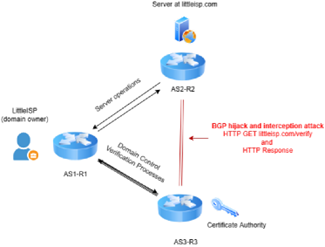
- What is BGP? The Border Gateway Protocol (BGP) is the fundamental routing protocol that acts as the “postal system of the Internet.” It dynamically maps and directs data packets across thousands of interconnected Autonomous Systems (AS) worldwide.
- The Mechanism of BGP Hijacking: BGP hijacking occurs when a rogue or compromised network operator falsely advertises IP address space that it does not actually own. This confuses the global routing directory, causing internet traffic to be misdirected.
- The Intent Behind Attacks: Misdirected data traffic can be surreptitiously monitored via “Man-in-the-Middle” (MitM) setups, harvested for sensitive credentials, or entirely blocked in a massive Distributed Denial of Service (DDoS) event.
- The Lack of Built-In Security: Designed in the early days of the internet, the core BGP protocol relies entirely on implicit trust between networks. It does not possess native cryptographic mechanisms to verify if a routing claim is genuine.
- RPKI as a Shield (Static Link): Resource Public Key Infrastructure (RPKI) is the modern cryptographic framework deployed to secure BGP. It utilizes public-key cryptography to verify that an Autonomous System is legally authorized to advertise specific IP prefixes.
- Role of CERT-In: Operating under the Ministry of Electronics and Information Technology (MeitY), CERT-In is India’s national nodal agency for responding to cyber security incidents under Section 70B of the Information Technology Act, 2000.
- National Critical Information Infrastructure Protection Centre (NCIIPC): Created under Section 70A of the IT Act, NCIIPC specifically secures sectors designated as “Critical Information Infrastructure” (CII), including power grids, banking, and strategic communications.
- Accidental vs. Malicious Hijacks: Not all BGP incidents are malicious cyber warfare; simple typographical or configuration errors by network engineers (known as “route leaks”) can accidentally disrupt global internet traffic routes.
- Impact on Cryptographic Traffic: Even if data is fully encrypted via HTTPS/TLS, a successful BGP hijack allows attackers to collect metadata or route users to sophisticated, look-alike phishing domains that bypass standard browser warnings.
(IE)
Spread the Word