Indian Polity & Governance
Retrospective Spectrum Fee Quashed by Bombay High Court:
Context: The Bombay High Court quashed a series of Union Cabinet decisions that had sought to impose a retrospective spectrum charging mechanism on major telecommunication providers, including Bharti Airtel and Vodafone Idea.
-
- Retrospective Taxation/Levy: Retrospective legislation changes the legal consequences of acts committed or relationships entered into prior to the enactment of the law.
- Constitutional limitations: While the Parliament of India has plenary powers to legislate retrospectively on economic matters, it cannot pass retrospective criminal laws due to the protection guaranteed under Article 20(1) (protection against ex-post facto laws).
- Judicial Review Principle: The High Court applied the principle of “promissory estoppel” and legitimate expectation, ruling that arbitrary retrospective financial demands alter the level-playing field for investments.
- Spectrum Assignment: Electromagnetic spectrum is a scarce natural resource owned by the public. Under the 2012 Supreme Court 2G Judgment, the apex court mandated that allocation of commercial natural resources must happen via a transparent, non-discriminatory public auction.
- Telecom Regulatory Authority of India (TRAI): Established under the TRAI Act, 1997, it is the independent statutory regulator for the telecommunications sector in India to ensure orderly growth and protect consumer interests.
- Telecom Disputes Settlement and Appellate Tribunal (TDSAT): Set up via an amendment to the TRAI Act in 2000, TDSAT adjudicates disputes between licensors, licensees, service providers, and consumers.
- Adjusted Gross Revenue (AGR) Context: Telecom operators pay a percentage of their revenue as license fees and spectrum usage charges (SUC) to the Department of Telecommunications (DoT). The definition of AGR has long been a flashpoint of dispute between the state and corporate firms.
- Article 226 Authority: The High Court exercised its extraordinary writ jurisdiction under Article 226 of the Constitution to quash the central executive orders.
- Ease of Doing Business Indicator: Sudden shifts in tax/regulatory regimes are viewed negatively by Foreign Institutional Investors (FIIs) and affect sovereign investment ratings.
- Cabinet Decisions Nature: Under Article 74, the Union Cabinet advises the President. While decisions represent policy direction, they remain subject to judicial review if they are found ultra vires to existing statutory provisions or violate fundamental rights.

(IE)
Political Deliberations to Increase Lok Sabha Strength and Delimitation:
Context: High-level political consultations intensified in New Delhi regarding structural formulas to expand the seat strength of the Lok Sabha ahead of the upcoming nationwide delimitation exercise.
-
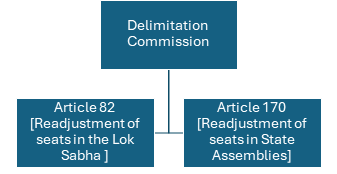
- Constitutional Mandate for Delimitation: Article 82 of the Indian Constitution instructs the Parliament to enact a Delimitation Act after every decennial census to redraw the territorial boundaries of Lok Sabha constituencies.
- State assembly readjustment: Correspondingly, Article 170 dictates the readjustment of territorial constituencies for each State Legislative Assembly following a post-census delimitation.
- The 84th Constitutional Amendment Act, 2001: This amendment froze the total number of seats in the Lok Sabha and State Assemblies based on the 1971 census data until the first census taken after the year 2026.
- The 1971 Census Rationale: The freeze was originally instituted via the 42nd Amendment Act in 1976 to prevent states that successfully implemented family planning and population control measures (primarily Southern states) from losing parliamentary representation.
- Delimitation Commission Composition: Set up under a central Act, the Commission is chaired by a retired judge of the Supreme Court and includes the Chief Election Commissioner (CEC) and respective State Election Commissioners.
- Judicial Immunity of Awards: Under the Constitution, the orders issued by the Delimitation Commission carry the full force of law and cannot be challenged in any court of law to prevent delays in election cycles.
- Parliamentary Modification Bar: When the final reports of the Delimitation Commission are laid before the Lok Sabha or State Assemblies, they can make no modifications or amendments to the boundaries specified.
- Current maximum strength: Under the existing framework, the maximum strength of the Lok Sabha can go up to 550 members (after the 104th Amendment abolished the Anglo-Indian nominated seats). The new Parliament building has been engineered to hold 888 seats in the Lok Sabha chamber to handle the impending expansion.
- Proportional representation challenge: The central debate revolves around devising an equitable seat allocation formula that reflects current population densities without penalizing states for structural demographic achievements.
- Federal balance core: Changes to the parliamentary seat equation alter the federal equilibrium of India, touching upon the basic structure principles concerning free and fair elections and federalism.
(IE)
International Relations
Escalation in West Asia Conflict and India’s Strategic Travel Advisory:
Context: Following fresh military exchanges between Israel and Iran that put the regional ceasefire under strain, the Indian Embassy in Tehran issued an urgent security advisory for its citizens.
-
- Advisory nature: The Ministry of External Affairs (MEA) and the Indian Embassy in Iran issued a non-binding but critical category-A travel advisory urging Indian nationals to avoid non-essential travel and leave Iran immediately due to airspace risks.
- Strait of Hormuz Significance: The geopolitical crisis directly threatens the Strait of Hormuz, a narrow choke-point between the Gulf of Oman and the Persian Gulf through which approximately one-fifth (20%) of the world’s total petroleum liquids pass.
- Choke-point Geography: The Strait of Hormuz is bounded by Iran to the north and Oman (Musandam peninsula enclave) and the United Arab Emirates (UAE) to the south.
- Operation sankalp: Historically, the Indian Navy deploys stealth frigates under Operation Sankalp in the Persian Gulf and Gulf of Oman to secure Indian-flagged merchant vessels transiting through these sensitive waters.
- Diaspora presence: The West Asian region houses over 8.5 million non-resident Indians (NRIs), making the safety of remittances and personnel a major foreign policy cornerstone for India.
- Energy dependency: India imports over 80% of its crude oil requirements, with a significant majority originating from West Asian suppliers (including Iraq, Saudi Arabia, and UAE), making regional stability critical for India’s macroeconomy.
- International North-South Transport Corridor (INSTC): Continued conflicts in Iran alter the progress of INSTC, a 7,200-km multi-mode network of ship, rail, and road routes moving freight between India, Iran, Azerbaijan, Russia, Central Asia, and Europe.
- Chabahar Port Aspect: India’s strategic investment in Iran’s Shahid Beheshti Terminal at Chabahar Port serves as a critical gateway to bypass Pakistan for trade access to landlocked Afghanistan and Central Asia.
- Vienna Convention: The safety of diplomatic missions during regional flare-ups is mandated by the Vienna Convention on Diplomatic Relations (1961), which defines the framework for diplomatic immunity and state protections.
- Maritime Law Mapping: The surrounding waters of the Persian Gulf are governed under the UNCLOS (United Nations Convention on the Law of the Sea), which protects the “Right of Transit Passage” through international straits.

(TH/IE)
Economy
New Bilateral Investment Treaty (BIT) Model Unveiled:
Context: The Union Government released details of its revised Bilateral Investment Treaty (BIT) architecture, reinforcing the strict mandatory 2-year domestic remedy clause and omission of the Most Favoured Nation (MFN) provisions.
-
- Definition of a BIT: A Bilateral Investment Treaty is a reciprocal agreement established between two sovereign states to protect and promote cross-border private capital investments.
- Exhaustion of Local Remedies (ELR): The updated model mandates that foreign investors must exhaust all available domestic judicial and administrative remedies for at least two years before escalating disputes to international arbitration tribunals.
- Investor-State Dispute Settlement (ISDS): ISDS is the formal mechanism within BITs that grants foreign investors the right to initiate dispute settlement proceedings against a host government before an international arbitral forum.
- Omission of Most Favoured Nation (MFN) Clause: India purposefully excluded the MFN provision to prevent foreign firms from “cherry-picking” more favourable investment protection clauses established in India’s older, legacy treaties with third-party nations.
- Enterprise-based Asset Definition: The new framework transitions from an “asset-based” definition of investment to an “enterprise-based” definition, ensuring only real, operational economic entities with long-term capital commitment receive legal protection.
- Protection of Regulatory Autonomy: The model includes strong carve-outs safeguarding the Indian state’s sovereign right to regulate economic matters, introduce public health reforms, levy taxes, and preserve national security without being sued under ISDS.
- ICSID Context: India is consistently not a member of the World Bank’s International Centre for Settlement of Investment Disputes (ICSID), citing that the convention’s rules lean heavily in favor of developed capital-exporting countries.
- UNCITRAL Alignment: Most international investment arbitrations involving India are conducted under the arbitration rules drafted by the United Nations Commission on International Trade Law.
- Impact on Foreign Direct Investment (FDI): While stricter BIT models shield the sovereign exchequer from predatory litigations, they can increase the risk premium for foreign entities evaluating large-scale capital entries.
- Article 73 Application: The negotiation and ratification of international economic treaties and BITs fall completely within the executive powers of the Union of India under Article 73 of the Constitution.

(IE)
India’s Current Account Balance Narrows to $7.1 Billion Surplus:
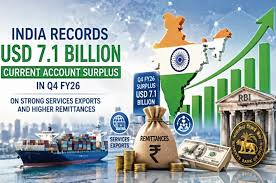
Context: Data released for Q4 showed India’s current account surplus narrowed to $7.1 billion, compressed by a surging domestic gold import bill and temporary capital outflows from foreign portfolio investors.
-
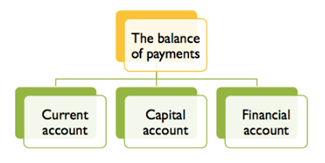
- Current Account Components: The Balance of Payments (BoP) Current Account records the export and import of goods (visible trade), services (invisible trade), and unilateral transfers (remittances, gifts, donations).
- Capital account contrast: Unlike the Current Account, the Capital Account tracks net changes in national asset ownership, including Foreign Direct Investment (FDI), Foreign Portfolio Investment (FPI), and external commercial borrowings (ECB).
- Trade deficit impact: India traditionally runs a merchandise trade deficit (importing more goods than it exports), which is structurally balanced out by a strong surplus in services exports (IT, consulting) and private remittances.
- Gold import economics: Gold is the second-largest component of India’s import bill after crude oil. A surge in domestic gold demand directly exerts downward pressure on the current account balance by widening the merchandise trade deficit.
- Foreign Institutional Investors (FIIs/FPIs): FPI involves investment in highly liquid financial assets like stocks and bonds. FPI flows are highly volatile (often called “hot money”) compared to stable, long-term FDI.
- Bloomberg Bond Index Inclusion Connection: The government’s fiscal tweaks aim to draw massive capital inflows as Indian sovereign bonds are progressively included in global emerging market indices like Bloomberg and JP Morgan.
- Foreign exchange reserves buffer: A current account surplus, paired with capital inflows, expands India’s Foreign Exchange Reserves, managed by the Reserve Bank of India (RBI) under the Foreign Exchange Management Act (FEMA), 1999.
- Invisibles and Remittances: India remains the world’s largest recipient of inward remittances, a major component of the “Invisibles” account that strengthens the current account balance.
- Rupee Exchange Rate Dynamics: Changes in the current account balance influence the demand-supply dynamics of the Indian Rupee against the US Dollar under India’s managed floating exchange rate system.
- BoP Formula: The fundamental balance of payments accounting identity dictates that:

(IE)
Geography
Great Nicobar Transshipment Project Declared a Strategic Focus:
Context: The Union Government re-affirmed that the multi-billion dollar Great Nicobar Project will serve India’s long-term maritime and strategic defence interests, emerging as a primary maritime focal point in the Indo-Pacific.
-
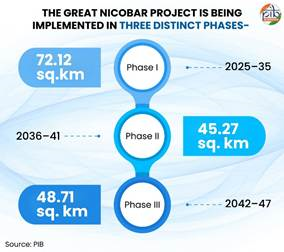
- The Great Nicobar Project seeks to transform Great Nicobar into a strategic maritime and economic hub by leveraging its proximity (about 40 nautical miles) to the East–West shipping route and reducing dependence on foreign transshipment ports keeping in view the defence and National Security purpose
- It includes major infrastructure components: a 14.2 million twenty-foot equivalent unit (MTEU) International Container Transshipment Terminal, a Greenfield International Airport (4000 Peak Hour Passengers-PHP)., a 450 MVA gas–solar power plant, and a planned township.
- The development follows a regulated environmental framework, with clearance under the EIA Notification, 2006 and ICRZ Notification, 2019, 42 compliance conditions, diversion of 1.82% of island forest cover, and compensatory afforestation planned over 97.30 sq. km.
- Tribal welfare remains central, with no displacement proposed for Shompen and Nicobarese communities and a net increase in notified tribal reserve area through re-notification measures.
-
- Geographic location: Great Nicobar is the southernmost and largest of the Nicobar Islands of India. It contains Indira Point, the absolute southernmost tip of India’s territory.
- Proximity to Choke Points: The island sits exceptionally close to the Malacca Strait, a crucial global maritime trade route connecting the Indian Ocean to the South China Sea.
- Key project pillars: The holistic project comprises an International Container Transshipment Terminal (ICTT), a military-civil dual-use international airport, a gas and solar-powered power plant, and a greenfield township.
- Ecological status: Great Nicobar was declared a Biosphere Reserve in 1989 and was included in UNESCO’s Man and the Biosphere (MAB) programme in 2013.
- Endemic Flora and Fauna: The island is home to unique species including the Nicobar Megapode (a scrub bird), the Giant Robber Crab, the Crab-eating Macaque, and Leatherback Sea Turtles.
- Indigenous tribes: The territory is the ancestral home of two primitive Mongoloid tribes: the Shompen (Particularly Vulnerable Tribal Group – PVTG) and the Nicobarese.
- Geological context: The island typography features the Campbell Bay National Park and Galathea National Park. It is highly prone to seismic activity as it lies near the Alpide-Sunda tectonic plate boundary.
- Strategic transshipment advantage: Currently, a massive portion of India’s transshipment cargo is handled at foreign ports like Colombo, Singapore, and Klang. The ICTT at Great Nicobar aims to capture this economic share.
- Environmental clearances framework: The project falls under the regulatory oversight of the Environment Impact Assessment (EIA) Notification, 2006, issued under the Environment (Protection) Act, 1986.
- Andaman and Nicobar Command (ANC): Based in Port Blair, the ANC is India’s first and only operational tri-services theater command, integrating the Army, Navy, and Air Force under a unified operational head to secure the island chain.
(IE)
Defence
Defence Investiture Ceremony 2026 (Phase-1) and Gallantry Awards Framework:
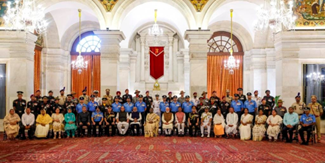
Context: The President of India conferred Gallantry Awards upon brave personnel of the Armed Forces, Central Armed Police Forces (CAPF), and state police forces during Phase-1 of the Defence Investiture Ceremony 2026 at Rashtrapati Bhavan.
-
- Constitutional authority: The President of India, as the Supreme Commander of the Armed Forces under Article 53(2) of the Constitution, formally confers all military gallantry plaques and honours.
- Classification of Awards: Gallantry awards in India are bifurcated into two categories: those for gallantry in the face of the enemy, and those for gallantry other than in the face of the enemy (peacetime awards).
- Wartime gallantry trilogy: The highest wartime awards include the Param Vir Chakra (PVC – highest), Maha Vir Chakra (MVC), and Vir Chakra (VrC), instituted on January 26, 1950, with retrospective effect from August 15, 1947.
- Peacetime gallantry trilogy: The peacetime counterparts are the Ashoka Chakra (highest peacetime gallantry award), Kirti Chakra, and Shaurya Chakra.
- Investiture venue: These awards are formally handed over during a solemn military ceremony conducted in the Darbar Hall or Ashoka Hall of the Rashtrapati Bhavan.
- Civilians eligibility: Unlike the wartime Param Vir Chakra, peacetime gallantry honours like the Ashoka Chakra, Kirti Chakra, and Shaurya Chakra can be conferred upon civilian citizens as well as military personnel.
- Posthumous Honors: Both categories of awards are frequently awarded posthumously, honouring absolute sacrifices in counter-insurgency and line-of-duty operations.
- The Selection Process: Nominations are invited twice a year by the Ministry of Defence from the Armed Forces Headquarters and the Ministry of Home Affairs (for CAPFs and police forces), which are then vetted by the Central Honours Committee.
- Order of Precedence: In the official warrant of precedence for wearing medals, the Param Vir Chakra stands at the absolute top, followed immediately by the peacetime equivalent, the Ashoka Chakra.
- Constitutional Article 18 Exemption: While Article 18 abolishes titles, the Supreme Court of India ruled in Balaji Raghavan v. UOI (1995) that National Awards and Gallantry decorations are not “titles” but recognitions of merit and thus do not violate the Article provided they are not used as prefixes or suffixes to the recipient’s name.
(PIB)
Internal Security
Launch of the Land Port Management System (LPMS):
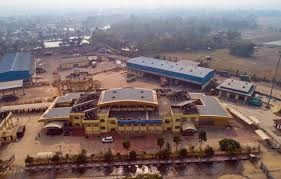
Context: The Union Home Minister launched the Land Port Management System (LPMS) in New Delhi, alongside inaugurating stakeholder accommodation facilities at the Dawki (Meghalaya) and Srimantapur (Tripura) Land Ports.
-
- Nodal Authority: The LPMS is implemented under the aegis of the Land Ports Authority of India (LPAI), which is a statutory body operating under the Department of Border Management, Ministry of Home Affairs.
- Statutory Origin: The LPAI was established under the Land Ports Authority of India Act, 2010, tasked with developing, sanitizing, and managing facilities for cross-border movement of passengers and goods.
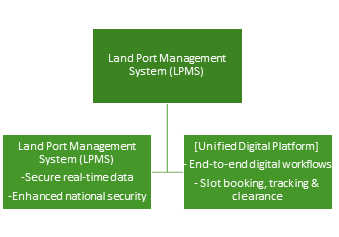
- Core Objective of LPMS: It is a state-of-the-art digital platform built to integrate operations across all functional Integrated Check Posts (ICPs) and Land Ports in India into a single cohesive system.
- Parity with Maritime/Aviation Hubs: The platform equips land ports with secure, real-time electronic exchange of logistics and regulatory information, mirroring data systems active at major international airports and seaports.
- Operational Modules: LPMS provides end-to-end digital workflows including digital slot booking for cargo trucks, electronic tracking, online payment processing, and single-window custom clearances.
- Geographic Focus – Dawki: Dawki Land Port is located in the West Jaintia Hills of Meghalaya, serving as a critical trade and transit link between India and Bangladesh.
- Srimantapur: Srimantapur Land Port is located in the Sepahijala district of Tripura, facilitating sub-regional connectivity with Bangladesh and reducing logistics costs for Northeast India.
- Smart Border Management Philosophy: The digital step shifts border infrastructure from manual verification to automated high-security systems, aligned with India’s goals for a Viksit Bharat by 2047.
- Neighbourhood First Policy: Upgrading land ports directly boosts the operational efficiency of Bangladesh-Bhutan-India-Nepal (BBIN) motor vehicle agreements and cross-border trade.
- Integrated Check Posts (ICPs): ICPs are sanitized entry/exit points on India’s international land borders that house customs, immigration, border security, and quarantine zones under one integrated facility.
(PIB)
Miscellaneous
Delhi LG Explores Induction of Ex-Agniveers into Fire Services:
Context: The Lieutenant Governor (LG) of Delhi directed the administration to explore formal institutional mechanisms to induct former Agniveers into the Delhi Fire Service to address personnel shortfalls and utilize disciplined youth.
-
- Agnipath Scheme Core: Launched in 2022, the Agnipath scheme recruits youth (called Agniveers) into the three arms of the Indian Armed Forces for a short-term period of four years.
- Retention Clause: Upon completion of the 4-year tenure, up to 25% of the Agniveers are enrolled into the regular cadre of the Armed Forces based on objective performance criteria, while the remaining 75% exit with a financial package (Seva Nidhi).
- Administrative Control over Delhi: The office of the LG of Delhi derives unique powers from Article 239AA of the Indian Constitution, inserted via the 69th Constitutional Amendment Act, 1991.
- Distribution of Powers (GNCTD vs Center): Under Article 239AA, the Legislative Assembly of Delhi can make laws on subjects in the State List and Concurrent List except three crucial matters: Public Order, Police, and Land, which remain under the direct control of the Central Government via the LG.
- Fire Services Jurisdiction: Public health, sanitation, and municipal utilities like Fire Services generally fall under the domain of local self-governments and the State list (Entry 5 of List II – Local Government / Entry 6 – Public Health).
- Seva Nidhi Package: The lumpsum terminal amount given to exiting Agniveers is a contributory fund where the individual and the Government of India match equal amounts, exempt completely from Income Tax.
- Lateral Induction Policies: The central government has historically provided reservation quotas (e.g., 10% in Central Armed Police Forces and Assam Rifles) to ease the transition of decommissioned soldiers into civilian administrative security roles.
- Sarkaria Commission Context: Administrative friction between the constitutional head (LG/Governor) and the elected Chief Minister is evaluated under the recommendations of the Sarkaria and Punchhi Commissions on Center-State relations.
- Public Employment Safeguards: Any recruitment process or lateral induction framework must comply with Article 16 of the Constitution, ensuring equality of opportunity in matters of public employment.
- National Career Service (NCS): Exiting Agniveers are integrated into the Ministry of Labour and Employment’s NCS portal to align their specialized skill sets with corporate and public enterprise requirements.
(IE)
Spread the Word