
Introduction
India’s ambitious infrastructure push in border regions reached a significant milestone as Union Minister Nitin Gadkari described the Zojila Tunnel as a “gamechanger for national security and integration.” Once completed, the tunnel will provide all-weather connectivity between Kashmir and Ladakh, overcoming one of the country’s most challenging geographical barriers.
Background: Why Zojila Matters
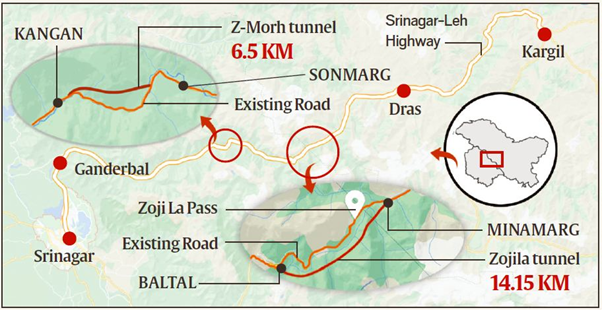
The Zojila Pass, located at an altitude of approximately 11,500 feet in the Himalayas, connects Srinagar in Kashmir with Kargil and Leh in Ladakh through National Highway-1.
Historically, this mountain pass has remained closed for nearly five to six months every year due to heavy snowfall, avalanches, and extreme weather conditions. During winter, Ladakh often becomes physically isolated from the rest of the country, creating challenges for civilian movement, trade, tourism, and military logistics.
The strategic significance of Zojila has grown substantially after:
-
- The creation of the Union Territory of Ladakh in 2019.
- Rising border tensions with China along the Line of Actual Control (LAC).
- The need for faster military mobilisation in high-altitude regions.
- Increased emphasis on border infrastructure development.
About the Zojila Tunnel Project
The Zojila Tunnel is being constructed under the Ministry of Road Transport and Highways.
Key Features
-
- Length: Approximately 13 km.
- One of Asia’s longest bi-directional road tunnels.
- Connects Baltal (Kashmir) with Minamarg (Ladakh).
- Designed to provide year-round connectivity.
- Expected to reduce travel time significantly.
- Built to withstand extreme Himalayan weather conditions.
The project is part of a larger strategy to modernise transport networks in Jammu & Kashmir and Ladakh.
Strategic Importance for National Security
1. Strengthening Military Logistics
The tunnel will enable uninterrupted movement of troops, military equipment, fuel, and essential supplies throughout the year.
Currently, winter closures often complicate logistics for forces deployed near sensitive border areas.
Year-round connectivity will:
-
- Reduce dependence on weather conditions.
- Improve operational readiness.
- Enhance rapid deployment capabilities.
- Strengthen India’s deterrence posture along both the China and Pakistan fronts.
2. Enhancing Border Infrastructure
Modern warfare increasingly depends upon logistics and infrastructure.
China has invested heavily in roads, railways, and airfields across the Tibetan Plateau. India’s accelerated infrastructure development, including the Zojila Tunnel, is aimed at narrowing this gap and improving strategic mobility in border regions.
3. Improving Disaster Response
The tunnel will facilitate faster movement of rescue teams, medical aid, and emergency supplies during natural disasters, avalanches, and extreme weather events.
4. Part of India’s Border Infrastructure Strategy
The Zojila Tunnel complements several other strategic infrastructure initiatives, including:
-
- Atal Tunnel in Himachal Pradesh.
- Sela Tunnel in Arunachal Pradesh.
- Border roads development projects.
- Advanced landing grounds and military airfields.
- Strategic bridges across border regions.
Together, these projects are reshaping India’s border infrastructure landscape.
Economic and Developmental Impact
Boost to Tourism
Ladakh has emerged as one of India’s most popular tourist destinations. However, seasonal road closures limit tourist arrivals.
All-weather connectivity can:
-
- Extend the tourism season.
- Increase tourist inflows.
- Generate local employment.
- Promote sustainable tourism activities.
Facilitating Trade and Commerce
The tunnel will improve the transportation of:
-
- Agricultural products.
- Construction materials.
- Consumer goods.
- Essential supplies.
Lower transportation costs and improved market access can significantly benefit local businesses and entrepreneurs.
Employment Generation
Large-scale infrastructure projects create direct and indirect employment opportunities during both construction and operational phases, contributing to regional economic growth.
Social Integration and Regional Connectivity
The Zojila Tunnel is expected to strengthen the social and economic integration of Ladakh with the rest of India.
Benefits include:
-
- Improved access to healthcare facilities.
- Better educational opportunities.
- Easier movement of people.
- Enhanced delivery of government services.
- Reduced isolation of remote communities.
Infrastructure development plays a critical role in ensuring inclusive growth and strengthening national integration in geographically challenging regions.
Conclusion
The Zojila Tunnel is far more than a transportation project. It represents a strategic investment in national security, economic development, and regional integration. By ensuring all-weather connectivity between Kashmir and Ladakh, the tunnel will enhance military preparedness, promote tourism and trade, improve public services, and strengthen India’s presence in a geopolitically sensitive region.
Spread the Word