Topic-1: Sports Diplomacy & Bilateral Infrastructure Cooperation
GS Paper 2: Bilateral, regional, and global groupings and agreements involving India and/or affecting India’s interests; Effect of policies and politics of developed countries on India’s institutional capacity.
GS Paper 3: Science and Technology applications in human performance; Infrastructure development; Human resource deployment and socio-economic empowerment.
Context: Building upon the 2023 Memorandum of Understanding on Cooperation in Sports, the Governments of India and Australia officially unveiled the India-Australia Roadmap for Sports Collaboration on July 10, 2026. This long-term strategic blueprint is timed to prepare for a major decade of global sporting events: the 2030 Commonwealth Games in Ahmedabad, the Brisbane 2032 Olympic and Paralympic Games, and India’s official bid to host a future edition of the Olympic Games.
Core Vertical Pillars of the Roadmap
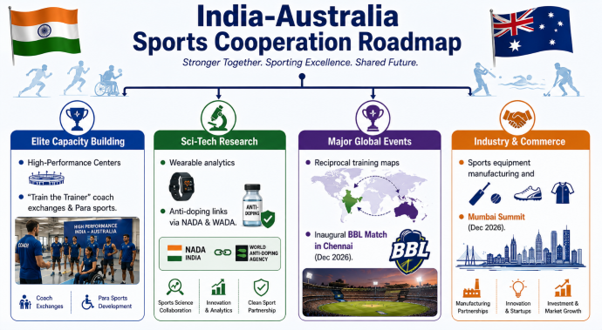
The roadmap divides its practical tasks across five key target areas designed to upgrade athletic training and boost local economic growth:
1. Capacity Building & High-Performance Ecosystems
-
- Training Hubs: Australia will share operational models to help establish and run High-Performance Sports Centres in India.
- Para Sport Integration: India will leverage Australian expertise in physical classification, coaching support, and specialized university research for Para-athletes.
- Coaching & Academic Pipelines: Introducing a “Train the Trainer” model to exchange coach educators between the two countries. The Government of India will also fund student scholarships to send talented young athletes to train at Australian high-performance institutes.
- Physical & Cultural Exchanges: Launching a school-level physical education exchange alongside a drive to promote Yogasana sports in Australia.
2. Collaborative Sports Science and Technology Research
-
- Performance Analytics: Promoting joint R&D between Indian and Australian universities focusing on athlete data analytics, injury prevention, advanced sports nutrition, and wearable health technology.
- Sport Integrity: Coordinating efforts between the National Anti-Doping Agency (NADA) India and Sport Integrity Australia to support WADA-led capacity building across the Asia/Oceania region.
3. Major Sporting Events & Bilateral Matches
-
- Reciprocal Pre-Event Training: Setting up formal pre-event training arrangements so athletes can share facilities and support networks ahead of the Commonwealth and Olympic Games.
- BBL in India: Highlighting the inaugural Big Bash League (BBL) match in Chennai (December 2026), Cricket Australia and the BCCI will work to make hosting annual BBL matches in India a regular event.
- Cultural Sports Diffusion: Promoting exhibition matches for traditional Indian sports (Kabaddi and Kho Kho) in Australia, alongside Australian Rules Football (AFL) and basketball events in India.
4. Sports Industry and Investment Platform
-
- The Mumbai Summit Baseline: Building on the Australia-funded Sports Industry Summit in Mumbai (December 2026) to drive corporate joint ventures in sports media, broadcasting, event management, and tech startups.
- Trade Integration: Expanding India’s export of competitively priced sports equipment to Australia while importing Australian expertise in strength and conditioning, athlete wellbeing, and sports psychology.
5. Women in Sports Partnership
-
- Launching joint initiatives based on the Australian Sports Commission’s flagship programs to promote women’s leadership, high-performance training, and tournament participation. The framework uses sports as a pathway for social inclusion and economic empowerment.
UPSC Prelims Fodder: Fact-Check
| Feature | Details |
| Bilateral Protocol | India-Australia Roadmap for Sports Collaboration (July 2026). |
| Major Event Anchors | 2030 Commonwealth Games (Ahmedabad) | 2032 Olympics (Brisbane). |
| Cricket Milestone | First-ever active BBL match in India to be hosted in Chennai (December 2026). |
| Corporate Engine | Sports Industry Summit scheduled in Mumbai (December 2026). |
| Integrity Nodes | Joint monitoring by NADA India and Sport Integrity Australia under WADA. |
| Traditional Sports | Pushing for the active display and growth of Kabaddi and Kho Kho in Australia. |
Conclusion:
The 2026 India-Australia Sports Roadmap expands soft-power diplomacy into a structured, technology-driven partnership. By linking Australian high-performance coaching and sports science with India’s manufacturing scale and digital public infrastructure, the framework helps India prepare its sports ecosystem to successfully host major global events like the Olympics.
Topic-2: Rural Digital Infrastructure, Grassroots E-Governance & Telecom Regulation
GS Paper 2: Important aspects of governance, transparency, and accountability; Institutional models of e-governance (TRAI, Department of Posts).
GS Paper 3: Infrastructure (Telecom Network and Digital Connectivity); Mobilization of resources; Inclusivity in the digital economy (Digital India).
Context: The Department of Posts (DoP) and the Telecom Regulatory Authority of India (TRAI) signed a landmark Memorandum of Understanding (MoU) in New Delhi to launch India’s largest village-level telecom network performance survey. The one-year project aims to systematically map and fix mobile connectivity gaps across rural India.
The Institutional Framework & Execution Model
The campaign leverages the massive physical footprint of the postal network to solve a long-standing regulatory challenge: gathering accurate, grassroots data on actual telecom service quality.
-
- The Target Canvas: The survey will audit and measure the live network performance of all four major Telecom Service Providers (TSPs)—Bharti Airtel, Reliance Jio, Vodafone Idea, and BSNL—across more than 5.68 lakh villages spanning all States and Union Territories.
- Human Resource Deployment: The project utilizes the Department of Posts’ network of over 1.40 lakh rural Branch Post Offices. The field tests will be carried out by Gramin Dak Sevaks (GDSs) during their routine daily mail and delivery operations.
- The Tech Architecture: Rather than relying on expensive tracking vehicles, GDS personnel will use a custom Android-based mobile application built by TRAI. This app runs background diagnostic tests to collect real-time data on signal strength, network latency, packet loss, and data speeds right at the consumer level.
Strategic Objectives & Policy Impact
-
- Evidence-Based Regulation: The initiative transitions TRAI from relying on self-reported TSP data to utilizing verified, independent field statistics. This strengthens its regulatory oversight and helps enforce Quality of Service (QoS) rules.
- Infrastructure Target Mapping: By pinpointing exact geographical dark spots, the government can effectively direct funding from the Universal Service Obligation Fund (USOF) / Digital Bharat Nidhi to build towers where they are needed most.
- Bridging the Digital Divide: Reliable rural connectivity supports the smooth delivery of digital public infrastructure (DPI) services, including DBT transfers, e-health platforms (Ayushman Bharat), and online education.
UPSC Prelims Fodder: Fact-Check
| Feature | Details |
| Bilateral Partners | Department of Posts (DoP) and Telecom Regulatory Authority of India (TRAI). |
| Survey Horizon Scale | Compiles field data covering over 5.68 Lakh villages nationwide. |
| Field Force Anchor | Managed on the ground by Gramin Dak Sevaks (GDSs) via rural post offices. |
| Technical Tool | Specialized Android diagnostic application designed directly by TRAI. |
| Monitored Providers | Bharti Airtel, Reliance Jio, Vodafone Idea, and BSNL. |
| Project Duration | Operationalized as a one-year intensive partnership (Launched July 2026). |
Conclusion:
The partnership between the Department of Posts and TRAI sets an excellent example of inter-departmental synergy for digital governance. By turning the daily delivery routes of Gramin Dak Sevaks into a live network testing grid, the government can gather precise data to fix rural connectivity gaps, ensuring that the benefits of Digital India reach the country’s most remote villages.
Topic-3: Intellectual Property Rights, Biopiracy Mitigation, & Indo-Australian Technical Alignment
GS Paper 2: Bilateral, regional and global groupings and agreements involving India and/or affecting India’s interests; Effect of policies of developed/developing countries on India’s sovereign resources.
GS Paper 3: Science and Technology- developments and their applications and effects in everyday life; Intellectual Property Rights (IPR) issues; Prevention of biopiracy.
Context: During the 3rd India–Australia Annual Summit held in Melbourne, the Council of Scientific and Industrial Research (CSIR) and IP Australia (the Australian Government’s intellectual property agency) officially signed a Traditional Knowledge Digital Library (TKDL) Access Agreement. The pact was concluded in the presence of Prime Minister Narendra Modi and Australian PM Anthony Albanese.
What is the Traditional Knowledge Digital Library (TKDL)?
The TKDL is a pioneering digital repository established in 2001 as a joint collaboration between the CSIR and the Ministry of AYUSH.
-
- The Core Objective: It serves as a specialized defensive patent protection tool. Its primary role is to act as documented “prior art” to prevent global biopiracy—the erroneous patenting of traditional Indian knowledge by foreign corporate entities.
- Scope of Content: The database contains scientific transcripts of over 5.2 lakh formulations and medical practices drawn from ancient Indian systems: Ayurveda, Unani, Siddha, Sowa Rigpa, and Yoga.
- Language Integration Strategy: To make the database useful for global patent officers who cannot read ancient Sanskrit or Urdu texts, the repository translates these formulations into five international languages: English, German, French, Japanese, and Spanish.
Mechanics of the India-Australia Agreement
The agreement integrates India’s defensive data directly into the Australian patent clearance workflow:
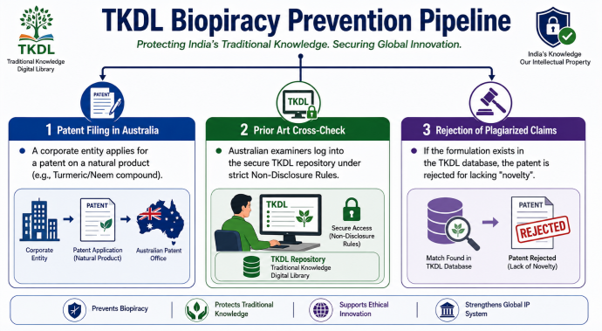
-
- Global Scale Baseline: With this signing, 18 international patent offices now hold structured, NDA-protected entry keys to the TKDL database.
- Proven Track Record: Globally, the TKDL has provided critical evidence to successfully revoke, amend, or reject more than 375 wrongful patent applications worldwide.
UPSC Prelims Fodder: Fact-Check
| Feature | Details |
| Bilateral Agreement | CSIR-TKDL and IP Australia Access Agreement (Signed July 9, 2026). |
| Summoning Diplomatic Forum | 3rd India–Australia Annual Summit, Melbourne. |
| TKDL Inception Year | 2001 (Joint initiative of CSIR and Ministry of AYUSH). |
| Global Access Footprint | 18 international patent offices now hold regulatory access. |
| Dataset Volume Scale | Contains over 5.2 lakh traditional formulations and practices. |
| Multilingual Engine | Translated into 5 international languages (Eng, Ger, Fre, Jap, Spa). |
| Administrative Overseers | Dr. N. Kalaiselvi (DG, CSIR) and Mr. Andrew Wilkinson (IP Australia). |
Conclusion:
The India-Australia TKDL agreement marks a significant victory for defensive intellectual property management in the Global South. By granting IP Australia access to over 5.2 lakh documented Indian formulations, both nations have built a robust legal barrier against biopiracy. This collaboration ensures that ancient indigenous heritage cannot be wrongfully monopolized under modern international patent laws.
Topic-4: India–New Zealand Strategic Partnership & Indo-Pacific Security Architecture
GS Paper 2: Bilateral, regional and global groupings and agreements involving India and/or affecting India’s interests; Effect of policies and politics of developed/developing countries on India’s interests.
GS Paper 3: Infrastructure (Logistics & Disaster Management); Security challenges (Maritime Domain Awareness, Counter-Terrorism, Cyber Security).
Context: During an official state visit to Auckland, the Prime Ministers of India and New Zealand officially elevated their bilateral ties to a Strategic Partnership and announced the India-New Zealand Roadmap to 2030. The four-year framework coordinates action across 10 distinct documents and 8 major announcements to align economic and maritime strategies in the Indo-Pacific.
Key Strategic and Defense Outcomes
The roadmap shifts bilateral relations toward active operational coordination in the maritime domain, guided by international maritime law ():
-
- Maritime Triad Arrangements: The two nations signed three interconnected naval agreements:
1. Memorandum of Arrangement on Maritime Cooperation: Provides a framework for intelligence sharing and joint activities.
2. Mutual Logistics Support Arrangement (MLSA): Enables reciprocal refueling, docking, and logistics support for the Indian Navy and New Zealand Defence Force during joint operations.
3. Hydrography and Nautical Cartography Agreement: Strengthens joint production of navigational charts and data sharing.
-
- Indo-Pacific Oceans Initiative (IPOI): New Zealand officially joined India’s IPOI, selecting Maritime Security as its priority pillar with a focus on combating Illegal, Unreported, and Unregulated (IUU) Fishing.
- Institutional Dialogues: Established an annual Maritime Security Dialogue alongside an active Joint Working Group (JWG) on Counter-Terrorism and a bilateral Cyber Dialogue.
Science, Education, and Disaster Resilient Infrastructure
-
- Antarctic and Polar Research: A new MoU between the National Centre for Polar and Ocean Research (NCPOR), Goa, and the University of Canterbury establishes a joint framework for deep-south polar research expeditions.
- Food Technology and Academic Mobility: The National Institute of Food Technology Entrepreneurship and Management (NIFTEM-K, Kundli) signed a research and student mobility pact with Massey University.
- Disaster Management: The National Disaster Management Authority (NDMA) India partnered with New Zealand’s National Emergency Management Agency (NEMA) to focus on earthquake resilience, tsunami preparedness, and coastal hazard mitigation.
- Maritime Heritage: The National Maritime Heritage Complex (NMHC) at Lothal, Gujarat, signed an agreement with the New Zealand Maritime Museum for joint research and historical preservation projects.
UPSC Prelims Fodder: Fact-Check
| Feature | Details |
| Diplomatic Shift | Bilateral ties officially elevated to a Strategic Partnership (July 11, 2026). |
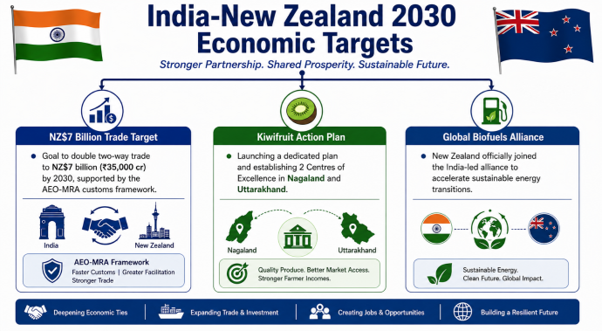
| Bilateral Trade Target | NZ$ 7 Billion (₹35,000 Crore) to be achieved by the year 2030. |
| IPOI Pillar Lead | New Zealand leads the Maritime Security pillar to combat IUU fishing. |
| Centers of Excellence | Two Kiwifruit Centres of Excellence set up in Nagaland & Uttarakhand. |
| Strategic Logistics | Signed the Mutual Logistics Support Arrangement (MLSA) for naval units. |
| Polar Research Nodes | Connects NCPOR Goa with the University of Canterbury for Antarctic studies. |
| Heritage Anchor | Connects Lothal NMHC (Gujarat) with the New Zealand Maritime Museum. |
Conclusion:
The 2026 India-New Zealand Roadmap to 2030 marks a major upgrade in India’s Act East and Indo-Pacific strategies. By combining naval logistics sharing (MLSA) with joint polar research, clean energy partnerships, and targeted agricultural projects like the Kiwifruit Action Plan, the two democracies have built a practical framework to support a rules-based order and boost economic growth across the region.
Spread the Word