Indian Polity & Governance
Three-Language Formula Controversies in School Curricula:
Context: A formal appeal was addressed to the PM by political representatives seeking a rollback of the mandatory inclusion of a third language in CBSE Classes 9 and 10, bringing the Three-Language Formula back under scrutiny.
-
- Origin: The Three-Language Formula was originally formulated in 1968 by the Ministry of Education based on the recommendations of the Kothari Commission (1964-66).
- National Education Policy (NEP) 2020 Stance: NEP 2020 recommends the continuation of the formula, but underscores that no language will be imposed on any state.
- The Core Formula Rules: It mandates the study of three languages: Mother tongue/regional language, Hindi/English, and a modern Indian or foreign language.
- Constitutional Provision on Mother Tongue: Article 350A states that it shall be the endeavour of every state to provide adequate facilities for instruction in the mother-tongue at the primary stage of education.
- Constitutional Office: Article 350B provides for the appointment of a Special Officer for Linguistic Minorities by the President to investigate matters relating to safeguards provided for them.
- Language Policy Status: Education is listed in the Concurrent List (List III) of the Seventh Schedule of the Constitution, allowing both Central and State legislation.
- Historical Shift: Education was moved from the State List to the Concurrent List via the 42nd Constitutional Amendment Act of 1976.
- CBSE Jurisdiction: The Central Board of Secondary Education (CBSE) is a national-level board of education for public and private schools, controlled and managed by the Ministry of Education.
- Article 343: This article declares Hindi in Devanagari script as the official language of the Union, while allowing the continued use of English for official purposes.
- Classical Languages: Independent of the school formula, India grants a special “Classical Language” status to languages meeting ancient historical criteria, carrying distinct academic benefits.
(IE)
Parliamentary Integration via AI Platforms:
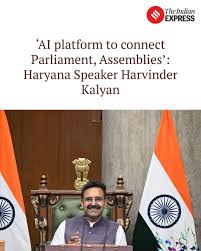
Context: The Haryana Legislative Assembly Speaker announced the deployment of a new Artificial Intelligence (AI) platform built to inter-link operations between the Union Parliament and State Legislative Assemblies.
-
- National e-Vidhan Application (NeVA): This AI initiative builds directly upon NeVA, a Mission Mode Project under the Digital India Programme.
- Nodal Ministry: The Ministry of Parliamentary Affairs is the nodal ministry supervising the deployment of such electronic/AI infrastructure across state legislatures.
- Constitutional Basis: Article 208 empowers a State Legislature to make rules for regulating its procedure and the conduct of its business, which now accommodates digital transitions.
- Paperless Concept: The objective is to convert all legislative assemblies into “Paperless” or “e-Assemblies,” streamlining digital access to bills, responses, and committee reports.
- Funding Model for NeVA: The financial assistance for implementing digital frameworks is shared 60:40 between the Centre and States, and 90:10 for Northeast/Himalayan regions.
- Data Processing Capability: The integrated AI platform utilizes Natural Language Processing (NLP) to transcribe speeches, process queries, and analyse legislative text in real-time across regional languages.
- Eighth Schedule Integration: The AI engines are programmed to support translations across languages recognized under the Eighth Schedule of the Indian Constitution.
- Public Access: One of the core tenets is to enhance citizen-legislator engagement, promoting transparency under the principles of responsive governance.
- First Digital Assembly: Nagaland became the first State Assembly in India to implement the National e-Vidhan Application (NeVA) completely paperless.
- Data Privacy: Secure frameworks are mandatory to safely host sovereign legislative data inside localized servers managed by the National Informatics Centre (NIC).
(IE)
Indian Society & Social Justice
Social Infrastructure Deficits Affecting Female Education:
Context: A detailed multi-district assessment report from Odisha highlighted that nearly 74% of school-going girls face recurring absenteeism due to lack of sanitation infrastructure, dedicated toilets, and privacy in schools during menstruation.
-
- Constitutional right: Education is a Fundamental Right under Article 21A of the Constitution, ensuring free and compulsory education for children aged 6 to 14 years.
- Right to Education (RTE) Act, 2009: Schedule 1 of the RTE Act mandates the provision of separate, functional toilets for girls and boys in every school facility.
- Sustainable Development Goals (SDG): This crisis intersects directly with SDG 4 (Quality Education), SDG 5 (Gender Equality), and SDG 6 (Clean Water and Sanitation).
- Swachh Vidyalaya Initiative: Launched under the broader Swachh Bharat Mission, its specific mandate is to ensure that every school in India has a set of functioning toilets with running water.
- Menstrual Hygiene Scheme (MHS): Administered by the Ministry of Health and Family Welfare, the scheme aims to promote menstrual hygiene among adolescent girls (10-19 years) in rural areas through subsidized sanitary napkins.
- National Family Health Survey (NFHS-5) Data: Nationally, NFHS-5 data shows a positive trend in the use of hygienic methods of protection among young women, though critical implementation gaps remain in rural pockets.
- Primary Drops-Out interrelation: Studies by UNESCO indicate that the absence of structured Menstrual Hygiene Management (MHM) is a primary driver of female school dropouts at the secondary level.
- Jal Jeevan Mission (JJM) Component: JJM actively complements school infrastructure by prioritizing tap water connections to all schools and Anganwadi centres across India.
- Socio-Economic Impact: Improving school infrastructure directly improves the Gross Enrolment Ratio (GER) for girls at the upper primary and secondary school levels.
- State-level Interventions: State governments are empowered to utilize funds from the Samagra Shiksha Abhiyan framework to bridge infrastructure and sanitation gaps in government schools.
(TH)
Economy
Domestic LPG Price Hike and Global Fuel Metrics:
Context: Following a domestic hike of ₹29 per cylinder for Liquefied Petroleum Gas (LPG), the central government issued data clarifying that Indian households still access among the lowest retail cooking gas prices globally despite international disruptions.
-
- LPG Composition: LPG is a flammable mixture of hydrocarbon gases, primarily containing propane and butane, stored under pressure as a liquid.
- Pricing mechanism: Domestic LPG prices in India are determined based on the Import Parity Price (IPP) formula, which mirrors international product prices (specifically Saudi Aramco’s contract price).
- Key Components of IPP: IPP includes international FOB price, ocean freight, insurance, custom duties, and port charges.
- Pradhan Mantri Ujjwala Yojana (PMUY): Launched in 2016 by the Ministry of Petroleum and Natural Gas, it provides deposit-free LPG connections to women from below-poverty-line (BPL) households.
- Subsidy Delivery: Subsidies under PMUY are credited directly to the beneficiary’s bank account via the PAHAL scheme using Direct Benefit Transfer (DBTL).
- World Largest Subsidized Program: PAHAL entered the Guinness Book of World Records as the world’s largest direct benefit transfer scheme.
- Taxation: Domestic LPG attracts a Goods and Services Tax (GST) rate of 5%, whereas commercial LPG is taxed under a higher slab.
- Import Vulnerability: India imports more than 55% of its total domestic consumption of LPG, primarily from Middle Eastern countries.
- Environmental Context: Shifting from traditional biomass cooking to LPG reduces Black Carbon emissions, a short-lived climate pollutant with potent global warming potential.
- Administered Pricing System: While petrol and diesel are market-deregulated, LPG prices retain targeted fiscal interventions and subsidies via state-owned Oil Marketing Companies (OMCs).
(TH)
Science & Technology
Astro-Climatic Heritage via 100 Years of Solar Data:
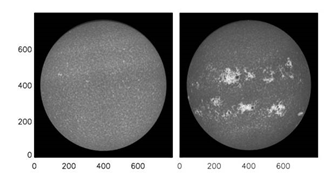
Context: The Department of Science and Technology highlighted findings derived from a century-long compilation of solar data (100 years of solar observations), tracing new clues regarding how the Sun’s surface tracks its 11-Year Activity Cycle.
-
- Solar Cycle Duration: The solar cycle is a periodic change in the Sun’s activity, measured from one minimum to the next, averaging approximately 11 years.
- Schwabe Cycle: The 11-year solar cycle is also scientifically referred to as the Schwabe Cycle, named after Heinrich Schwabe, who discovered it.
- Sunspots: These are temporary phenomena on the Sun’s photosphere that appear as dark spots compared to surrounding areas. They are caused by intense magnetic field concentrations that inhibit convection.
- Solar Maximum vs. Minimum: During Solar Maximum, the number of sunspots increases dramatically, leading to higher solar radiation and coronal mass ejections (CMEs).
- Kodaikanal Solar Observatory (KSO): In India, the KSO (managed by the Indian Institute of Astrophysics) has been a premier historical repository tracking solar data for over a century.
- Space Weather Disruptions: High solar activity alters Earth’s ionosphere, potentially disrupting satellite communications, Global Positioning Systems (GPS), and power grids.
- Aditya-L1 Mission: India’s maiden dedicated scientific mission to study the Sun, placed in a halo orbit around the Lagrangian Point 1 (L1) of the Sun-Earth system.
- L1 Point Advantage: A satellite placed in the halo orbit around the L1 point has the major advantage of continuously viewing the Sun without any occultation or eclipses.
- Solar Wind: This is a continuous stream of charged particles (plasma) consisting chiefly of electrons and protons flowing outward from the Sun’s corona into space.
- Maunder Minimum: A historical period (roughly 1645 to 1715) where sunspots became exceedingly rare, coinciding with a period of lower temperatures on Earth known as the “Little Ice Age.”
(PIB)
Internal Security
Launch of the Land Port Management System (LPMS):
Context: The Union Home Minister and Minister of Cooperation announced the scheduled institutional launch of the advanced Land Port Management System (LPMS) in New Delhi to digitize cross-border trade operations.
-
- Purpose: The LPMS is an integrated digital platform designed to streamline operations, cargo tracking, and passenger movement across India’s international land borders.
- Implementing Authority: It is deployed under the aegis of the Land Ports Authority of India (LPAI), a statutory body under the Ministry of Home Affairs.
- LPAI Act: LPAI was established under the Land Ports Authority of India Act, 2010 to build, modify, and manage cross-border cargo and passenger facilities.
- Integrated Check Posts (ICPs): LPAI manages ICPs, which are sanitized zones at international borders handling customs, immigration, and border security under one roof.
- Key trading partners: India’s land ports primarily facilitate trade and transit with Bangladesh, Nepal, Bhutan, Myanmar, and Pakistan.
- Trade Facilitation Agreement (TFA): This digitalization aligns with the World Trade Organization’s (WTO) TFA, to which India is a signatory, aiming to expedite the movement, release, and clearance of goods.
- Security integration: LPMS integrates with border guarding forces like the Border Security Force (BSF) and Sashastra Seema Bal (SSB) to maintain robust electronic oversight.
- Single-Window Clearance: It aims to reduce the “Time Release” metric of cargo clearance by providing a single-window interface for regulatory authorities.
- Land Border Extent: India shares land borders with seven countries spanning over 15,106.7 km, making organized cross-border trade mechanisms essential.
- Economic Multiplier: Efficient land ports reduce logistical costs, helping India improve its ranking in the World Bank’s Logistics Performance Index (LPI).
(PIB)
Government Schemes & Initiatives
Implementation of Ayushman Bharat (PM-JAY) in West Bengal:
Context: The Union Ministry of Health and Family Welfare announced that West Bengal is set to become the 36th State/UT to implement the Ayushman Bharat Pradhan Mantri Jan Arogya Yojana (AB-PMJAY), marking complete pan-India coverage of the scheme.
-
- Core objective: AB-PMJAY is the world’s largest government-funded health assurance scheme, aiming to provide a health cover of ₹5 lakh per family per year.
- Type of Facility: It covers secondary and tertiary care hospitalization across both public and empanelled private hospitals in India.
- Target beneficiaries: It covers over 12 crore poor and vulnerable families (approx. 55 crore beneficiaries) identified via the Socio-Economic Caste Census (SECC) 2011 database under occupational and deprivation criteria.
- Funding pattern: The funding is shared between the Central and State governments in a 60:40 ratio for normal states, 90:10 for Northeastern and Himalayan states, and 100% central funding for UTs without legislatures.
- No Caps: There is no restriction on family size, age, or gender, preventing any discrimination or exclusion.
- Pre-existing Conditions: All pre-existing medical conditions are covered from Day 1 of the policy implementation.
- Cashless & Paperless: Benefits under the scheme are completely cashless and paperless at the point of service delivery across the nation.
- National Portability: A beneficiary registered in one state can receive treatment in any empanelled hospital anywhere across India.
- Nodal Agency: The National Health Authority (NHA), an attached office of the Ministry of Health and Family Welfare, is responsible for its implementation at the national level.
- State-Level Structure: At the state level, State Health Agencies (SHAs) direct the implementation through trust, insurance, or mixed models.
(PIB)
Organisations in news
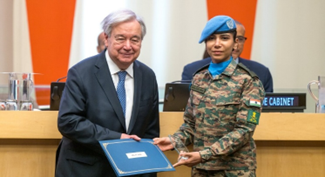
UN Military Gender Advocate Award to Major Abhilasha Barak:
Context: Major Abhilasha Barak is recognized with the prestigious United Nations Military Gender Advocate of the Year Award, highlighting India’s expanding role in global peacekeeping equity.
-
- Award purpose: Created in 2016, the UN Military Gender Advocate of the Year Award honours the dedication and effort of an individual military peacekeeper in promoting the principles of UN Security Council Resolution 1325.
- UNSCR 1325: Adopted in the year 2000, this landmark resolution focuses on Women, Peace, and Security (WPS), urging increased participation of women in UN peace operations.
- Historical Milestones: Major Abhilasha Barak had previously made history in 2022 by becoming the Indian Army’s first woman combat aviator after joining the Army Aviation Corps.
- India’s Contribution to UNPKF: India is historically one of the largest cumulative troop and police contributors to the United Nations Peacekeeping Forces (UNPKF).
- All-Female Unit Legacy: In 2007, India became the first country to deploy an all-female Formed Police Unit (FPU) for a UN peacekeeping mission, stationed in Liberia.
- Blue Helmets: UN Peacekeepers are universally known as “Blue Helmets” due to their distinctive headgear.
- UN Peacekeeping Principles: Peacekeeping operations operate under three basic principles: consent of the parties, impartiality, and non-use of force except in self-defence and defence of the mandate.
- Funding body: The budget for UN Peacekeeping operations is distinct from the UN regular budget, decided via an assessed scale of contributions by the UN General Assembly.
- Department in Charge: UN Peacekeeping is managed at the UN Secretariat level by the Department of Peace Operations (DPO).
- Constitutional Alignment: Active participation in international peacekeeping furthers the directive under Article 51 of the Indian Constitution (Directive Principles of State Policy), which commands the State to foster international peace and security.
(TH)
Spread the Word