
Introduction
India has completed a paradigm shift in environmental governance, moving away from fragmented conservation toward a unified, lifecycle ecosystem strategy guided by the principles of Vishwaas (trust in nature’s recovery), Nirman (building resilient green assets), and Jan Kalyaan (public welfare via ecological safety).
Key Points
-
- Macro Environment Matrix: India’s forest and tree cover spans 8.27 lakh sq. km (25.17% of total geography), storing an absolute 30.43 billion tonnes of carbon stock.
- River Rejuvenation Capital: The Namami Gange Programme has sanctioned 524 hydro-infrastructure projects worth ₹43,030 crore, adding 6,610 MLD of sewage treatment capacity.
- Wetland Preservation Scale: India’s recognized Ramsar sites expanded nearly fourfold, rising from 26 in 2014 to 99 wetlands by April 2026.
- Sovereign Waste Re-engineering: Municipal solid waste processing capacity surged from 17% in 2014 to over 77%, backed by mandatory rules on four-stream source segregation.
- Target-Ahead Climate Leadership: India met its initial Paris Agreement emissions intensity reduction and non-fossil fuel electricity capacity targets years ahead of the 2030 deadline.
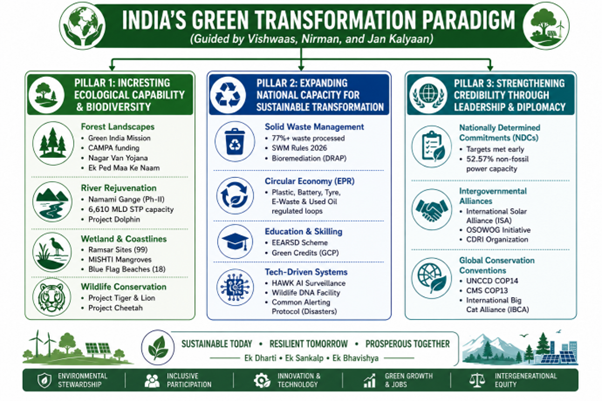
Pillar 1: Increasing Ecological Capability and Biodiversity
Ecological capability underpins a nation’s capacity to absorb climate shocks, recharge natural resources, and preserve vital biological loops.
1. Forest Landscapes and the Carbon Sink Grid
-
- The Strategic Reserve: Administered via the Green India Mission (GIM), forest cover stands at 7.15 lakh sq. km (21.76%) and tree cover at 1.12 lakh sq. km (3.41%). GIM has deployed ₹1,019.26 crore to maximize carbon sequestration.
- Statutory Afforestation Rails: Operating under the Compensatory Afforestation Fund Act, 2016, CAMPA funded more than 3.20 lakh hectares of afforestation between FY 21 and FY 25, utilizing GIS tracking, digital annual plans, and the HARIT-SANKALP enforcement dashboard.
- Nagar Van & Green Walls: The Nagar Van Yojana has deployed ₹557.62 crore to build 626 urban forests. Concurrently, the Aravalli Green Wall Initiative targets the ecological restoration of 6.31 million hectares across Gujarat, Rajasthan, Haryana, and Delhi.
- Ek Ped Maa Ke Naam: Launched in 2024, this public movement resulted in planting 262.4 crore saplings by December 2025, with performance metrics mapped via the Meri LiFE portal.
2. Basin-Wide Rejuvenation: The Namami Gange Framework
The Namami Gange Programme integrates urban sewage infrastructure with ecosystem restoration across the Ganga basin. Extended under Phase-II with an added ₹22,500 crore outlay, its structural metrics include:
-
- Sewerage Infrastructures: Deployed 218 treatment projects to intercept municipal waste, rendering 138 STPs fully operational.
- Industrial Containment: Successfully dropped the industrial Biochemical Oxygen Demand (BOD) load from 26 TPD in 2017 to 10.75 TPD.
- Biological Indicators: Released 203 lakh Indian Major Carp fingerlings. Range-wide assessments under Project Dolphin recorded 6,327 Gangetic dolphins and 3,037 gharials, utilizing standardized population tracking models.
3. Wetland and Marine Frontier Conservation
-
- The Ramsar Expansion: Guided by the National Plan for Conservation of Aquatic Ecosystems (NPCA) and the Wetlands Rules, 2017, central allocations grew to ₹1,088.85 crore, expanding the country’s Ramsar network to 99 sites.
- MISHTI Scheme Coverages: Focused on shoreline protection, the scheme has expanded mangrove cover to 4,992 sq. km, creating a buffer against cyclones and storm surges.
- Maritime Certification Systems: Under the National Coastal Mission and CRZ Notification 2019, India expanded its eco-labeled beach portfolio to 18 Blue Flag certified sites. This is balanced by the National Marine Turtle Action Plan to protect vulnerable nesting beaches.
Pillar 2: Expanding National Capacity for Sustainable Transformation
1. Re-Engineering Solid Waste into Circular Resources
Municipal waste processing surged from a low 17% in 2014 to 77%, processing 1,29,206 TPD of daily urban output.
-
- The Solid Waste Management Rules, 2026: Replaces old guidelines to mandate four-stream source segregation (wet, dry, sanitary, and special care waste) backed by real-time online tracking.
- Extended Bulk Waste Generator Responsibility (EBWGR): Holds large commercial establishments directly accountable for the 30% of municipal waste they generate. It enforces a mandatory increase in substituting solid fuels with Refuse Derived Fuel (RDF) from 5% to 15% across cement kilns.
- Dumpsite Remediation Accelerator Programme (DRAP): Targets clearing legacy waste across 1,048 cities via biomining, aiming for zero dumpsites.
2. Institutionalizing Extended Producer Responsibility (EPR)
India closed its industrial manufacturing loop by implementing sector-specific EPR frameworks across five core waste streams:
| Waste Stream Vertical | Active Recyclers Enrolled | Documented Volume Processed |
| Plastic Waste Grid | 2,986 Recyclers | 196.97 Lakh MT |
| Tyre Waste System | 579 Recyclers | 122.29 Lakh MT |
| Battery Waste Loop | 520 Recyclers | 69.37 Lakh MT |
| Electronic Waste (E-Waste) | 386 Recyclers | 28.75 Lakh MT |
| Used Industrial Oils | 103 Recyclers | 0.19 Lakh MT |
3. Advanced Conservation Technology & Disaster Resiliency
-
- Enforcement Technologies: Deployed AI-driven surveillance modules like HAWK for predictive anti-poaching analysis, the Gajah Suchana tracking system, and Next-Gen DNA Sequencing facilities at WII Dehradun to curb wildlife trafficking.
- Early Warning Frameworks: Implemented the Common Alerting Protocol (CAP) to deliver 4,500 crore geo-targeted warning messages alongside automated tracking of 28,000 glacial lakes in the Himalayan rim.
- The Green Credit Programme (GCP): Operationalized a market-linked mechanism under the Green Credit Rules, 2023, allocating 4,391 hectares of degraded forest land for commercial eco-restoration.
Pillar 3: Strengthening Credibility Through Climate Diplomacy
By sticking to the principle of Common but Differentiated Responsibilities (CBDR), India converted its domestic environmental targets into global diplomatic leverage:
-
- The NDC Scaling (1.0 to 3.0): India reduced its emissions intensity by over 36% from 2005 levels, meeting its primary Paris Accord goals 11 years ahead of schedule. Non-fossil sources now command 52.57% of installed power capacity.
- International Solar Alliance (ISA): Launched with France, this treaty-based body has expanded to 112 member countries, serving as an institutional vehicle to scale green energy financing in solar-rich regions.
- G20 Green Development Pact: Championed during India’s G20 Presidency to establish a global consensus on circular economy approaches and sustainable lifestyles.
- Mission LiFE (Lifestyle for Environment): Anchors behavioral change protocols within international climate texts, including the COP27 Sharm El Sheikh Implementation Plan.
- International Big Cat Alliance (IBCA): Established as a treaty-based intergovernmental organization in 2025 to transfer India’s field experience in apex predator conservation to 26 member countries across Asia, Africa, and Latin America.
- The OSOWOG & CDRI Networks: Promotes cross-border clean power sharing via One Sun One World One Grid and global infrastructure insulation through the Coalition for Disaster Resilient Infrastructure, headquartered in New Delhi.
Challenges
-
- The Hindu (The Solar Aquifer Depletion Paradox): Editorial analyses in The Hindu highlight that while initiatives like the Green Grids OSOWOG and PM-KUSUM expand solar energy penetration, providing zero-marginal-cost solar power to rural aquifers has unintentionally accelerated ground-water extraction, demonstrating that carbon mitigation can clash with water table preservation if unmetered.
-
- Indian Express (The EPR Leakage and Biomining Bottlenecks): Structural critiques in the Indian Express note that despite registering 4,574 recyclers, secondary markets for EPR trading remain illiquid and prone to certificate manipulation. Furthermore, regional municipal bodies lack the technical capacity to scale legacy waste processing under the DRAP timelines without turning to landfill expansions.
- ORF (The Phytosanitary-Extension Disconnect): Policy papers from the Observer Research Foundation (ORF) emphasize that while India shapes global biodiversity platforms (like CMS COP-13 or the IBCA), a gap exists between international standard alignments and local implementations. For example, high pesticide use on domestic crops causes export rejections under Western phytosanitary guidelines, revealing a disconnect between top-tier diplomacy and first-mile agricultural practices.
Way Forward
-
- Linking Green Credits to the ULI Framework: Integrating the Green Credit Programme with the Unified Lending Interface (ULI) to enable automated, low-interest ESG credit lines for industries achieving zero-waste targets.
- Volumetric Aquifer Metering for Solar Irrigation: Implementing smart IoT-based flow sensors on solar pumps to match clean energy utilization with groundwater recharge cycles.
- Standardizing Digital Recycling Registries: Upgrading the IBBI and Central Pollution Control Board digital portals to automate EPR certificate trading, preventing double-counting and fraud.
- Expanding IBCA Tech Transfers: Utilizing the International Big Cat Alliance to export India’s AI-driven HAWK anti-poaching software to developing range nations.
Conclusion
India’s green transformation highlights how a country can align domestic development with global environmental sustainability. By pairing large-scale ecological restorations like Namami Gange with rigorous circular rules like the 2026 Waste Management Guidelines and international initiatives like the International Solar Alliance, the state has built a resilient eco-system.
Spread the Word