Topic-1: Fiscal Decentralisation & Data Architecture for State Finance Commissions
GS Paper 2: Appointment to various Constitutional posts, powers, functions and responsibilities of various Constitutional Bodies; Devolution of powers and finances up to local levels and challenges therein; Important aspects of governance, transparency, and accountability.
GS Paper 3: Indian Economy and issues relating to planning, mobilization of resources, growth, development, and employment; Data-driven policymaking.
Context: The Ministry of Panchayati Raj is scheduled to release the definitive “Report of the Committee on Datasets for State Finance Commissions” on 8th June 2026 in New Delhi. The report will be unveiled by Dr. V. Anantha Nageswaran, Chief Economic Advisor (CEA) to the Government of India.
Constitutional Mandate of State Finance Commissions (SFCs)
The operational framework of local self-government (Panchayati Raj Institutions and Urban Local Bodies) relies heavily on fiscal federalism handled at the sub-national level:
-
- Constitutional Backing: Under Article 243-I (and Article 243-Y for municipalities) of the Constitution of India, the Governor of a State must constitute a State Finance Commission at regular intervals of every five years.
- Core Mandate: SFCs are the apex constitutional bodies tasked with reviewing the baseline financial health of Panchayats and recommending the structural principles that govern:
- The net distribution of taxes, duties, tolls, and fees leviable by the State between the State administration and the local bodies.
- The allocation of grants-in-aid to the Panchayats from the Consolidated Fund of the State.
- Measures needed to improve the overall financial position of the Panchayats.
The Genesis: Resolving the Local Fiscal Data Gap
The creation of this specialized committee stems from long-standing functional hurdles in sub-national devolution:
-
- The November 2024 Catalyst: During the Finance Commissions’ Conclave on Devolution to Development held under the leadership of the Chairman of the Sixteenth Finance Commission (16th FC), a critical administrative gap was identified.
- The Structural Bottleneck: It was established that SFCs across India routinely faced severe difficulties in accessing comprehensive, clean, and reliable datasets split across different state departments and parastatal agencies. This data asymmetry directly degraded the precision, rigour, and execution timelines of SFC recommendations.
- Institutional Collaboration: In response, the Ministry of Panchayati Raj constituted a dedicated committee to standardize the data ecosystem, working in tandem with fiscal research bodies like the National Institute of Public Finance and Policy (NIPFP).
Framework of the Report: Building an Evidence Base
The report moves away from speculative resource allocation by introducing a structured, mandatory mapping of essential data points required by SFCs to perform their audits:
-
- Standardisation and Interoperability: The report lays down clear benchmarks to ensure financial data formats are uniform across different line departments, making it easier for automated tools to ingest and analyze fiscal metrics.
-
- Data-Driven Local Governance: By providing actionable blueprints to improve data availability, the framework builds a solid foundation for evidence-based fiscal governance. This ensures that funds are distributed based on verified local needs rather than arbitrary political decisions.
- Institutional Capacity Building: It provides recommendations to upgrade the technical skills of rural local body accountants and district statistical offices, ensuring real-time entry of local public finance metrics.
UPSC Prelims Fodder: Fact-Check
| Feature | Details |
| Report Title | Report of the Committee on Datasets for State Finance Commissions. |
| Nodal Ministry | Ministry of Panchayati Raj (MoPR). |
| Release Dignitary | Dr. V. Anantha Nageswaran (Chief Economic Advisor). |
| Constitutional Node | Article 243-I (Panchayats) and Article 243-Y (Municipalities). |
| Research Partner | National Institute of Public Finance and Policy (NIPFP). |
| Origin Point | Finance Commissions’ Conclave on Devolution to Development (Nov 2024). |
Conclusion:
The release of this committee report acts as a vital step in strengthening the financial foundation of local self-governments across India. By systematically organizing the raw data feeds needed by State Finance Commissions, the Ministry of Panchayati Raj is correcting a structural flaw that has long slowed down genuine fiscal decentralisation.
Topic-2: E-Governance Reforms in Consumer Justice Delivery
GS Paper 2: Government policies and interventions for development in various sectors and issues arising out of their design and implementation; Important aspects of governance, transparency, and accountability, e-governance- applications, models, successes, limitations, and potential.
GS Paper 3: Science and Technology- developments and their applications in everyday life (Artificial Intelligence & Digital Infrastructure).
Context: The Department of Consumer Affairs’ flagship e-Jagriti portal has been awarded the prestigious Silver Award at the National Awards for e-Governance (NAeG) 2026. The award was presented under Category I – Government Process Re-engineering by Use of Technology for Digital Transformation, out of 341 central and state nominations.
Institutional Consolidation via e-Jagriti
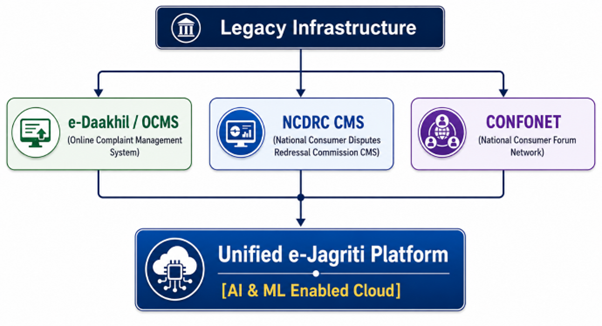
Launched on 1 January 2025, e-Jagriti solved the long-standing problem of judicial fragmentation by merging four separate legacy applications into a single, seamless, and paperless platform:
-
- The Consolidated Core: The portal unifies the Online Complaint Management System (OCMS), e-Daakhil (online case filing), the National Consumer Disputes Redressal Commission Case Management System (NCDRC CMS), and the legacy CONFONET network.
-
- Macro Disposal Telemetry: Since its launch, the unified system has registered 4,15,365 users and processed the filing of 2,29,174 cases. With 2,07,997 cases successfully resolved, the platform maintains an overall lifetime disposal rate of 90.75%.
Performance Upgrades & Virtual Courts (FY 2025-26)
The implementation of e-Jagriti sparked a noticeable increase in performance metrics across national, state, and district consumer forums:
-
- Efficiency Gains: During FY 2025-26, the annual disposal rate climbed to 92.30% (1,52,707 cases resolved out of 1,65,456 filings), up from 89.47% in the previous fiscal year.
- Exceeding the 100% Disposal Threshold: Multiple state commissions cleared their backlogs so efficiently that their annual disposal rates crossed 100%. These top-performing benches include the NCDRC apex bench, Uttarakhand, Chhattisgarh, Chandigarh, Madhya Pradesh, Punjab, Meghalaya, Rajasthan, Karnataka, and Arunachal Pradesh.
- The Shift to Hybrid Video Conferencing: Virtual hearings are now the default mode across all NCDRC benches and 35 State Commissions.
| Virtual Court Indicators | FY 2024-25 Baseline | FY 2025-26 Achievements |
|---|---|---|
| Cases Handled via Video Conf. | 14,494 | 30,683 |
| Total Virtual Hearings Conducted | 24,181 | 87,083 |
| Final Disposals via Virtual Mode | 1,587 | 4,941 |
Tech Architecture & Global Diaspora Reach
1. Core Technical Components
The e-Jagriti system removes physical bottlenecks through an array of automated, user-friendly tools:
-
- AI-Enabled Infrastructure: Uses built-in voice-to-text functionality for easier dictation, automated AI chatbot support, and machine learning models to help organize and triage incoming filings.
- Integrated Payment Gateways: Connects directly with national digital payment architectures like Bharat Kosh, PayGov, and SBI ePay for quick fee processing.
- Proactive Alerts: The system scales up communications, executing over 19.7 lakh automated SMS notifications and boosting email alerts from 1.98 lakh to over 37.3 lakh to keep litigants updated in real time.
2. Serving the Non-Resident Indian (NRI) Diaspora
The platform features an open, OTP-based global onboarding system that allows non-resident citizens to seek justice against domestic consumer fraud without traveling back to India.
The system has registered 3,312 NRI users, logged 751 international complaints, and already finalized the disposal of 61 complex diaspora disputes.
-
- Top Five NRI Complaint Nodes:
1. USA: 234 cases
2. UK: 82 cases
3. UAE: 77 cases
4. Canada: 58 cases
5. Germany: 39 cases
UPSC Prelims Fodder: Fact-Check
| Feature | Details |
| Platform Name | e-Jagriti (Unified Consumer Grievance Portal). |
| Parent Ministry | Ministry of Consumer Affairs, Food & Public Distribution. |
| E-Gov Honor | Silver Award (Category I) at NAeG 2026. |
| Unified Systems | Merged e-Daakhil, OCMS, NCDRC CMS, and CONFONET. |
| Lifetime Disposal | Sitting at a strong 90.75% milestone. |
| Payment Nodes | Bharat Kosh, PayGov, and SBI ePay. |
Conclusion:
The e-Jagriti portal demonstrates how technology can successfully modernize traditional legal processes. By merging isolated legacy databases into a single, AI-powered system, the Department of Consumer Affairs has lowered structural barriers, increased case resolution speeds, and extended access to the global Indian diaspora.
Spread the Word