
Indian Polity & Governance
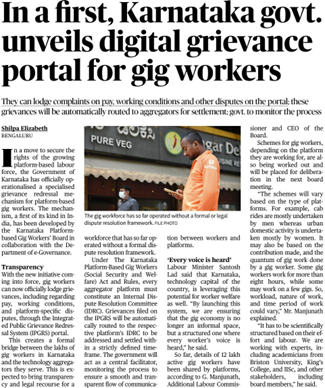
Karnataka’s Gig Worker Grievance Portal:
Context: Karnataka notified India’s first Gig Worker Grievance Portal under the 2025 Act to protect platform-based workers.
-
- Complaints must be resolved within 15 to 45 days by the Industrial Dispute Resolution Council (IDRC).
- The portal is governed by the Karnataka Platform-Based Gig Workers Welfare Board.
- It addresses the “Worker Classification” ambiguity where platforms treat workers as “partners” rather than employees.
- The 2025 Act aims to provide social security benefits like health and accidental insurance.
- A 1% welfare fee on platform transactions is often used to fund these welfare boards.
- The scheme introduces Unique Worker IDs to ensure benefits are portable across different platforms.
- It is a pioneering state-level move as a comprehensive national legal framework is still pending.
- Digital literacy and awareness remain challenges for the effective rollout of these portals.
- The move balances digital innovation with the protection of labor rights in the gig economy.
- Other states are expected to follow this model for their respective informal workforces.
(TH)
Citizenship (Amendment) Rules, 2026 & e-OCI Cards:
Context: The Union Home Ministry notified the Citizenship (Amendment) Rules, 2026, introducing electronic Overseas Citizen of India (e-OCI) cards.
-
- The rules allow for the issuance of e-OCI cards alongside physical ones for easier verification.
- A new proviso mandates that minors holding Indian passports cannot simultaneously possess foreign passports.
- This update aims to address long-standing concerns over dual citizenship misuse among minors.
- All applications for OCI registration must now be made electronically via Form XXVIII.
- The shift to e-OCI is part of the government’s Digital India initiative for seamless consular services.
- OCI status is a “lifetime visa” and does not grant the right to vote or hold public office.
- Electronic cards will have enhanced security features like encrypted QR codes.
- The rules streamline the renewal process, which was previously a pain point for OCI holders.
- The government aims for a paperless identity ecosystem for the Indian diaspora.
- These changes reflect a move toward stricter adherence to the single citizenship principle.
(ET)
International Relations
India-ASEAN Review of Trade in Goods Agreement (AITIGA):
Context: Prime Minister Modi announced that India and ASEAN aim to conclude the review of the ASEAN-India Trade in Goods Agreement (AITIGA) by the end of 2026 to make it more modern and user-friendly.
-
- AITIGA was originally signed in 2009 and came into effect in January 2010.
- The review seeks to address the widening trade deficit India has with ASEAN nations.
- Key focus areas include simplifying Rules of Origin (RoO) and removing non-tariff barriers.
- It aims to prevent the “re-routing” of Chinese goods through ASEAN countries into India.
- Trade between India and ASEAN grew to over $130 billion in recent years.
- The review covers trade facilitation, sanitary and phytosanitary (SPS) measures, and technical barriers to trade (TBT).
- Modernizing the pact is seen as essential for India’s Act East Policy and supply chain resilience.
- ASEAN is India’s fourth-largest trading partner, making this review economically vital.
- The goal is to create a more balanced and equitable trade partnership.
- Regular Joint Committee meetings are monitoring the progress of these negotiations.
(IE)
Economy
Priority Sector Lending (PSL) Framework Review:
Context: The Economic Advisory Council to the PM (EAC-PM) released a working paper highlighting structural issues in the current Priority Sector Lending (PSL) framework.
-
- The paper argues that the PSL mandate of 40% of Adjusted Net Bank Credit (ANBC) may lead to misallocation.
- It highlights that over-lending to certain segments may create credit bubbles.
- PSL targets were originally designed to ensure flow of credit to sectors like Agriculture, MSMEs, and Education.
- EAC-PM suggests moving toward a more market-linked and outcome-based credit system.
- The current framework does not distinguish between credit-hungry regions and credit-saturated ones.
- Rising NPAs in priority segments like micro-finance and small loans is a major concern.
- The paper recommends regular revision of sectoral caps based on economic cycles.
- Digital lending and fintechs should be better integrated into the PSL ecosystem.
- Ensuring “credit quality” is as important as achieving “credit quantity.”
- The findings could lead to a major overhaul of RBI’s PSL guidelines in the next fiscal year.
(PIB)
Geography, Mapping, Ecology & Environment and DM
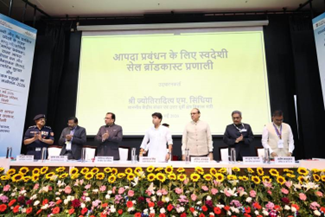
Cell Broadcast System (CBS): Multi-Hazard Warning Tool:
Context: A successful nationwide test of the Cell Broadcast System (CBS) following its full rollout.
-
- CBS allows authorities to send instant, geo-targeted alerts to all mobile phones in a specific area.
- It does not require a data connection or a functional internet—it works on telecom radio signals.
- The system is developed by C-DOT in collaboration with the NDMA.
- Alerts bypass network congestion, ensuring messages reach users even when lines are jammed.
- It is a critical tool for disasters like cyclones, flash floods, and tsunamis.
- The system is integrated with the SACHET platform for standardized emergency info.
- Messages are accompanied by a unique, loud alert tone that overrides silent settings.
- It supports multiple local languages to ensure broad reach.
- The government aims to make India “disaster warning-ready” for the last mile.
- International standards (CAP) are followed to ensure interoperability between states.
(PIB)
Science & Technology
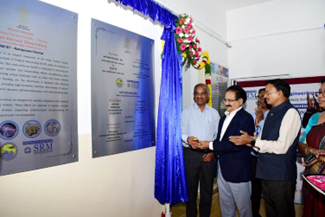
Urban Testbed and Aerosol Observatory in Chennai:
Context: The Ministry of Earth Sciences Secretary inaugurated India’s first Urban Testbed and Aerosol Observatory in Chennai to study city-specific climate patterns.
-
- The observatory will monitor Aerosol Optical Depth (AOD) and urban heat island effects.
- It uses high-frequency sensors to track air pollutants and their interaction with local meteorology.
- The “Urban Testbed” approach helps in developing precise hyper-local weather models.
- It is part of India’s effort to improve disaster resilience in coastal metropolitan areas.
- Aerosols significantly impact monsoon patterns and urban rainfall distribution.
- The project integrates satellite data with ground-based observations for better accuracy.
- Chennai was chosen due to its unique coastal-urban climate challenges.
- The data will assist urban planners in designing “cool cities” to mitigate heat waves.
- It supports the National Clean Air Programme (NCAP) objectives.
- The observatory is a collaborative project between the India Meteorological Department (IMD) and research institutes.
(PIB)
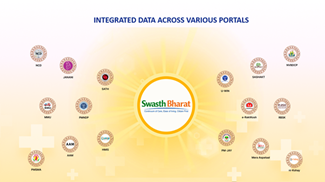
Swasth Bharat Portal: National Health Digital Hub:
Context: As part of the Ayushman Bharat Digital Mission, the full operationalization of the Swasth Bharat Portal took place.
-
- The portal acts as a unified digital interface for all health-related government services.
- It integrates the ABHA (Ayushman Bharat Health Account) for seamless health records.
- The portal allows for real-time monitoring of disease outbreaks at the district level.
- It provides a “one-stop shop” for citizens to access telemedicine, blood banks, and hospital bed availability.
- The system uses a decentralized architecture to ensure data privacy and security.
- It aims to reduce the “out-of-pocket expenditure” by providing information on generic medicines (Jan Aushadhi).
- The portal is a key component of India’s commitment to Universal Health Coverage.
- Integration with state health portals is nearly 95% complete.
- It includes a dedicated section for Senior Care, following NITI Aayog’s recent recommendations.
- Artificial Intelligence is being used to predict demand for medical supplies in rural areas.
(PIB)
Hantavirus: Public Health Alert:
Context: A hantavirus outbreak aboard cruise ship MV Hondius has left three dead and multiple countries on alert.
-
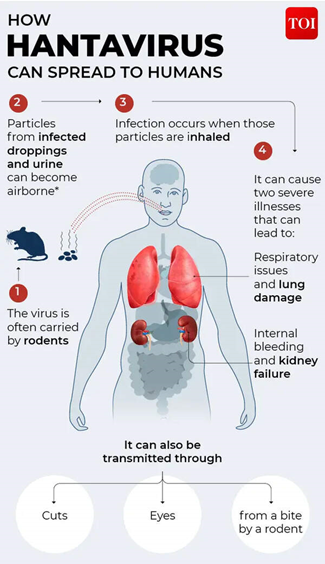
- Hantaviruses are a family of viruses spread mainly by rodents (rats and mice).
- Transmission occurs through inhalation of aerosolized virus from rodent droppings, urine, or saliva.
- It can cause Hantavirus Pulmonary Syndrome (HPS) or Hemorrhagic Fever with Renal Syndrome (HFRS).
- Unlike COVID-19, it is not generally spread from person to person.
- Early symptoms include fever, muscle aches, and fatigue, later progressing to severe shortness of breath.
- There is no specific treatment or vaccine; supportive care is the primary management.
- Rodent control in and around homes is the most effective prevention strategy.
- The virus is “enveloped,” meaning it can be easily killed by common disinfectants.
- Outbreaks are often linked to changes in land use or seasonal rodent population spikes.
- Public health surveillance has been stepped up in high-risk forest-fringe areas.
(TH)
Miscellaneous
World Inequality Report 2026: India’s Wealth Gap:
Context: The World Inequality Lab released its 2026 report, highlighting stark economic disparities in India.
-
- The report states that the top 10% of Indians hold 65% of the total wealth and 58% of the total income.
- The Gini Coefficient, measuring inequality from 0 (perfect equality) to 1 (perfect inequality), has risen for India.
- Urban inequality is notably higher than rural inequality due to concentrated development in cities.
- The top 5% in urban areas spend nine times more than the bottom 5%.
- Non-food expenditure shows the largest divide, indicating limited access to modern lifestyles for the poor.
- Oxfam India data further suggests the top 1% hold roughly 40% of national wealth.
- Standard NSS surveys often miss the “super-rich,” leading to an underestimation of true inequality.
- Economic growth is increasingly driven by debt-led consumption rather than genuine welfare improvements.
- Agricultural labourers face higher suicide rates (5,913) compared to cultivators (4,633), indicating deeper distress.
- Progressive taxation and land reforms are recommended as key policy interventions.
(IE)
Pulitzer Prize 2026: Key Wins in Journalism:
Context: The announcement of the Pulitzer Prizes 2026, noting global recognition for reporting on conflict zones.
-
- The Pulitzer Prize is the most prestigious award in American journalism, literature, and music.
- Established in 1917 by provisions in the will of Joseph Pulitzer.
- It is administered by Columbia University in New York.
- There are 21 categories, including Public Service, Breaking News, and International Reporting.
- The Public Service award is the only one that carries a gold medal.
- In 2026, many awards focused on the humanitarian impact of the West Asia conflict.
- Investigative reporting on AI and election interference was another major theme.
- Recipients include journalists, photographers, and authors from diverse backgrounds.
- The prize highlights the role of the “Fourth Estate” in holding power to account.
- Previous Indian winners include Siddharth Varadarajan and Danish Siddiqui (posthumously).

(ET)
Spread the Word