ANS.
STRUCTURE
1. Explain the statement in brief
2. Then relate to ethical implications both positive and negative in governance with examples
3. Conclusion with a philosophy or quote
THE CONTEXT (INTRODUCTION)
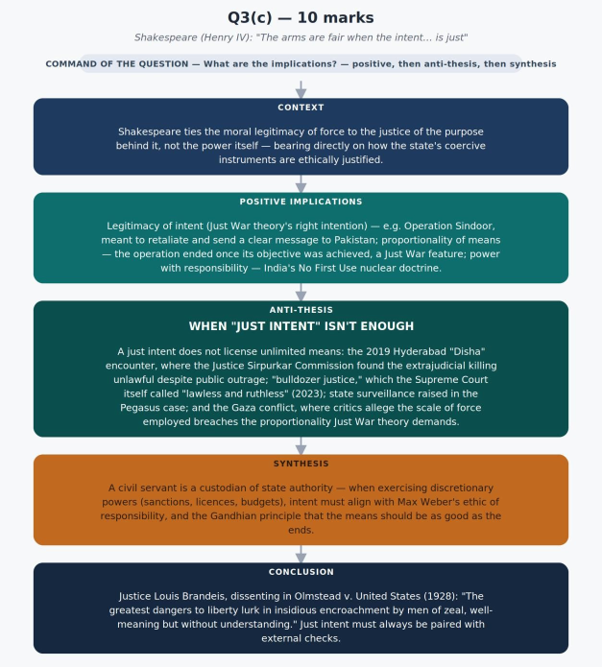
Shakespeare ties the moral legitimacy of force to the justice of the purpose behind it, not to the power itself — a line with direct bearing on how the state’s coercive instruments (police power, preventive detention, prohibitory orders, surveillance) are ethically justified in governance.
Implications in governance (Positive):
-
- Legitimacy of intent: The same legal power can be “fair” or “unfair” depending on why it is actually used — echoing Just War theory’s requirement of right intention.
Example: Operation Sindoor was meant to retaliate and give a strong message to Pakistan.
-
- Proportionality of means: Operation Sindoor was proportional and also India ended the operation once objective achieved-ending the war is a feature of Just War Theory.
- Power with responsibility: No first use principle which India has adopted for its nuclear weapon.
Anti-thesis
-
- A just intent does not license unlimited means: The 2019 Hyderabad “Disha” encounter is a stark illustration — police claimed to deliver justice for a horrific rape-murder that had provoked nationwide outrage, but the Justice Sirpurkar Commission found the extrajudicial killing unlawful.
- Lack of proportionality and restraint: Bulldozer justice violates proportionality, turning even a security objective into an unethical act-the SC judgement “bulldozer action is lawless and ruthless”-2023.
- State surveillance and suppressions of voice: Pegasus case observation by the supreme court.
- Right to self-defence by Israel and disproportionate use of force: Ethnic cleansing in Gaza goes against Just War Theory.
Synthesis
A civil servant is a custodian of state authority. When exercising discretionary powers—such as issuing sanctions, granting licenses, or allocating budgets—the intent must always align with ethical responsibility of Max Weber
Gandhian ethics of ‘means should be as good as ends’ become the guiding principle.
CONCLUSION:
Governance must therefore treat intent as necessary but never sufficient: As Justice Louis Brandeis warned in Olmstead v. United States (1928): “The greatest dangers to liberty lurk in insidious encroachment by men of zeal, well-meaning but without understanding.” Shakespeare’s just intent must always be paired with external checks.
Spread the Word