
Indian Polity & Governance
Anti-Defection Law & Supreme Court Hearing on ‘Merger’ Loophole:
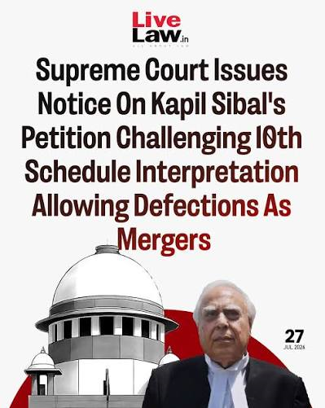
Context: The Supreme Court issued notice seeking the Centre’s response on petitions challenging Paragraph 4 of the Tenth Schedule (the ‘two-thirds merger’ exception).
-
- Constitutional Basis: Added to the Constitution by the 52nd Constitutional Amendment Act, 1985 (Tenth Schedule) under Articles 102(2) and 191(2).
- Grounds for Disqualification: Voluntary giving up of party membership, voting against party whip without prior permission, independent member joining a party, nominated member joining after 6 months.
- Paragraph 4 Exception: Disqualification does not apply if a political party merges with another and at least two-thirds of the legislature party members agree to the merger.
- 91st Amendment Act, 2003: Omitted the “one-third split” exception previously present under Paragraph 3, retaining only the “two-thirds merger” provision.
- Adjudicating Authority: The Speaker or Chairman of the House decides disqualification petitions under the Tenth Schedule.
- Kihoto Hollohan vs. Zachillhu Case (1992): SC upheld Tenth Schedule constitutionality but ruled Speaker’s decision is subject to judicial review once a final decision is made.
- No Time Limit: Tenth Schedule does not prescribe a specific timeframe for the Speaker to decide disqualification petitions.
- Keisham Meghachandra Singh Case (2020): SC ruled Speakers must decide Tenth Schedule petitions within a “reasonable time” (normally 3 months).
- Independent vs. Nominated Members: An independent MP/MLA is disqualified if they join ANY political party; a nominated member can join within 6 months without disqualification.
- Sub-delegated Exception Challenge: Petitioners argue that Paragraph 4 is being misused to effect wholesale defection of factional groups without actual organizational merger of the political party.
(TH)
SC Orders Forensic Auditor in Ayodhya Ram Temple Donation SIT Probe:
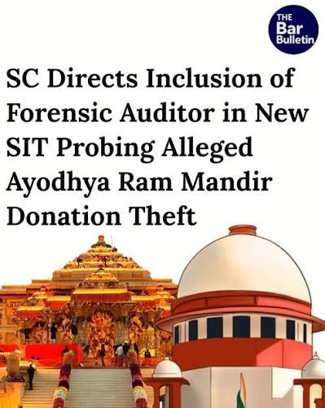
Context: The Supreme Court directed the Uttar Pradesh government to include an independent forensic auditor in the reconstituted Special Investigation Team (SIT) probing alleged theft and mismanagement of public donations at the Shri Ram Janmabhoomi Temple in Ayodhya.
-
- Shri Ram Janmabhoomi Teerth Kshetra: Trust created by the Government of India pursuant to the Supreme Court’s 2019 judgment in the Ayodhya title dispute.
- Public Religious Trust: Registered under the Indian Trusts Act, 1882 / Income Tax Act, 1961 for managing public religious and charitable endowments.
- Forensic Audit: A specialized examination of financial records, transaction trails, and ledger books to produce evidence suitable for use in a court of law.
- State Control over Religious Endowments: Article 25(2)(a) empowers the State to regulate economic, financial, political, or secular activities associated with religious practices.
- Freedom to Manage Religious Affairs: Article 26 guarantees freedom to establish and maintain institutions for religious/charitable purposes, subject to public order, morality, and health.
- SIT Custody & Direction: The SC Bench led by CJI directed the 4-member SIT headed by an Inspector-General of Police (IGP) to submit a progress status report within two weeks.
- Charitable Endowments List: “Trust and Trustees” fall under Entry 10 of the Concurrent List (List III) of the Seventh Schedule.
- FCRA Compliance: Public trusts receiving foreign donations must hold valid registration under the Foreign Contribution (Regulation) Act, 2010.
- CAG Jurisdiction: CAG does not automatically audit autonomous religious trusts unless specifically mandated by Parliament or requested by the Governor/President under law.
- Nagara Style Architecture: The Ayodhya Ram Temple is constructed in the traditional Nagara style of temple architecture, characterized by a elevated Jagati, Shikhara, and Garbhagriha.
(TH)
International Developments
Security Dynamics in the Sahel Region & Transnational Threats (Mali):
Context: Reports highlighted rising insurgency and transnational kidnapping risks for foreign nationals in Mali and the broader Sahel region.
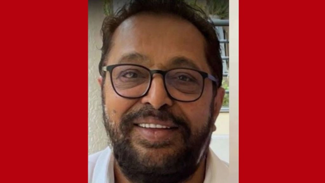
A 75-year-old India-origin diamond merchant Dhiru Ramani, who was kidnapped in Mali has been released after his family paid a ransom of 4 million euros, worth close to Rs 44 crore. He was seized in April while in Mali, where he had recently bought a gold mine and had been living for some time.
-
- Sahel Belt Geography: The ecoclimatic and biogeographic realm of transition in Africa between the Sahara Desert to the north and Sudanian Savanna to the south.
- Sahel Countries: Extends across West to East Africa including Senegal, Mauritania, Mali, Burkina Faso, Niger, Nigeria, Chad, Sudan, and Eritrea.
- Alliance of Sahel States (AES): Formed by military juntas of Mali, Burkina Faso, and Niger after withdrawing from ECOWAS (Economic Community of West African States).
- Lake Chad Basin: Shared by Chad, Cameroon, Niger, and Nigeria; shrinking rapidly due to climate change, over-extraction, and Boko Haram insurgency.
- MINUSMA Withdrawal: The UN Multidimensional Integrated Stabilization Mission in Mali (MINUSMA) ended its peacekeeping operations after request from Mali’s government.
- Operation Barkhane: Former French anti-insurgent military operation in Africa’s Sahel region (terminated in 2022).
- Landlocked States: Mali, Niger, and Burkina Faso are all landlocked West African nations reliant on coastal trade corridors.
- River Niger: West Africa’s principal river; rises in Guinea Highlands, flows through Mali, Niger, border of Benin, then Nigeria into the Gulf of Guinea.
- Timbuktu WHS: Historic city in Mali known for Sankore Madrasah and ancient manuscripts; listed on UNESCO World Heritage in Danger list.
- Operation Kaveri / Indravati Parallel: India executes specialized evacuation/protection protocols (e.g., Operation Kaveri in Sudan, Operation Indravati in Haiti) when citizens face security distress abroad.
(IE)
Economy
NSE Launches India’s First Domestic Benchmark-Based Natural Gas Futures:
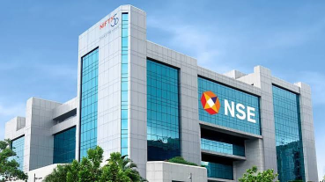
Context: The National Stock Exchange (NSE) commenced trading in India’s first domestic benchmark-based Natural Gas Futures contracts, shifting reliance away from foreign benchmarks like Henry Hub.
-
- First Domestic Benchmark: Unlike older contracts linked to US Henry Hub or UK NBP, these derivatives are benchmarked directly against domestic Indian gas hubs.
- Regulatory Body: Regulated by the Securities and Exchange Board of India (SEBI), which oversees commodity derivatives trading following the SEBI-FMC merger in 2015.
- Target Sector: Provides price risk hedging tools for city gas distribution (CGD) companies, fertilizer units, power producers, and industrial consumers.
- Gas-Based Economy Goal: Supports India’s national target to raise the share of natural gas in the primary energy mix from ~6.7% to 15% by 2030.
- Indian Gas Exchange (IGX): India’s first automated national-level gas trading platform (launched in 2020), operating under the Petroleum and Natural Gas Regulatory Board (PNGRB).
- Kirit Parikh Committee: Recommended gas pricing reforms, capping domestic APM (Administered Price Mechanism) gas prices and establishing floor/ceiling limits linked to crude oil imports.
- Derivatives vs. Spot Market: Futures contracts are standardized exchange-traded legal agreements to buy/sell at a predetermined future date, unlike spot cash markets.
- Customs Duty & Import Dependency: India imports over 45-50% of its natural gas consumption in the form of Liquefied Natural Gas (LNG).
- Unified Gas Pipeline Tariff: PNGRB introduced a unified pipeline tariff regime to streamline transport costs across ‘One Nation, One Grid’.
- PNGRB Statutory Status: Established under the PNGRB Act, 2006 to regulate refining, transportation, distribution, and sale of petroleum products and natural gas.
(IE/mint)
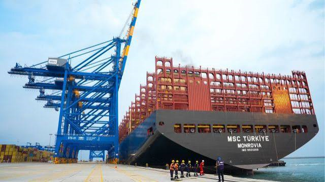
Vizhinjam Port Notified as Customs Port Under Customs Act, 1962:
Context; The Central Board of Indirect Taxes and Customs (CBIC) formally notified the Vizhinjam International Transshipment Deepwater Multipurpose Seaport (Kerala) as a Customs Port under Section 7 of the Customs Act, 1962.
-
- Customs Port Status: Section 7 of the Customs Act, 1962 empowers CBIC to appoint places to be customs ports for unloading of imported goods and loading of export goods.
- First Deepwater Transshipment Port: Vizhinjam is India’s first deepwater international transshipment hub, situated near Thiruvananthapuram, Kerala.
- Natural Draft Advantage: Boasts a natural draft of 18–20 meters, allowing large Megamax container ships to dock without extensive dredging.
- Strategic Location: Located just 10 nautical miles from the East-West international shipping route connecting Europe, the Persian Gulf, and East Asia.
- Transshipment Dependency Reduction: Reduces India’s dependence on foreign transshipment hubs like Colombo (Sri Lanka), Singapore, and Port Klang (Malaysia).
- Public-Private Partnership (PPP): Developed under Design, Build, Finance, Operate, and Transfer (DBFOT) model with landlord port architecture.
- Cabotage Laws: Ministry of Ports relaxed cabotage restrictions to allow foreign-flagged vessel movement between Indian ports to boost transshipment volumes.
- Sagarmala Programme: Vizhinjam is a flagship project under Sagarmala for port-led industrial development and logistics cost reduction.
- CBIC Governance: Statutory body under the Department of Revenue, Ministry of Finance; deals with customs, GST, and central excise.
- Economic Impact: Expected to save over $200 million annually in foreign exchange spent on transshipment operations abroad.
(PIB/IE)
Geography
Non-Revenue Water (NRW) & Urban Water Governance:
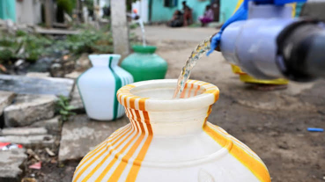
Context: A comparative study published on urban water systems highlighted that Indian cities lose between 40–50% of treated municipal water as Non-Revenue Water (NRW).
-
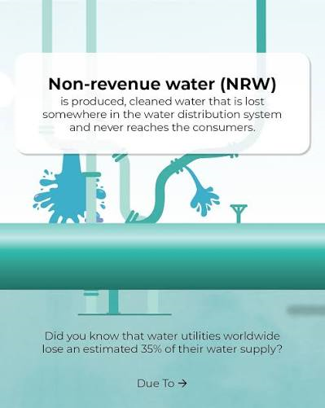
- Definition of NRW: Non-Revenue Water is water produced and sent into the distribution system that is lost before reaching the consumer (unbilled due to leaks, theft, or metering errors).
-
- Components of NRW: Real losses (physical leaks/pipe bursts), Apparent losses (illegal connections, meter inaccuracy), and Unbilled Authorized Consumption.
- AMRUT 2.0 Target: Atal Mission for Rejuvenation and Urban Transformation (AMRUT 2.0) aims for 100% water supply coverage and reducing NRW to below 20% in urban areas.
- Wastewater Treatment Level: Less than 20–30% of municipal sewage in India is currently treated, leaving immense scope for greywater recycling.
- SDG Target 6.3: Aims to improve water quality by reducing pollution, eliminating dumping, and halving the proportion of untreated wastewater by 2030.
- Water as a Subject: Water is a State subject (Entry 17 of List II), while interstate rivers fall under Union jurisdiction (Entry 56 of List I).
- Jal Jeevan Mission (Urban): Aims to provide functional household tap connections (FHTC) to all households in statutory towns.
- 24×7 Continuous Water Supply (Puri Model): Puri (Odisha) became India’s first city to achieve ‘Drink from Tap’ quality water complying with IS 10500 standards.
- National Water Mission (NWM): One of 8 missions under National Action Plan on Climate Change (NAPCC); key campaign is Catch the Rain.
- Central Ground Water Authority (CGWA): Statutory body constituted under Section 3(3) of the Environment (Protection) Act, 1986.
(TH)
Art & Culture / History
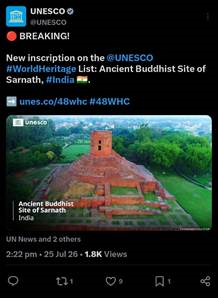
Inscription of Sarnath on the UNESCO World Heritage List:
Context: The Ancient Buddhist Site of Sarnath (Uttar Pradesh) was officially inscribed as India’s 45th World Heritage Site during the 48th session of the UNESCO World Heritage Committee in Busan, South Korea.
-
- Historical Significance: Sarnath (Migadaya / Deer Park) is where Gautama Buddha delivered his first sermon (Dhammacakkappavattana Sutta) to his first five disciples (Panchavaggiya).
- Fourth WHS in UP: Sarnath joins Taj Mahal, Agra Fort, and Fatehpur Sikri as Uttar Pradesh’s 4th World Heritage Site.
- Dhamek Stupa: Marks the exact spot where Buddha gave his first sermon; built initially by Emperor Ashoka (249 BCE) and later rebuilt during the Gupta period.
- Chaukhandi Stupa: Built during the Gupta period to mark the spot where Buddha met his five disciples; later topped with an octagonal tower by Govardhan (son of Raja Todar Mal) to commemorate Humayun’s visit.
- Lion Capital of Ashoka: Discovered at Sarnath, the four back-to-back lions standing on a circular abacus featuring a Dharmachakra, elephant, bull, horse, and lion served as the official National Emblem of India.
- Mulagandhakuti Vihara: Represents the ruins of the main temple where Buddha resided during his retreat in Sarnath.
- UNESCO Criteria: Sarnath fulfilled Criteria (i), (ii), (iii), and (vi) due to its monumental architecture, influence on Buddhist art, and universal spiritual connection.
- World Heritage Sites in India: India now has 45 World Heritage Sites (37 Cultural, 7 Natural, 1 Mixed—Khangchendzonga National Park).
- World Heritage Committee (WHC): Operates under the 1972 World Heritage Convention; consists of 21 state parties elected by the General Assembly.
- Gupta School of Art: Sarnath developed a distinct school of Buddhist sculpture marked by delicate modeling, transparent drapery, and serene facial expressions.
(TH/PIB)
Internal Security
Operation Navajeevan-II: Mass Surrender of Left-Wing Extremists in Jharkhand:
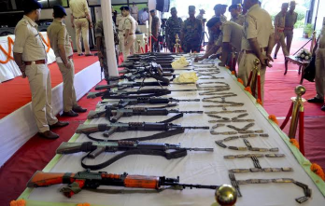
Context: Sixteen Maoists, including top regional commanders carrying cumulative cash rewards of ₹1 crore, surrendered before security forces in Jharkhand under Operation Navajeevan-II.
-
- Operation Navajeevan-II: Targeted surrender and rehabilitation policy initiative implemented by Jharkhand Police and CRPF to rehabilitate active Left-Wing Extremists (LWE).
- Red Corridor: Refers to the region in eastern, central, and southern India that experiences significant LWE violence (spanning parts of Jharkhand, Chhattisgarh, Odisha, Telangana, Maharashtra).
- Maoist Ideology: Rooted in Marxism-Leninism-Maoism; seeks to overthrow the state through “Protracted People’s War” using rural peasantry.
- SAMADHAN Doctrine: Strategy framed by Ministry of Home Affairs to combat LWE:
-
-
- S – Smart Leadership
- A – Aggressive Strategy
- M – Motivation and Training
- A – Actionable Intelligence
- D – Dashboard Based Key Performance Indicators
- H – Harnessing Technology
- A – Action Plan for each Theatre
- N – No access to Financing
-
-
- Special Infrastructure Scheme (SIS): Central scheme aimed at upgrading intelligence branches and Fortified Police Stations in LWE-affected areas.
- Greyhounds & CoBRA: CoBRA (Commando Battalion for Resolute Action) is the specialized LWE unit of CRPF; Greyhounds is the elite anti-Maoist force of Andhra Pradesh/Telangana.
- Civic Action Programme (CAP): Funded by MHA to build bridges between local tribal populations and Central Armed Police Forces (CAPFs).
- PESA Act, 1996: Provisions of the Panchayats (Extension to Scheduled Areas) Act protects tribal self-governance in Scheduled Areas—a vital counter-measure against Maoist alienation.
- Fifth Schedule of the Constitution: Deals with administration and control of Scheduled Areas and Scheduled Tribes in 10 states (including Jharkhand).
- Aspirational Districts Programme (ADP): NITI Aayog initiative focusing on accelerating development in 112 backward districts, most of which were historically LWE-affected.
(TH)
Sports
Commonwealth Games 2026: Valluri Ajaya Babu Sets CWG Snatch Record:
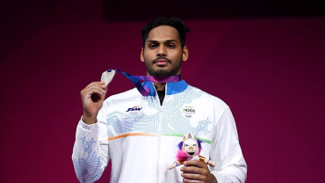
Context: PM congratulated weightlifter Valluri Ajaya Babu on winning the Silver Medal in the Men’s 79 kg category at the 2026 Glasgow Commonwealth Games, setting a new CWG record in the Snatch event.
-
- Event & Venue: The XXIII Commonwealth Games (2026) are hosted in Glasgow, Scotland.
- Snatch vs. Clean & Jerk: Weightlifting comprises two disciplines:
-
- Snatch: Lifting the barbell from the ground to overhead in a single continuous movement.
- Clean & Jerk: A two-phase lift where the bar is first brought to the shoulders and then jerked overhead.
-
- International Weightlifting Federation (IWF): Global governing body for weightlifting, recognized by the International Olympic Committee (IOC).
- Commonwealth Games Federation (CGF): Organization responsible for directing and controlling the Commonwealth Games, restricted to member states of the Commonwealth of Nations.
- Commonwealth of Nations: Voluntary association of 56 independent sovereign states, most of which were former territories of the British Empire (Headquarters: Marlborough House, London).
- Khel Ratna & Arjuna Award Criteria: Performance in multi-sport international events (Olympics, Asian Games, Commonwealth Games) forms the primary scoring metric under the National Sports Awards Code.
- Target Olympic Podium Scheme (TOPS): Flagship scheme of the Ministry of Youth Affairs and Sports to provide elite assistance to potential medal prospects.
- National Anti-Doping Agency (NADA): Statutory body under the National Anti-Doping Act, 2022 responsible for implementing WADA-compliant anti-doping rules in India.
- Glasgow 2026 Format: A scaled-back, cost-effective Games format focusing on core sports to make hosting sustainable for member countries.
- Article 51A(h) & Sports: Fundamental Duty under Article 51A(j) commands citizens to strive towards excellence in all spheres of individual and collective activity.
(PIB)
Spread the Word