Indian Polity & Governance
PM Completes 4,399 Days, Surpassing Historical Prime Ministerial Tenures:
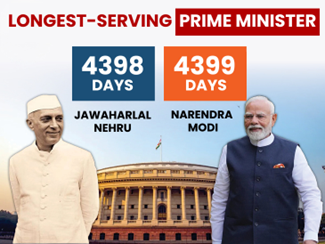
Context: On 10 June 2026, Prime Minister Narendra Modi marked 4,399 consecutive days in office, surpassing historical benchmarks for the longest continuous tenure as an elected Prime Minister of India.
-
- The Milestone: This day marks a notable structural milestone in India’s executive governance post-Independence, reflecting a continuous 12-year legislative paradigm under the NDA alliance.
- Constitutional Provisions: In India, the Prime Minister is appointed by the President under Article 75 of the Constitution.
- Tenure reality: Legally, the PM does not have a fixed tenure but holds office during the “pleasure of the President.” However, this pleasure is bound by the PM enjoying the majority support of the Lok Sabha.
- Executive vs. Head of State: The PM is the Real Executive Authority (de facto head), whereas the President is the Nominal Executive Authority (de jure head) as per the Westminster model.
- Historical context: Jawaharlal Nehru remains the longest-serving Prime Minister in terms of cumulative total days in office (including the interim government phase), followed by Indira Gandhi.
- Collective responsibility: Under Article 75(3), the Council of Ministers headed by the PM is collectively responsible to the House of the People (Lok Sabha).
- Federal dynamic: The milestone was marked by discussions highlighting the evolution of Competitive and Cooperative Federalism over the last decade, emphasizing the changing fiscal devolution patterns.
- Devolution transition: This era coincided with the implementation of the 14th and 15th Finance Commission recommendations, which substantially increased the untied tax devolution pool to states.
- Digital Public Infrastructure (DPI): Governance under this long-standing executive phase has been legally defined by the expansion of the JAM Trinity (Jan Dhan, Aadhaar, Mobile) to implement Direct Benefit Transfers (DBT).
- Rank in Precedence: In the Indian Table of Precedence, the Prime Minister ranks 3rd, coming right after the President (1st) and the Vice-President (2nd).
(TH)
Economy
Rise in Fertiliser Subsidy Burden Due to Global Supply Crunch:
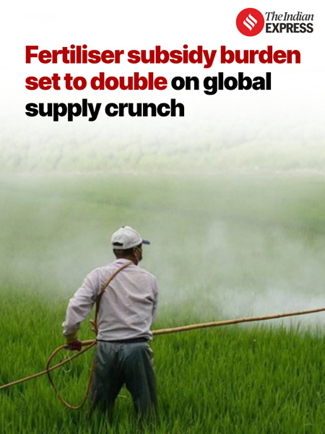
Context: Exporters and agrarian ministries flagged that India’s total fertiliser subsidy burden is set to double owing to compounding global supply chain disruptions and West Asian port congestions.
-
- The Core Trigger: Escalating geopolitical tensions in West Asia have led to severe ocean freight congestion, container shortages, and opportunistic pricing by maritime carriers.
- Subsidy mechanism: The government shields domestic farmers from global price spikes by absorbing the increased cost of imported fertilizers and raw materials through central subsidies.
- Static Concept (NBS Scheme): Phosphatic and Potassic (P&K) fertilizers are governed under the Nutrient Based Subsidy (NBS) Scheme administered since 2010.
- NBS Implementation: Under NBS, a fixed amount of subsidy decided on an annual/bi-annual basis is provided on each grade of subsidized fertilizer based on its nutrient content (Nitrogen, Phosphorus, Potash, and Sulphur).
- Urea pricing exception: Unlike P&K fertilizers, Urea is not fully under NBS. The Maximum Retail Price (MRP) of urea is statutorily fixed by the Central Government; the difference between the production/import cost and the fixed MRP is paid as a subsidy to manufacturers.
- Import Dependency: India is heavily dependent on imports for rock phosphate, ammonia, and muriate of potash (MoP). West Asia and Belarus/Russia are critical global source hubs.
- Fiscal Deficit Impact: A doubling of the fertilizer subsidy strains the revenue expenditure component of the Union Budget, potentially widening the targeted fiscal deficit.
- Neem-Coated Urea: 100% of domestic urea production is neem-coated to prevent the diversion of agricultural urea for industrial uses and to regulate nitrogen release into the soil.
- Alternative Measures: To counter global supply shocks, India is aggressively promoting Nano Urea and Nano DAP, liquid variants developed indigenously that require lesser logistics footprint.
- Nodal Ministry: The administration of all fertilizer subsidies and distribution is under the Ministry of Chemicals and Fertilizers (NOT the Ministry of Agriculture).
(IE)
Launch of the BHAVYA Portal and Scheme:
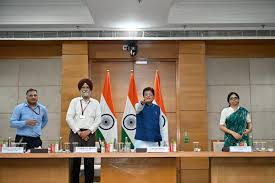
Context: Union Minister of Commerce and Industry launched the BHAVYA Portal to operationalize the Bharat Audyogik Vikas Yojana (BHAVYA), a massive financial outlay aimed at boosting domestic industrial infrastructure.
-
- Core objective: The BHAVYA portal aims to map, track, and operationalize the development of 100 world-class industrial parks across the country.
- Financial outlay: The Bharat Audyogik Vikas Yojana is a flagship scheme with an allocated budget of ₹33,660 crore.
- Governance model: It functions via a Centre-State partnership model, promoting cooperative federalism by incentivizing states to upgrade industrial ecosystems.
- Financial support breakdown: The Government of India (GoI) provides central assistance of up to ₹1 crore per acre for core, value-added, and social infrastructure within the parks.
- External connectivity: The scheme mandates allocating up to 25% of the total project cost purely for establishing external connectivity (roads, rail links, power grids).
- Technological infrastructure: The portal features digital mapping, satellite-based land assessment, testing, and certification tracking to ensure transparent land banks.
- Static Connection (NIMZs): This aligns with India’s National Manufacturing Policy which previously envisioned National Investment and Manufacturing Zones (NIMZs) to increase manufacturing’s share in GDP.
- Ease of Doing Business: The online portal functions as a single-window clearance interface for prospective domestic and global investors seeking land in these 100 designated parks.
- Employment generation: The policy explicitly targets generating high-skilled manufacturing jobs, correcting India’s structural economic skew from agriculture directly to services.
- Nodal Ministry: The scheme is strictly governed under the Department for Promotion of Industry and Internal Trade (DPIIT) under the Ministry of Commerce and Industry.
(PIB)
RBI’s Twin USD-INR Forex Swap Facility:
Context: To combat forex pressure and attract crucial foreign currency inflows amid global uncertainties, the Reserve Bank of India (RBI) introduced two specialized USD-Rupee Forex Swap Facilities.
-
- The Core Mechanism: A Forex Swap involves the RBI selling/buying foreign currency simultaneously with an agreement to reverse the transaction at a specified future date.
- Target Facility 1: The first window is dedicated specifically to fresh Foreign Currency Non-Resident Bank [FCNR(B)]
- Target Facility 2: The second window is for eligible External Commercial Borrowings (ECBs) and overseas Foreign Currency Borrowings (OFCBs).
- Currency Restrictions: The specialized swap facility with the RBI will be valid and transacted in US Dollars (USD) only.
- Eligibility for Banks: Only Authorised Dealer (AD) Category-I banks can directly avail of this forex swap facility from the RBI for deposits raised in freely convertible currencies.
- Maturity Mandate: For ECBs and OFCBs, the swap facility is strictly limited to borrowings with a minimum average maturity of 3 years and above.
- Monetary Tool Purpose: This serves as a quantitative monetary tool to boost India’s foreign exchange reserves and prevent depreciation pressures on the Indian Rupee (INR).
- Static Concept (FCNR-B): FCNR(B) accounts allow Non-Resident Indians (NRIs) to maintain fixed deposits in foreign currencies in India, insulating them from exchange rate fluctuations.
- Difference from normal Repo: Unlike repo transactions which inject liquidity into domestic banking via government securities, a forex swap directly affects foreign currency liquidity and exchange rate stability.
- Global Trigger Context: Exporters and mutual funds have faced headwinds due to global supply crunches and port congestions, prompting the RBI to shield the capital account via this dual-swap instrument.
(ET)
Sahamati Foundation recognized as Account Aggregator SRO:
Context: The Reserve Bank of India (RBI) officially recognized the Sahamati Foundation as the Self-Regulatory Organisation (SRO) for India’s Account Aggregator (AA) ecosystem.
-
- What is an SRO? A Self-Regulatory Organisation is a non-governmental entity that sets and enforces rules and standards relating to the conduct of entities in its industry, acting as a bridge between the regulator (RBI) and market players.
- Role of Sahamati: It will now serve as the formal representative industry body for the entire financial consent-data sharing network, including FinTechs, banks, and aggregators.
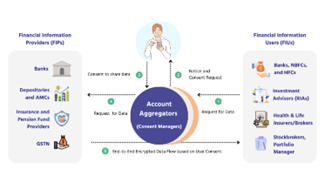
- Account Aggregator (AA) Definition: An AA is a type of RBI-regulated financial entity (NBFC-AA) that helps an individual securely and digitally access and share information from one financial institution they have an account with to any other regulated financial institution in the AA network.
- Consent Architecture: Data sharing through AA is purely based on explicit citizen consent; AAs are data-blind, meaning they cannot read, store, or monetize the data passing through them.
- Static Framework (DEPA): The AA architecture is India’s implementation of the Data Empowerment and Protection Architecture (DEPA), which gives citizens control over their data.
- Regulatory Oversight: Even though Sahamati acts as an SRO, it remains subservient to the ultimate regulatory directives of the RBI under Section 45-IA of the RBI Act, 1934.
- Significance of the Move: This introduces a formalized industry-led governance framework to prevent data misuse, standardize APIs, and resolve inter-institution disputes.
- The Financial Information Providers (FIPs): Institutions that hold the user’s data (e.g., Banks, Mutual Funds, GST Repositories) are called FIPs.
- The Financial Information Users (FIUs): Institutions that consume the shared data to provide services (e.g., Lenders, Wealth Managers) are called FIUs.
- Financial Inclusion Impact: The SRO will speed up the formalization of MSME lending by standardizing how cash-flow data is shared via the AA ecosystem without collateral.
(BS+ET)
Geography
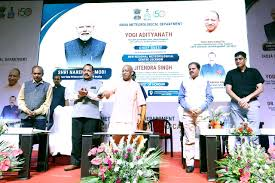
Regional Meteorological Centre (RMC) Inaugurated in Lucknow:
Context: Union Minister of State for Earth Sciences and the Chief Minister of Uttar Pradesh jointly inaugurated a new state-of-the-art Regional Meteorological Centre (RMC) in Lucknow.
-
- Administrative Setup: The RMC Lucknow operates under the India Meteorological Department (IMD), which comes under the Ministry of Earth Sciences (MoES).
- Objective: It is aimed at strengthening localized weather forecasting, agromet advisory services, and extreme weather early warning systems across the Indo-Gangetic plain.
- Static Structure of IMD: IMD has six primary Regional Meteorological Centres located historically at Chennai, Guwahati, Kolkata, Mumbai, Nagpur, and New Delhi. RMC Lucknow will heavily decentralize services for northern India.
- Climatic Relevance: The region is highly vulnerable to climate shifts, including severe heatwaves, dense winter smog/fog, lightning strikes, and unpredictable monsoon patterns.
- Technology Integration: The centre will integrate real-time data from Doppler Weather Radars (DWR) and INSAT series satellites to provide ‘Nowcasting’ (weather forecasts valid up to a few hours).
- Agromet Services: It will directly feed into the Gramin Krishi Mausam Sewa (GKMS) to provide block-level crop weather advisories to farmers.
- Static Concept (Nowcasting): Unlike traditional medium-range forecasts, nowcasting relies on rapid-radar telemetry to issue immediate warnings for localized phenomena like cloudbursts or sudden thunderstorms.
- Disaster Risk Reduction (DRR): The centre aligns with India’s commitment to the UN’s Sendai Framework for Disaster Risk Reduction, targeting zero mortality from extreme weather events.
- Hydrological Impact: It will monitor catchment areas of major rivers like the Ganga, Gomti, and Ghaghara to improve flood-forecasting models.
- Data Sharing: The RMC will act as a collaborative hub for state disaster management authorities (SDMA) and academic institutions focusing on climate shifts over North India.
(PIB)
Terms in news
Cyber slavery:
-
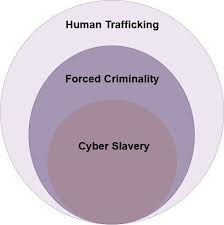
- A form of modern exploitation that begins with online deception and evolves into physical human trafficking.
- Involves exploiting individuals through digital means under coercive or deceptive conditions.
- Offenders target innocent individuals and lure them by giving fake promises to offer them employment or alike.
- It can take many different forms, such as coercive involvement in cybercrime, forced employment in online frauds, exploitation in the gig economy, or involuntary slavery.
(TH)
Spread the Word