Introduction:
The long-standing relationship between India and the United Arab Emirates has transitioned from historical maritime trade across the Arabian Sea to a high-density, multi-sectoral Comprehensive Strategic Partnership. Prime Minister Narendra Modi’s official visit to Abu Dhabi on 15 May 2026 (his eighth visit in 12 years) highlights the geopolitical alignment between the two nations. In an era marked by West Asian instability and supply chain vulnerabilities, this engagement cements the UAE as India’s core anchor in the Gulf region under the framework of its “Think West” policy.
Strategic Geopolitical & Maritime Alignments
-
- Strait of Hormuz Safeguards: Given the disruptions in the Red Sea corridors, India conveyed a strong stance in favor of maintaining safe transit passage through the Strait of Hormuz, which is vital for global energy and food security.
- Operationalization of MAITRI VTC: The MAITRI (Master Application for International Trade and Regulatory Interface) Virtual Trade Corridor was formally operationalized during the visit. This digital customs and logistics integration streamlines maritime commerce between Indian ports (such as JNPT and Mundra) and the UAE’s Jebel Ali port.
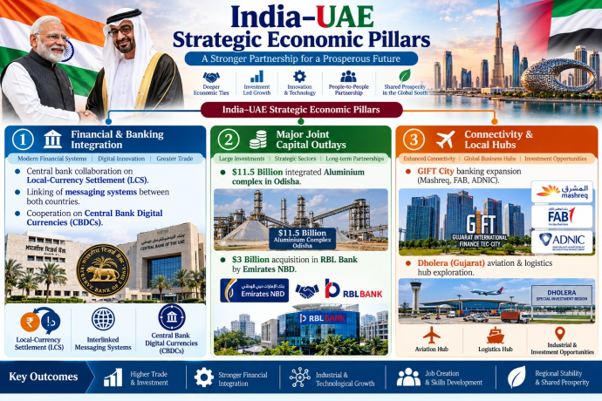
- Digital Financial Interoperability: Continued momentum was added to integrating India’s UPI with the UAE’s AANI platform, alongside linking RuPay with the JAYWAN national debit card system to lower remittance friction.
Key Bilateral Outcomes
The 2026 bilateral talks yielded deep structural outcomes across traditional and frontier sectors:
1. Hydrocarbon and Strategic Energy Security
-
- ISPRL–ADNOC Treaty: An agreement allowing Abu Dhabi National Oil Company to store up to 30 million barrels of crude oil in India’s subterranean caverns, enhancing India’s buffer against market shocks.
- Strategic Gas & LPG Expansion: Initiated joint development for underground strategic gas reserves alongside a long-term LPG supply contract with Indian Oil Corporation Limited (IOCL) to support India’s domestic green-fuel targets.
2. Strategic Defence Framework
Building on initial parameters mapped out in early 2026, the leaders inked a comprehensive Framework for the Strategic Defence Partnership. The mandate moves beyond simple joint exercises toward defence industrial co-production, co-development of military hardware, secure communication architectures, and cross-border cyber defence protocols.
3. Maritime Infrastructure & Technical Upskilling
-
- Vadinar Ship Repair Cluster: A Memorandum of Understanding between Cochin Shipyard Limited (CSL) and Drydocks World (DDW) of Dubai to construct a state-of-the-art ship repair hub at Vadinar, Gujarat.
- Maritime Centre of Excellence: CSL, DDW, and the Centre of Excellence in Maritime & Shipbuilding (CEMS) partnered to train and deploy a future-ready technical workforce under the Skill India Mission.
4. Sovereign AI and High-Performance Computing (HPC)
A term sheet was finalized between India’s C-DAC and the UAE’s G42 to establish an 8 Exaflop Supercomputing Cluster in India. This forms the physical infrastructure backbone for the IndiaAI Mission, facilitating sovereign AI research, large language model (LLM) training, and localized digital innovation.
Challenges:
-
- West Asian Instability and Trade Security: The Hindu reports that persistent geopolitical conflicts in West Asia introduce continuous risks to regional supply lines. Drone and missile threats targeting commercial shipping lanes necessitate constant naval escorts, keeping shipping insurance premiums volatile.
- China’s Deepening Footprint in the Gulf: Geopolitical briefs (Drishti IAS / ORF) highlight that China’s aggressive investment in UAE ports, free trade zones, and 5G communication grids creates a complex environment for India’s strategic and counter-intelligence interests.
- The “Emiratisation” of Labor Markets: While the 4.5-million-strong Indian diaspora remains the primary source of bilateral remittances, the UAE’s structural shift toward domestic Emiratisation targets puts pressure on low-skilled Indian blue-collar workers. This necessitates an immediate pivot toward training Indians for high-skilled, technical “grey-collar” positions.
Way Forward:
-
- Arbitration Mechanisms for Sovereign Wealth Funds: Establishing a dedicated, fast-track dispute resolution window in GIFT City, Gujarat, to handle UAE’s sovereign capital flows and sustain investor confidence.
- Green Maritime Corridors: Leveraging the newly operationalized MAITRI corridor to build eco-friendly shipping routes powered by green hydrogen or ammonia bunkering between Western India and Jebel Ali.
- Minilateral Synergy (I2U2 and IMEC): Insulating bilateral project executions from regional political shocks by accelerating smaller working-group components of the I2U2 framework and the India-Middle East-Europe Economic Corridor (IMEC).
- Advanced Cyber and Tech Clusters: Setting up collaborative defense labs to pilot anti-drone tech and AI-driven maritime traffic monitoring systems.
Conclusion
The Prime Minister’s May 2026 visit to Abu Dhabi redefines India’s engagement with West Asia, moving it beyond a traditional buyer-seller energy relationship to a cutting-edge technological and defense partnership.
Spread the Word