
Particularly Vulnerable Tribal Group (PVTG) is a classification used by the Government of India for the most disadvantaged sub-sections of the Scheduled Tribes (ST). These groups are identified based on their extreme socio-economic backwardness, stagnant or declining population, and fragile livelihoods.
As of April 2026, there are 75 officially notified PVTGs residing in 18 States and the Union Territory of Andaman & Nicobar Islands.
Criteria for Identification
PVTGs are not a constitutional or statutory category but an administrative classification. The following four criteria (established via the Dhebar Commission) are used for their identification:
-
- Pre-agricultural technology: Use of rudimentary tools, hunting-gathering, and shifting cultivation.
- Stagnant or declining population: High mortality and low fertility rates leading to demographic fragility.
- Extremely low literacy: Often below 10–20%, with limited access to formal schooling.
- Subsistence level of economy: Dependence on forest produce and local barter systems with very little market surplus.
PVTGs in the Nicobar Context
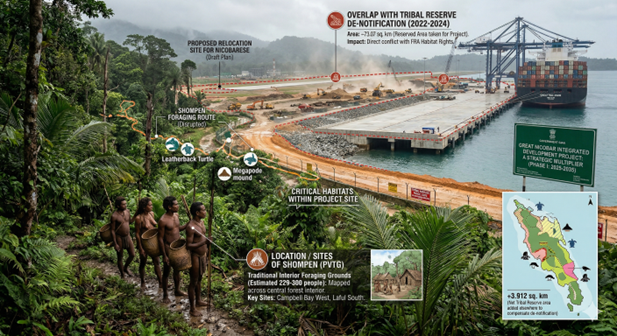
The status of the Shompen and Nicobarese (though the Nicobarese are an ST, not a PVTG, they share the same habitat) is a central point of the 2026 Great Nicobar Project debate.
-
- The Shompen (PVTG): A Mongoloid tribe of semi-nomadic hunter-gatherers living in the interior forests of Great Nicobar. Their population is estimated at only 229-300.
- Habitat Rights: Under Section 3(1)(e) of the Forest Rights Act (FRA), 2006, PVTGs have “Habitat Rights.” These rights go beyond land ownership and include the right to traditional territory, socio-cultural practices, and traditional knowledge.
- The 2026 Conflict: As of April 4, 2026, there is significant legal friction in the Calcutta High Court regarding whether the Great Nicobar Project’s draft “Relocation Plan” violates the Habitat Rights of the Shompen.
Major Welfare Initiatives: PM-JANMAN
The government is currently implementing the PM-JANMAN (Pradhan Mantri Janjati Adivasi Nyaya Maha Abhiyan), a ₹24,104 crore flagship mission launched in late 2023 to saturate PVTG habitations with basic facilities by 2026.
-
- Housing: Over 6 lakh pucca houses completed out of a target of 4.9 lakh.
- Connectivity: 3,000+ habitations covered with mobile towers; 1,900 km of link roads built.
- Electrification: Nearly 36 lakh unelectrified households have been energized using solar power and grid connections.
- Health: 750 Mobile Medical Units (MMUs) are currently operational, specifically designed to reach remote PVTG settlements.
Geographical Distribution (Top States)
| State | Number of PVTG Groups | Major Tribes |
|---|---|---|
| Odisha | 13 (Highest) | Bondo, Dongria Kondh, Juang |
| Andhra Pradesh | 12 | Chenchu, Konda Reddi |
| Madhya Pradesh | 7 | Baiga, Saharia, Bharia |
| A&N Islands | 5 | Jarawa, Sentinelese, Shompen, Onge, Great Andamanese |
The classification is critical because it prioritizes these groups for specific funds under the Scheduled Tribe Component (STC). However, the biggest challenge in 2026 remains the “Identity-Development Conflict”—how to provide modern facilities like roads and electricity without destroying the cultural integrity and relative isolation that these tribes depend on for survival.
Spread the Word