TOPIC-1: Strategic Restructuring & Privatization of IDBI Bank Ltd.
-
- UPSC Relevance: GS Paper 3 (Indian Economy — Banking Sector Reforms, Disinvestment & Privatization, Prompt Corrective Action [PCA], Valuation Methodologies, & Foreign Direct Investment [FDI]).
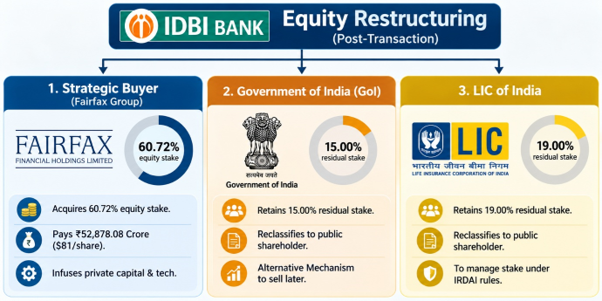
Introduction: The Cabinet Committee on Economic Affairs (CCEA) approved the strategic buyer for the disinvestment of IDBI Bank Ltd. on October 14, 2026. M/s 10955230 Canada Inc. (a subsidiary of Fairfax Financial Holdings Ltd.) was selected to acquire a 60.72% aggregate stake for ₹52,878.08 Crore. Marking the largest FDI transaction in India’s financial sector to date.
Shareholding Reorganization Structure:
The Government of India (GoI) and the Life Insurance Corporation of India (LIC) are jointly selling a controlling stake while retaining minority, non-controlling equity positions:
Key Highlights:
-
- Historical Context: Placed under the RBI’s Prompt Corrective Action (PCA) framework in May 2017 due to high Non-Performing Assets (NPAs) and accumulated losses. Following capital infusions and balance-sheet cleanup, the RBI lifted PCA restrictions in March 2021, paving the way for strategic privatization.
- Valuation Methodology: Because IDBI Bank’s stock market price was thinly traded and volatile (fluctuating between ₹61.01 and ₹118.38), market prices were set aside to avoid misaligning valuation with intrinsic worth. Two independent methodologies were applied:
1. Relative Valuation (Market Multiple Method): Benchmark ratios derived from the March 31, 2026, closing accounts of all Public Sector Banks (PSBs).
2. Asset Valuation Method: Net asset value calculation incorporating tangible/intangible assets, real estate holdings, and liabilities as per audited FY26 accounts.
-
- Benchmark vs. Winning Bid: The average of the two independent valuations yielded a benchmark price of ₹75.99 per share. The winning bid by Fairfax at ₹81.00 per share exceeded both the benchmark price and individual valuation estimates.
UPSC Quick Reference Table
| Feature | Detailed Specification |
| Nodal Body & Approving Authority | DIPAM (Ministry of Finance) & Cabinet Committee on Economic Affairs (CCEA) |
| Approved Strategic Buyer | M/s 10955230 Canada Inc. (Fairfax Financial Holdings Ltd.) |
| Total Transaction Value | ₹52,878.08 Crore (at ₹81.00 per share) |
| Equity Stake Disinvested | 60.72% (GoI: 30.48% | LIC: 30.24%) |
| Residual Holding | GoI: 15% | LIC: 19% (Both convert to public shareholder status) |
| Valuation Benchmark | ₹75.99 per share (Derived via Market Multiple & Net Asset Valuation) |
| Economic Milestone | Largest Foreign Direct Investment (FDI) in India’s financial sector |
Key Governance:
-
- Fiscal Burden Reduction: Eliminates IDBI Bank’s reliance on government recapitalization assistance, transferring capital requirements to the strategic investor.
- Institutional Governance: Both GoI and LIC will withdraw nominee directors from the Board, ensuring complete management autonomy for the new strategic owner.
- Regulatory Oversight: The transaction remains subject to the Reserve Bank of India’s final Fit and Proper clearance and regulatory compliance roadmap.
Conclusion:
The transition of IDBI Bank from a Prompt Corrective Action (PCA)-restricted lender reliant on public recapitalization to a privately commercial bank reflects a broader structural shift toward market efficiency, advancing the goals of Aatmanirbhar Bharat and sustainable economic growth.
TOPIC-2: National Symposium ‘Ayutech Navonmesh 2026’ on AI in Ayurveda
-
- UPSC Relevance: GS Paper 2 (Statutory, Regulatory & Quasi-Judicial Bodies — Institutes of National Importance [INI], Ministry of Ayush, WHO Global Traditional Medicine Centre [Jamnagar]) & GS Paper 3 (Science & Technology — Applications of Artificial Intelligence in Healthcare, Drug Discovery, Standardization of Traditional Medicine, & Public Health Delivery).
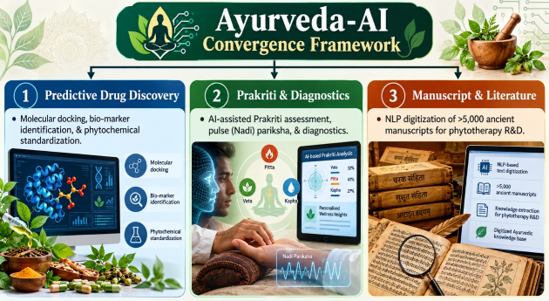
Introduction: The Institute of Teaching and Research in Ayurveda (ITRA), Jamnagar, under the Ministry of Ayush, organized the national symposium ‘Ayutech Navonmesh 2026’ marking the Institute’s 6th Foundation Day. The theme “Application of Artificial Intelligence (AI) in Ayurveda” to integrate traditional knowledge with digital technologies for drug discovery, clinical research, and standardized healthcare delivery.
Integration Architecture:
Key Highlights:
-
- Global Collaboration: Feature participation from the WHO Global Traditional Medicine Centre (GTMC, Jamnagar) and WHO Switzerland Digital Health Division, alongside national bodies like NIPER Gandhinagar and Gujarat Ayurved University.
- Core Domains of AI Deployment:
- Drug Development & Quality Assurance: Machine-learning models for botanical authentication, heavy metal safety limits, and active phytocompound profiling.
- Precision Healthcare: AI-driven diagnostic tools for individual Prakriti (body constitution) mapping and personalized regimen formulation.
- Medical Education & Research: AI-assisted systematic reviews and predictive disease modeling using real-world clinical data.
- Institutional Profile — ITRA Jamnagar:
- Dedicated on October 15, 2020, as India’s first and only Institute of National Importance (INI) in the field of Ayurveda (under the ITRA Act, 2020).
- Houses 300 NABH-accredited hospital beds, 6 NABL-accredited diagnostic laboratories, over 30,000 books, and more than 5,000 rare Ayurvedic manuscripts.
UPSC Quick Reference Table
| Feature | Detailed Specification |
| Nodal Institution | Institute of Teaching and Research in Ayurveda (ITRA), Jamnagar |
| Parent Ministry | Ministry of Ayush, Government of India |
| Statutory Status | Institute of National Importance (INI) (Conferred via ITRA Act, 2020) |
| Event Name & Dates | Ayutech Navonmesh 2026 | October 15–16, 2026 (6th Foundation Day) |
| Central Theme | Application of Artificial Intelligence (AI) in Ayurveda |
| Key Partner Body | WHO Global Traditional Medicine Centre (GTMC), Jamnagar |
Conclusion:
Ayutech Navonmesh 2026 highlights the modernization of India’s traditional medicine ecosystem leveraging artificial intelligence alongside ITRA’s institutional capabilities helps validate Ayurvedic therapies.
TOPIC-3: Multi-State Co-operative Societies (Auditor’s Report) Order, 2026 (MSCARO, 2026)
-
- UPSC Relevance: GS Paper 2 (Statutory Bodies, Regulatory Oversight, Central Registrar of Cooperative Societies [CRCS], Good Governance, & E-Governance) & GS Paper 3 (Indian Economy — Cooperative Sector Reforms, Financial Stress Detection, Cyber Security, & Anti-Money Laundering [PMLA]).
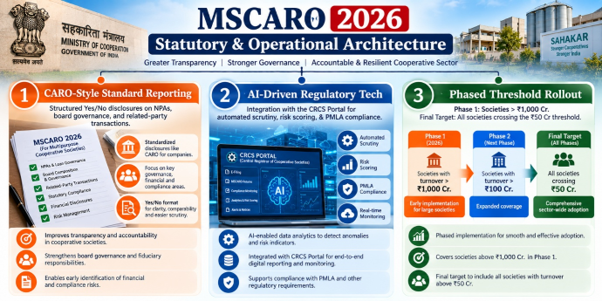
Introduction: Under the vision of ‘Sahkar se Samriddhi’, the Ministry of Cooperation mandated the Multi-State Co-operative Societies (Auditor’s Report) Order, 2026 (MSCARO, 2026) formulated under Section 73(6) of the amended Multi-State Co-operative Societies Act (2023).
Statutory Backing: The framework was formulated following consultations with the Reserve Bank of India (RBI), Institute of Chartered Accountants of India (ICAI), Comptroller and Auditor General of India (CAG), and various Multi-State Cooperative Societies (MSCS).
Key Highlights:
-
- Early Detection of Financial Stress: Mandates structured reporting on Non-Performing Assets (NPAs), overdue loans, liquidity ratios, repayment defaults, and borrowing limits to identify vulnerabilities before systemic failure occurs.
- Standardized Governance Audits: Requires statutory auditors to verify board eligibility, statutory committee functioning, Annual General Meeting (AGM) timelines, and related-party transaction approvals.
- Cybersecurity & PMLA Verification: Extends audit mandates to cover institutional cybersecurity measures and Anti-Money Laundering (AML) compliance under the Prevention of Money Laundering Act (PMLA), including Principal Officer appointments and Suspicious Transaction Reporting (STR).
- Tech-Enabled Supervision via CRCS Portal: Integrates audit data into the Central Registrar of Cooperative Societies (CRCS) Portal to enable AI-driven analytics, automated risk scoring, and targeted inspection dashboards.
- Phased Implementation Schedule:
- Phase 1: Applies immediately to large-scale MSCS exceeding ₹1,000 crore in relevant financial thresholds.
- Long-Term Objective: Expands to cover all MSCS crossing the ₹50 crore threshold, giving smaller cooperatives time to upgrade internal accounting systems.
UPSC Quick Reference Table
| Feature | Detailed Specification |
| Nodal Ministry | Ministry of Cooperation |
| Enabling Provision | Section 73(6) of the Multi-State Co-operative Societies (Amendment) Act, 2023 |
| Regulatory Benchmark | Modelled on corporate sector CARO (Companies (Auditor’s Report) Order) |
| Regulatory Portal | CRCS Portal (Central Registrar of Cooperative Societies) |
| Compliance Inclusions | PMLA (Anti-Money Laundering), Cybersecurity Audit, & Related-Party Transactions |
| Implementation Phasing | Initial threshold: > ₹1,000 Crore | Eventual threshold: > ₹50 Crore |
Conclusion:
Introducing MSCARO 2026 represents a shift toward financial discipline, transparency, and modern corporate governance across Multi-State Cooperative Societies.
TOPIC-4: Central Government Approves India’s Accession to SIOFA
-
- UPSC Relevance: GS Paper 2 (Bilateral, Regional, and Global Groupings and Agreements involving India; UNCLOS, High Seas Governance, Regional Fisheries Management Organizations [RFMOs]) & GS Paper 3 (Indian Economy — Blue Economy, Deep-Sea Fishing, High Seas Fisheries Guidelines 2025, Strategic Marine Resources, & Coastal Security).
Introduction: The Central Government approved India’s full accession to the Southern Indian Ocean Fisheries Agreement (SIOFA) on October 14, 2026. Transitioning from a Cooperating Non-Contracting Party (CNCP) to a full Contracting Party. The decision expands India’s deep-sea fishing fleet into international waters, secures legitimate high-seas fishing rights and strengthens India’s role in global fisheries governance in alignment with national Blue Economy priorities.
Strategic Context:
-
- The High Seas comprise approximately 65% of the global ocean, historically dominated by five major distant-water fishing entities: China (21%), Taiwan (13%), Japan (11%), South Korea (11%), and Spain (8%).
- Indian fishing vessels have operated mostly within 60–80 nautical miles of the Exclusive Economic Zone (EEZ).
- Full accession to SIOFA follows the Guidelines for High Sea Fisheries (issued in December 2025) to help scale up Indian-flagged deep-sea vessels across international waters.
Key Highlights:
-
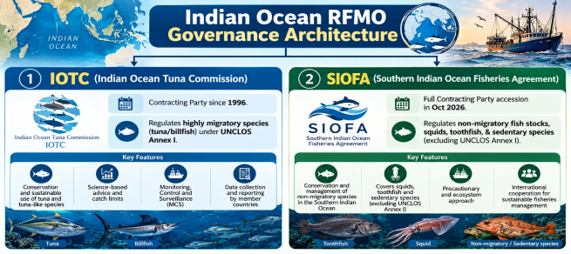
- Targeted High-Value Marine Species: Authorizes Indian-flagged vessels to harvest non-migratory deep-water stocks including squids, Patagonian toothfish, alfonsino, crustaceans, and molluscs within SIOFA’s high-seas jurisdiction.
- Full Voting Rights & Scientific Co-operation: Grants India voting rights on key statutory bodies, including the Scientific Committee and the Compliance Committee, allowing full access to global stock assessment data and research programs.
- Enforcement & Maritime Security (HSBI Scheme): Enables India to participate in the High Seas Boarding and Inspection (HSBI) Scheme under SIOFA to curb Illegal, Unreported, and Unregulated (IUU) fishing, reinforcing national maritime domain awareness.
- Jurisdictional Scope: SIOFA covers non-migratory fishery resources in the Southern Indian Ocean, explicitly excluding highly migratory species covered under UNCLOS Annex I (managed by IOTC) and coastal state continental shelf species under UNCLOS Article 77(4).
UPSC Quick Reference Table
| Feature | Detailed Specification |
| Nodal Body (India) | Department of Fisheries, Ministry of Fisheries, Animal Husbandry and Dairying |
| Agreement Name | Southern Indian Ocean Fisheries Agreement (SIOFA) |
| Membership Upgrade | Shifted from CNCP (Cooperating Non-Contracting Party since 2022) to Contracting Party |
| Enabling Policy | Guidelines for High Sea Fisheries (December 2025) |
| Target Fisheries | Non-migratory stocks: Squid, toothfish, alfonsino, molluscs, & crustaceans |
| Security Framework | Participation in High Seas Boarding & Inspection (HSBI) Scheme to combat IUU fishing |
Conclusion:
India’s full accession to SIOFA marks a step in expanding its presence across the high seas by securing voting rights, access to marine data and deep-sea harvesting privileges in the Southern Indian Ocean.
TOPIC-5: India’s Ramsar Site Tally Reaches 103 — Inclusion of Sukhna Wetland & Sauj Jheel
-
- UPSC Relevance: GS Paper 3 (Environment & Ecology — Biodiversity Conservation, Ramsar Convention on Wetlands, Amrit Dharohar Capacity Building Scheme, & Climate Security).
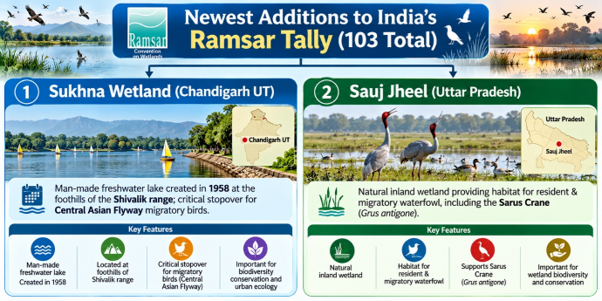
Introduction: India’s total tally of Ramsar Sites (Wetlands of International Importance) has reached 103. The announcement follows the official designation of Sukhna Wetland in Chandigarh and Sauj Jheel in Uttar Pradesh, reinforcing India’s commitment to wetland conservation, biodiversity protection, and water security under global environmental treaties.
Ecological Significance:
-
- Sukhna Wetland (Chandigarh): Situated at the base of the Shivalik hills, this man-made reservoir serves as a major habitat for migratory waterfowl traveling along the Central Asian Flyway (CAF), including species like the Ruddy Shelduck, Pintail, and Common Teal.
- Sauj Jheel (Uttar Pradesh): Adds to Uttar Pradesh’s growing roster of protected wetlands. It acts as a vital breeding and foraging ground for local avian fauna, specifically supporting vulnerable species like the Sarus Crane and various marshland biodiversity clusters.
Policy Framework:
-
- Ramsar Convention Alignment: India became a party to the Ramsar Convention on Wetlands in 1982. The treaty promotes the “wise use” of all wetlands through local, regional, and national actions.
- Amrit Dharohar Capacity Building Scheme: Launched to promote eco-tourism, local livelihood generation, and carbon sequestration across Ramsar sites in alignment with community-led conservation models.
- Montreux Record Context: Distinct from the general Ramsar list, the Montreux Record tracks wetlands facing ecological character changes due to technological developments or pollution (India currently has two sites listed: Keoladeo National Park, Rajasthan and Loktak Lake, Manipur).
UPSC Quick Reference Table
| Feature | Detailed Specification |
| Nodal Ministry | Ministry of Environment, Forest and Climate Change (MoEFCC) |
| International Treaty | Ramsar Convention on Wetlands (1971) |
| Total Indian Sites | 103 Sites (Reached in October 2026) |
| New Site 1 | Sukhna Wetland (Chandigarh UT) |
| New Site 2 | Sauj Jheel (Uttar Pradesh) |
| Key Conservation Policy | Amrit Dharohar Scheme & Wetlands (Conservation and Management) Rules, 2017 |
Conclusion:
Designating Sukhna Wetland and Sauj Jheel as Wetlands of International Importance helps preserve avian biodiversity, improves climate resilience and supports local eco-tourism and sustainable community livelihoods.
TOPIC-6: BSIP Study on Indian Summer Monsoon Fluctuations & Early Agricultural Adaptations
-
- UPSC Relevance: GS Paper 1 (Geography — Indian Summer Monsoon System, Paleoclimatology, & Holocene Climate Events) & GS Paper 3 (Science & Technology — Birbal Sahni Institute of Palaeosciences [BSIP], Climate Resilience, & Sustainable Agriculture).
Introduction: A landmark study by scientists at the Birbal Sahni Institute of Palaeosciences (BSIP), Lucknow, published in the Journal of Asian Earth Sciences, reconstructed 4,600 years of climate and environmental history in the Central Ganga Plain by analyzing multi-proxy sedimentary records from Karela Lake (an oxbow lake in Hulas Khera near Lucknow). The study reveals how Indian Summer Monsoon (ISM) fluctuations dictated lake hydrology, vegetation dynamics, soil microbial activity and early farming adaptation strategies following the post-Indus Valley epoch.
Research Methodology:
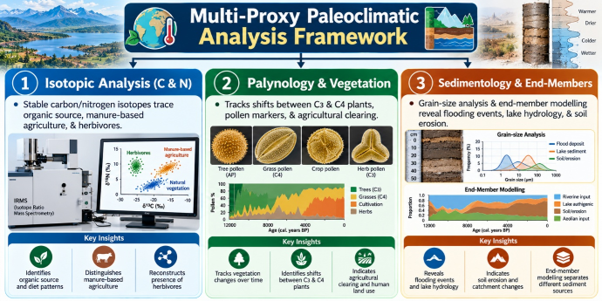
The study provides a continuous natural archive of environmental change in the Central Ganga Plain by coupling high-resolution AMS (Accelerator Mass Spectrometry) radiocarbon dating with geochemical and biological proxies:
Anthropogenic Adaptation:
-
- Climatic Epochs Identified: The study mapped four distinct environmental phases tied to global climate anomalies:
- 4.2 ka Arid Event: Severe monsoonal weakening that forced changes in cropping patterns and agricultural practices.
- Roman Warm Period: Increased monsoonal moisture favoring agricultural expansion.
- Little Ice Age (LIA): Recorded flooding events linked to altered westerly winds and cooler climatic conditions.
- Agricultural Adaptation & Livestock Management: Isotopic signatures of nitrogen () and organic matter reveal early farmers used manure-based agricultural practices and integrated livestock rearing to withstand monsoon variability.
- Sensitivity of Oxbow Lakes: Establishes that small oxbow lakes in the Central Ganga Plain act as sensitive natural paleoclimatic archives, preserving evidence of historical human-environment interactions.
- Climatic Epochs Identified: The study mapped four distinct environmental phases tied to global climate anomalies:
UPSC Quick Reference Table
| Feature | Detailed Specification |
| Research Institute | Birbal Sahni Institute of Palaeosciences (BSIP), Lucknow (Autonomous institute under DST) |
| Study Site | Karela Lake (Oxbow lake), Hulas Khera, Mohanlalganj, Lucknow, UP |
| Chronological Horizon | 4,600 Years BP (Late Holocene Epoch) |
| Primary Journal | Journal of Asian Earth Sciences (2026) |
| Key Proxy Methods | AMS Radiocarbon Dating, & Stable Isotopes, Palynology, Grain-size End-Member Modeling |
| Key Findings | Monsoon shifts drove plant transitions, flooding in LIA, & early manure-based crop adaptation |
Policy Implications:
-
- Long-Term Climate Modeling: Generates foundational baseline data to refine predictive regional climate models for the Central Ganga Plain, one of the world’s most densely populated agricultural regions.
- Food & Water Security Planning: Informs modern climate adaptation policies, wetland conservation strategies, and crop diversification frameworks by learning from historic agricultural resilience mechanisms.
Conclusion:
The BSIP study by detailing the adaptive strategies of post-Indus agricultural communities including crop diversification and livestock manure utilization the research demonstrates the historical resilience of regional farming systems. It will be crucial for building climate-resilient food and water security systems across the densely populated Indo-Gangetic basin.
Spread the Word