TOPIC-1: India–Czech Republic Defence Industrial Cooperation
-
- UPSC Relevance: GS Paper 2 (Bilateral Groupings & Agreements involving India; India–Central Europe Relations) & GS Paper 3 (Defence Industrial Infrastructure, Joint Ventures, Make-in-India in Defence, & Strategic Aatmanirbhar Bharat).
Context: Raksha Mantri Shri Rajnath Singh held a bilateral meeting with the 1st Deputy Prime Minister and Minister of Industry & Trade of the Czech Republic, Mr. Karel Havlíček, in New Delhi on October 13, 2026. The two leaders reviewed the entire spectrum of bilateral defence ties and agreed to expand defence industrial collaboration in alignment with India’s Make-in-India and Aatmanirbhar Bharat initiatives.
Defence Synergy:
-
- India and Czech Republic share a long-standing partnership in heavy engineering, defence manufacturing, and industrial tech transfer.
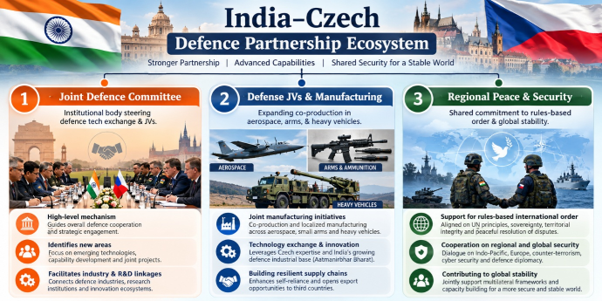
- Bilateral defence engagements are primarily driven through the institutional framework of the India–Czech Joint Defence Committee which serves as the principal body for identifying technology co-development, joint ventures (JVs) and supply chain integration across military platforms.
Key Highlights:
-
- Expansion of Joint Ventures: Both sides praised existing joint manufacturing ventures (including automotive/heavy vehicle chassis for military transport and small arms tech) and agreed to deepen cooperation under the India-Czech Joint Defence Committee.
-
- Support for Aatmanirbhar Bharat: Discussions focused on shifting from a buyer-seller relationship to joint R&D, local assembly, and technological co-production within Indian defence industrial corridors.
- Geopolitical & Regional Security Review: Exchanged perspectives on global security challenges, stressing the need for international cooperation to preserve regional peace and maritime/terrestrial stability.
UPSC Quick Reference Table
| Feature | Detailed Specification |
| Nodal Ministries | Ministry of Defence (India) & Ministry of Industry and Trade (Czech Republic) |
| Key Dignitaries | Shri Rajnath Singh (Raksha Mantri) & Mr. Karel Havlíček (1st Deputy PM & Minister of Industry & Trade) |
| Institutional Mechanism | India–Czech Joint Defence Committee |
| Strategic Focus | Defence industrial JVs, co-production, and alignment with Make-in-India |
| Industrial Tour Cities | New Delhi, Bengaluru, and Mumbai |
Conclusion:
India and Czech Republic reinforces India’s focus on domestic defence manufacturing under Aatmanirbhar Bharat. Leveraging Czech strengths in precision engineering, aviation, and heavy machinery helps diversify India’s defence supply chains and strengthens strategic cooperation with Central European partners.
TOPIC-2: India–Canada Roundtable on Pulse Protein Innovation
-
- UPSC Relevance: GS Paper 2 (Bilateral Groupings & International Institutional Cooperation — India–Canada Academic/Scientific Ties, Shastri Indo-Canadian Institute) & GS Paper 3 (Agriculture & Food Processing Industries — Pulse Value Addition, Food Security [SDG 2.2], Functional Protein Extraction, & NIFTEM Initiatives).
Introduction: The National Institute of Food Technology Entrepreneurship and Management, Kundli (NIFTEM-K)—an Institute of National Importance under the Ministry of Food Processing Industries (MoFPI) hosted a high-level Roundtable Conference on “Pulse Protein Innovation, Value Addition and Strategic Partnerships” on October 13, 2026.
Bilateral Food Innovation Architecture:
-
- India is the world’s largest consumer and producer of pulses, while Canada (led by the province of Saskatchewan) is a major global exporter of dry peas, lentils, and chickpeas.
- This partnership bridges Canada’s agricultural supply chain and pulse breeding with NIFTEM-K’s food engineering, fortification, and market commercialization infrastructure.
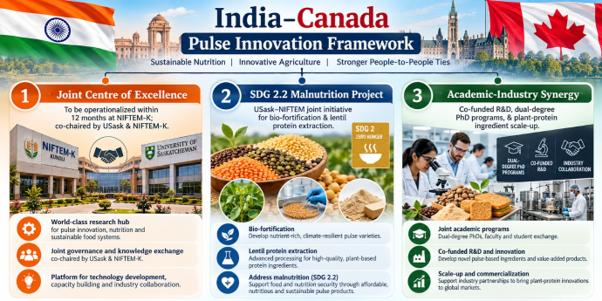
- The event brought together diplomatic, academic, and industrial delegations from India and Canada (specifically Saskatchewan and Alberta) to accelerate pulse processing technology and establish a joint Centre of Excellence.
Technical Research Priorities:
-
- Institutional Governance & Joint Centre of Excellence: Actioned the MoU signed between NIFTEM-K and the University of Saskatchewan (USask) to set up a dedicated Centre of Excellence for Pulse Protein at NIFTEM-K within one year.
- Research Roadmap & SDG 2.2 Alignment: Launched a multi-country research program titled “Sustainable Health Innovation in Fortification (Lentils) for SDG 2.2 (End All Forms of Malnutrition)”, co-submitted by USask and NIFTEM-K for Canadian government funding.
- Overcoming Pulse Processing Bottlenecks: Identified critical food engineering challenges, including:
- Functional Integrity: Preserving protein solubility, emulsification, and gelation properties during extraction.
- Sensory & Texture Profiles: Eliminating off-flavors (beany notes) and improving texture for plant-based meat and dairy alternatives.
- Process Efficiency: Lowering thermal energy and water consumption during isolate/concentrate extraction.
- Academic Exchange & Dual PhD Program: Instituted joint PhD research pathways where USask scholars conduct field trials and food matrix testing at NIFTEM-K facilities.
- Broad Industry Representation: Attended by Pulse Canada, Saskatchewan Pulse Growers, Good Food Institute India, ICAR-IIPR Kanpur, and ICRISAT.
UPSC Quick Reference Table
| Feature | Detailed Specification |
| Nodal Institution (India) | NIFTEM-K (Ministry of Food Processing Industries) |
| Primary Canadian Partner | University of Saskatchewan (USask) & Government of Saskatchewan |
| Key Anchor Organisms | Pulse Canada, Saskatchewan Pulse Growers, & ICAR-IIPR |
| Core Target | Establish Joint Centre of Excellence for Pulse Protein within 1 year |
| SDG Alignment | SDG 2.2 (Zero Hunger / Ending Malnutrition by 2030) |
| R&D Priority | Pulse protein extraction, flavor masking, texture optimization, & bio-fortification |
Conclusion:
The India–Canada Roundtable on Pulse Protein Innovation strengthens scientific collaboration between two major pulse ecosystems. Translating research into commercial protein extraction, food fortification and value addition supports food processing.
TOPIC-3: iGOT Karmayogi Platform Expanded to Adi Karmayogi Volunteers (AKVs)
-
- UPSC Relevance: GS Paper 2 (Government Policies and Interventions for Vulnerable Sections, Tribal Welfare, Mission Karmayogi, Capacity Building Frameworks, & Digital Governance) & GS Paper 3 (Invasive Technology at Grassroots & Inclusive Growth).
Introduction: The Ministry of Tribal Affairs (MoTA) and Karmayogi Bharat signed a Memorandum of Understanding (MoU) in New Delhi on October 13, 2026, to launch a dedicated Adi Karmayogi microsite under the iGOT Karmayogi framework. This initiative extends the civil service capacity-building framework of Mission Karmayogi to grassroots Adi Karmayogi Volunteers (AKVs) and village-level tribal welfare functionaries.
Mission Karmayogi Meets Adi Karmayogi Abhiyan:
While Mission Karmayogi (National Programme for Civil Services Capacity Building) originally focused on modernizing civil servants from a “rule-based” to a “role-based” framework. This initiative decentralizes governance tools directly to tribal communities.
-
- It operationalizes the Adi Karmayogi Abhiyan by embedding digital training into grassroots delivery channels: Current Scale: Out of the target 76,000 ASKs and 1,54,000 AKVs, 60,507 ASKs and 1,22,072 AKVs are already registered on the national portal.
Key Architectural Features:
-
- Digital Accessibility & Mobile Learning: The dedicated AKV microsite on iGOT provides mobile-friendly, standardized learning modules covering tribal welfare schemes (e.g., PM-JANMAN, DAJGUA, EMRS, and FRA rights), complete with assessment tests and digital certificates.
- Institutional Division of Roles:
- Karmayogi Bharat (SPV): Hosts, maintains, and operates the platform, handles technical support, onboarding, and state-wise progress analytics.
- Ministry of Tribal Affairs (MoTA): Functions as domain owner, defining competencies, approving localized content, and driving platform adoption.
- Blended Learning (Field + Digital): Complements a 3-day in-person training program delivered via State Administrative Training Institutes (ATIs) and Tribal Welfare Departments. Priority States (Maharashtra, Odisha, Goa, and Tripura) aim for completion by October 31, 2026, with nationwide coverage targeted for December 31, 2026.
UPSC Quick Reference Table
| Feature | Detailed Specification |
| Nodal Ministries | Ministry of Tribal Affairs (MoTA) & Karmayogi Bharat (DoPT SPV) |
| Core Platform | iGOT Karmayogi (Integrated Government Online Training) |
| Target Audience | Adi Karmayogi Volunteers (AKVs) & grassroots tribal functionaries |
| Grassroots Hubs | Adi Sewa Kendras (ASKs) (Target: 76,000+ village centers) |
| Core Training Focus | Scheme entitlements (PM-JANMAN, FRA), bottom-up village planning, & last-mile delivery |
| Key Flagship Parent | Mission Karmayogi & Adi Karmayogi Abhiyan |
Conclusion:
Expanding the iGOT Karmayogi platform to Adi Karmayogi Volunteers represents a shift toward decentralized, citizen-centric tribal governance. Equipping local community volunteers with digital tools, scheme literacy, and leadership training strengthens Adi Sewa Kendras as effective institutions for last-mile delivery and inclusive development under Viksit Bharat 2047.
TOPIC-4: Inaugural ASEAN-India Defence Think Tank Forum (2026)
-
- UPSC Relevance: GS Paper 2 (Bilateral, Regional, and Global Groupings; ASEAN-India Defence Relations, Act East Policy, SAGAR & MAHASAGAR Visions) & GS Paper 3 (Security Challenges & Defence Infrastructure — Maritime Domain Awareness, Defence Co-Production [iDEX/TDF], Counter-Drone Systems, & HADR).
Introduction: The maiden ASEAN-India Defence Think Tank Forum held at the Manohar Parrikar Institute for Defence Studies and Analyses (MP-IDSA), New Delhi, on October 14, 2026.
Strategic Context:
-
- The forum follows the announcement made by the Raksha Mantri at the 2nd ASEAN-India Defence Ministers’ Informal Meeting in Kuala Lumpur (October 2025).
- India’s security posture bridges domestic self-reliance (Aatmanirbhar Bharat) with regional maritime security frameworks, emphasizing that self-reliance does not imply isolation, but rather creates trusted partnerships for co-development and long-term technical support.
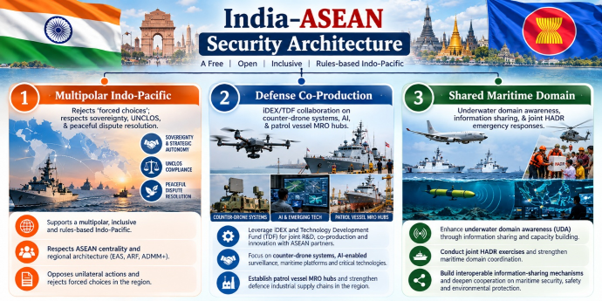
- It is aligned with the ASEAN-India Year of Maritime Cooperation (2026). The forum institutionalized Track-1.5 strategic dialogue between India and all eleven ASEAN member states to build an rules-based Indo-Pacific.
Key Highlights:
-
- Rules-Based Maritime Order: Stressed expanding Underwater Domain Awareness (UDA), maritime information sharing, and joint coast guard/naval operations to counter illegal fishing, piracy, and sea-lane disruptions under UNCLOS.
- Defense Tech & Co-Production Framework: Urged ASEAN partners to move beyond buyer-seller relationships toward Co-Development, Co-Production, and MRO (Maintenance, Repair, and Overhaul). Highlighted India’s willingness to share platforms like patrol vessels, radar systems, air defense, and drones.
- Innovation & Start-up Synergy: Proposed linking ASEAN tech ecosystems with Indian initiatives like iDEX (Innovations for Defence Excellence) and the TDF (Technology Development Fund) to address low-cost asymmetrical threats (e.g., counter-drone tech, cyber defense).
- Practical Action Plan for Think Tanks: Suggested concrete outcomes, including:
1. Developing a joint India-ASEAN research agenda (maritime, cyber, space, HADR).
2. Executing pilot projects, such as a joint tabletop exercise on maritime disaster response.
3. Establishing young-scholar fellowship exchanges and Track-1.5 policy feedback channels.
UPSC Quick Reference Table
| Feature | Detailed Specification |
| Nodal Institution | Manohar Parrikar Institute for Defence Studies and Analyses (MP-IDSA) |
| Event Name | 1st ASEAN-India Defence Think Tank Forum (Oct 14–15, 2026) |
| Designated Theme Year | 2026: ASEAN-India Year of Maritime Cooperation |
| Core Doctrines | Act East Policy, SAGAR, and MAHASAGAR |
| Tech Incubators | iDEX (Innovations for Defence Excellence) & TDF (Technology Development Fund) |
| Key Operational Pillars | Maritime Domain Awareness (MDA/UDA), Counter-Drone Systems, MRO Hubs, & HADR |
Conclusion:
The launch of the ASEAN-India Defence Think Tank Forum deepens strategic engagement between India and Southeast Asia. Hence linking defence co-production, startup innovation, and underwater domain awareness under SAGAR and MAHASAGAR frameworks reinforces India’s commitment to rules-based Indo-Pacific.
Spread the Word