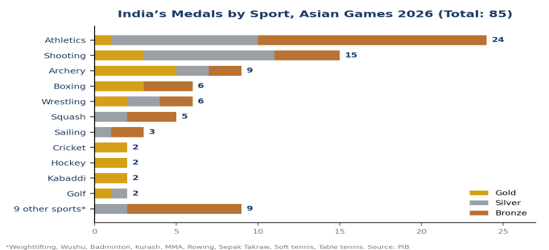
Introduction: The 20th Asian Games were held in Aichi-Nagoya, Japan (19 September–4 October 2026) under the slogan “Imagine One Asia”. India sent one of its largest-ever contingents (501 athletes, 36 disciplines) and finished with 85 medals (21 Gold, 27 Silver, 37 Bronze). India’s link with the Games is historic, as it hosted the first Asian Games in New Delhi in 1951, and its present sports ecosystem (Khelo Bharat Niti, Khelo India, TOPS) aims at Los Angeles 2028 and the 2036 Olympics.
Basic Facts
-
- Asian Games (Asiad): Biggest sports competition in Asia, held every four years, organised by the Olympic Council of Asia (OCA); currently 45 participating countries or regions.
- 2026 edition: 16 days, 43 sports, 71 disciplines, 469 events and 1,407 medals.
- Host: Japan’s third time hosting (earlier Tokyo 1958 and Hiroshima 1994).
- 5th Asian Para Games: 18–24 October 2026, Aichi-Nagoya; first time Japan hosts the Para Games.
- Emblem and mascot: The emblem uses purple (iris), gold (Kinshachi of Nagoya Castle) and green (environmental consciousness: EXPO 2005, COP10) leading to the red sun of the OCA. Mascot “HONOHON” (from ‘honoho’, flame) is inspired by the Shachihoko, the guardian deity of Nagoya Castle.
India’s Founding Role: First Asian Games, 1951
-
- Idea: Conceived by G.D. Sondhi, IOC member for India proposed at a conference of Asian countries in New Delhi (1947).
- Context: Post-World War II efforts to strengthen Asian ties, with many regions recently decolonised; India saw it as a way to display unity and rebuild bonds broken by the war.
- First edition (March 1951) was opened by President Rajendra Prasad at the National Stadium. 11 nations, 489 athletes, 6 sports; India finished second (behind Japan).
- Over time, the Games have fostered friendship, world peace and respect for diversity.
India at Aichi-Nagoya 2026
-
- Contingent: 501 athletes across 36 disciplines; 300+ athletes were debutants, showing growing bench strength.
- Send-off (8 September 2026): Dr Mandaviya, IOA President Dr P.T. Usha and Chef de Mission Sahdev Yadav unveiled the official jersey.
- Opening ceremony: Flag-bearers were Manu Bhaker (double Olympic medallist) and Pawan Sehrawat (Kabaddi).
Gold medal highlights (21):
-
- Archery led with 5 golds; Shooting and Boxing won 3 each.
- Team sports “gold rush”: Cricket, Hockey and Kabaddi won 2 golds each (men’s cricket beat Pakistan by 19 runs in the final; men’s hockey retained the title with a 5-1 win over Malaysia; men’s and women’s kabaddi both won gold).
- Other golds: Wrestling (2), Athletics (1), Golf (1).
Asian Para Games 2026 and India
-
- Participation: About 3,000 athletes from 45 National Paralympic Committees, 18 Para sports.
- India participates through the Paralympic Committee of India (PCI), marking its fifth appearance.
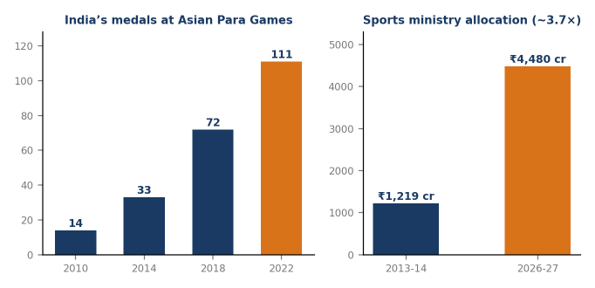
- Benchmark: Hangzhou 2022 was a record 111 medals (29 Gold), of which 40 (36%) were won by women.
Policy Push for Sports
| Initiative | Key Features |
|---|---|
| Khelo Bharat Niti (1 July 2025) | National sports policy: inclusive, performance-driven system; bridges rural–urban gap; community participation and partnerships to cut costs; links sport with NEP 2020; supports women, tribal communities and PwDs; targets excellence at 2036 Olympics. |
| Budget support | ₹4,479.88 crore in Union Budget 2026-27 (from ₹1,219 crore in 2013-14); ₹500 crore for sports goods manufacturing. |
| Khelo India (revamped 2026-27 to 2030-31) | Combined outlay ₹36,441 crore (with National Sports Federations); ₹924.35 crore for 2026-27; earlier outlay ₹3,790.50 crore (2021-26). 1,067 Khelo India Centres; 349 infrastructure projects (₹3,176 crore); 2,745 Khelo India Athletes; 63,000+ athletes in Khelo India Games since 2018. |
| KIRTI | Talent identification for children aged 9–18 through 174 Talent Assessment Centres using data tools for merit-based selection. |
| TOPS | Foreign training, competitions, camps, equipment; stipend ₹50,000/month (Core), ₹25,000/month (Development); supports 55 Core, 62 Para Core, 140 Development athletes (April 2026); helped at Tokyo 2020 and Paris 2024. |
| National Sports University, Imphal (2018) | Sports science, technology, management and coaching. |
| Fit India Movement | Makes fitness part of daily life. |
| National Sports Governance Act (Bill passed Aug 2025) | National Sports Board to recognise sports bodies; National Sports Tribunal to settle disputes. |
Roadmap: A ten-year plan with over ₹36,000 crore for sports infrastructure, and a 360-degree approach involving federations, States and other stakeholders, aimed at LA 2028 and 2036.
Significance
-
- From 1951 Asiad to present, sport reflects India’s Asian solidarity and cultural diplomacy.
- Debutants (300+) and diverse medals reflect widening participation, including Para athletes and women.
- Sports goods manufacturing (₹500 crore), infrastructure and events create jobs and sports economy.
- Link with Fit India, NEP 2020 and school sports improves fitness and discipline.
- National Sports Governance Act with Board and Tribunal improves accountability and dispute resolution.
- Provides a stepping stone to LA 2028 and the 2036 Olympics.
Challenges
-
- Compared with India’s earlier record at the Hangzhou Asian Games (107 medals, 28 gold), the 85-medal outcome is lower, and Asia’s China, Japan and Korea dominate multi-sport events.
- Sports is a State subject (Entry 33, List II), leading to uneven infrastructure and funding across States.
- Disputes, delays in elections and lack of professional management were the reasons behind the Sports Governance Act. Its implementation capacity is yet to be tested.
- WADA reports have repeatedly placed India among countries with high anti-doping violations, which harms credibility.
- Heavy government dependence and limited private and CSR investment in sports.
- Success at the Asian level has not fully translated into Olympic podiums (e.g., Paris 2024 saw no gold).
Way Forward
-
- Adopt Australia’s Australian Institute of Sport (AIS) approach to centralised sports science and athlete pathways.
- Follow UK Sport’s “no compromise” model (lottery funding tied to medal potential), which lifted British Olympic performance after 1996.
- Learn from Japan’s post-Tokyo legacy of school and community sports clubs (Bukatsu) to build the talent base.
- Strengthen KIRTI-based early talent scouting and district-level Khelo India Centres, with focus on girls, tribal and rural youth.
- Operationalise National Sports Board and Tribunal quickly with transparent federation elections and a strong NADA for anti-doping.
- Promote private and CSR funding, sports goods manufacturing and sports tourism through events like CWG 2030 (Ahmedabad) and the 2036 Olympic bid.
Conclusion
India’s 85-medal, 21-gold campaign at Aichi-Nagoya shows depth and growing bench strength but turning this momentum into Olympic success will depend on strong accountable governance, sports science and sustained funding in line with the vision of a sporting nation by 2036.
Spread the Word