CONTEXT: The 2nd edition of the FHI released by NITI Aayog (March 2026) ranks 18 major States and for the first time, 10 North-Eastern & Himalayan States on fiscal soundness using CAG-verified data for FY 2023-24. Amid rising global public debt (USD 102 trillion, 2024) and States now accounting for nearly one-third of India’s general government debt.
Key Findings of the Report
-
- Odisha ranks 1st among 18 major States with an FHI score of 73.1 (up from 67.4 in 2022-23) driven by controlled deficits, high-quality expenditure and prudent debt management.
- Goa (2nd, 54.7) and Jharkhand (3rd, 50.5) complete the ‘Achiever’ category. They marked by own-tax shares above 60% and fiscal deficits below 3% of GSDP.
- Punjab ranks lowest (18th, 12.4), followed by Andhra Pradesh, West Bengal and Kerala. The ‘Aspirational’ group facing debt of 35-45% of GSDP and committed expenditure of 50-60% of revenue receipts.
- Among NE/Himalayan States, Arunachal Pradesh tops (59.5) on strong expenditure quality while Himachal Pradesh and Manipur trail due to weak revenue mobilisation and high committed spending.
- Most major States improved on Quality of Expenditure, but several (Karnataka, Telangana, Kerala, Tamil Nadu) slipped a category. Thus, signalling emerging fiscal stress even among mid-tier performers.
State-wise Breakdown: FHI Classification, FY 2023-24 (18 Major States)
| Category | Major States (Rank, FY 2023-24) |
|---|---|
| Achiever | Odisha (1), Goa (2), Jharkhand (3) |
| Front Runner | Gujarat (4), Maharashtra (5), Chhattisgarh (6), Telangana (7), Uttar Pradesh (8), Karnataka (9) |
| Performer | Madhya Pradesh (10), Haryana (11), Bihar (12), Tamil Nadu (13), Rajasthan (14) |
| Aspirational | Kerala (15), West Bengal (16), Andhra Pradesh (17), Punjab (18) |
India-Specific Data
| Indicator | Value / Data Point |
|---|---|
| Global public debt (2024) | USD 102 trillion |
| Developing countries' share of debt spent on debt service (≥) | 6.5% of export earnings (half of developing countries) |
| Countries spending more on interest than health/education | 46 countries, affecting 3.4 billion people |
| Share of India's general government debt held by States | ~ one-third |
| States covered in FHI 2026 (2nd edition) | 18 Major States + 10 NE/Himalayan States |
Comparative Trend: Top-4 vs Bottom-Ranked State (FHI Score, 2014-15 to 2023-24)
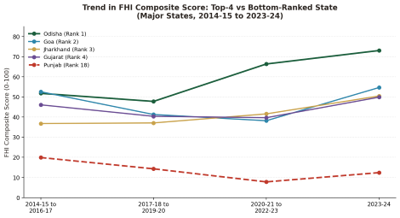
Note: Scores are 3-year period averages except FY 2023-24, which is a single-year score. Source: NITI Aayog FHI 2026, Table A2.
Recommendations from the Report
-
- Strengthen revenue mobilisation by broadening GST bases and enhancing own-tax capacity, especially in Aspirational-category States, while curbing committed expenditure to restore fiscal flexibility.
- Rationalise subsidies, adopt standard expenditure heads, and improve the quality and composition of capital spending via medium-term fiscal plans.
- Undertake targeted fiscal consolidation in stressed States & tighter control of off-budget borrowings and stronger cash/debt management.
- Enhance Public Financial Management systems, transparency via CAG-verified data, and peer benchmarking through tools like the FHI.
Conclusion:
The FHI 2026 shows State-level fiscal health is integral to India’s macroeconomic stability with States now holding nearly a third of general government debt. Achiever States (Odisha, Goa, Jharkhand) prove disciplined spending and strong own-revenue effort can coexist with high capital outlay, while persistent stress in Aspirational States (Punjab, West Bengal, Kerala, Andhra Pradesh) signals deep structural rigidities that call for sustained fiscal governance reform and evidence-based benchmarking.
Source: NITI Aayog, Fiscal Health Index 2026 (For the Financial Year 2023-24), published March 2026.
Spread the Word