Introduction: On 1 October 2026, Union Public Service Commission (UPSC) completes 100 years. It began on 1 October 1926 as India’s first Public Service Commission as an advisory body whose Chairman and Members were appointed by the Secretary of State in London. Over the century it evolved into an independent constitutional body (Part XIV, Articles 315–323) that recruits through merit-based open competition while steadily widening access and inclusion.
Evolution of UPSC
-
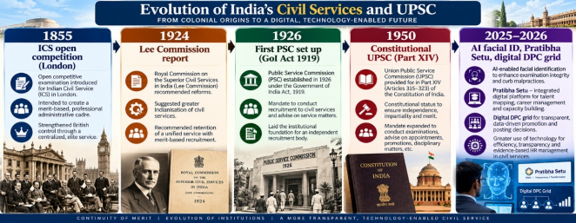
- 1855: Indian Civil Service (ICS) examination instituted in London, replacing the East India Company’s nomination system with open competition.
- The examination was held only in London, in English, with subjects like Greek and Latin, so it favoured those educated in the British system. The maximum age was cut from 23 to 19, leaving Indians little time to prepare.
- Satyendranath Tagore became the first Indian ICS officer (cleared 1863, joined 1864). By 1919, only 78 of 1,255 ICS officers were Indian.
- Government of India Act, 1919 (Montagu-Chelmsford Reforms) provided for a Public Service Commission. The ICS examination was held in India (Allahabad) for the first time in 1922.
- Lee Commission (1924) recommended a statutory Public Service Commission and a 4 British : 4 Indian : 2 promoted Indians intake, which guaranteed the British 40% of every intake by birth, not competition.
- The Commission was set up under the Public Service Commission (Functions) Rules, 1926 (Sections 96B and 96C of the 1919 Act). Sir Ross Barker was the first Chairman, at Metcalfe House, Delhi. Despite its limited powers, it was the first permanent recruiting body seated and staffed in India.
Quick Facts
-
- Civil Services Day: 21 April, marking Sardar Patel’s 1947 “steel frame of India” speech at Metcalfe House.
- HQ: Dholpur House, Shahjahan Road (since 1952), built in 1920 in Art Deco style.
- UPSC Museum: opened 11 November 2016; Golden Jubilee stamp issued 8 November 1977.
- Current Chairman: Dr. Ajay Kumar (since 15 May 2025); 3 of 8 Members are women.
- Age limits (2014): 32 / 35 / 37 years (General / OBC / SC-ST), with up to 10 years extra for PwD.
Constitutional Mandate
| Article | What it provides |
|---|---|
| 315 | PSCs for the Union and States; Joint PSC for two or more States. |
| 316 | Chairman and Members appointed by the President. |
| 317 | Removal or suspension only by the President, after a Supreme Court inquiry. |
| 318 | Regulations on conditions of service of Members and staff. |
| 319 | Restrictions on holding office after ceasing to be a Member; the UPSC Chairman is ineligible for further employment under the Centre or a State. |
| 320 | Functions: conducting examinations and advising on recruitment methods, promotions and disciplinary matters. |
| 321 | Parliament or a State Legislature may extend the Commission’s functions. |
| 322 | Expenses charged on the Consolidated Fund of India. |
| 323 | Annual report to the President; cases where advice was not accepted, with reasons, laid before Parliament. |
Functions of the UPSC
-
- Recruitment by examination: Civil Services, Indian Forest Service, Engineering Services, Combined Medical Services, NDA & NA, CDS, CAPF (Assistant Commandants), etc.
- Recruitment by selection: Interviews and tests for specialist posts requisitioned by Ministries and Departments.
- Advice to Government: On Recruitment Rules, promotions (DPCs), induction into All India Services and disciplinary cases. In 2023-24, it processed records of 24,581 officers for promotion and 532 officers were inducted into AIS.
- Police leadership: Since 2012–13, following Prakash Singh vs Union of India (2006), it empanels senior IPS officers for appointment as DGP in States.
Landmark Reforms: 1926–2026
| Year | Milestone |
|---|---|
| 1935 | GoI Act, 1935: Federal and Provincial PSCs; consultation with the Commission made mandatory on recruitment, promotions and discipline. Renamed Federal PSC (1937). |
| 1947–48 | H.K. Kripalani first Indian Chairman; ICS gives way to the IAS; first batch of IFS recruited. |
| 1950 | Federal PSC becomes UPSC on 26 January. |
| 1966 | Indian Forest Service, third All India Service, constituted. |
| 1969 / 1979 | Eighth Schedule languages allowed for Essay and GS papers; formalised in Main (1979). |
| 1979 | Kothari Committee: three-stage Civil Services Examination (Prelims, Mains, Interview). |
| 1993 | Essay paper introduced in Mains (Satish Chandra Committee recommendation). |
| 2000 | Online Recruitment Application (ORA) system launched. |
| 2011 / 2013/2015 | CSAT introduced (2011); Mains restructured with four GS papers, including Ethics, Integrity & Aptitude (2013)/CSAT made qualifying (33%). |
| 2018 | Query-Based Marks Information System; Public Disclosure Scheme (now Pratibha Setu). |
| 2022 | Four Group A Railway services unified as Indian Railway Management Service (IRMS). |
Scale and Growth
Applications across examinations and recruitment by selection rose from 42,727 (1950-51) to a peak of 45,10,044 (2022-23), an increase of over a hundredfold. In 2022-23, the Commission conducted 15 examinations (33.5 lakh applications) and handled 233 requisitions for 4,411 posts.
-
- Women: 6% of those recommended in 1952 to 31.2% in CSE 2025, with 11 of the top 25 ranks. Kiran Bedi became the first woman IPS officer (1972).
- Persons with Disabilities: Scribes since 1994; today scribe, extra time, centre of choice, escort and interview facilitator are entitlements for PwBD.
- Social inclusion: The UPSC did not frame reservation policy, but it built the national platform to implement it, including the EWS category (CSE 2019) and a transgender category in the application form (2020).
- Language: Eighth Schedule languages in Mains; interview in an Indian language with an interpreter (since 1980-81).
- Relaxations: Age relaxations for those whose preparation was disrupted by events like the Goa liberation, Bangladesh Liberation War, Uganda-Zanzibar crisis and Gulf War; women get fee exemption.
- Pratibha Setu (revamped June 2025): Connects candidates who clear all stages but narrowly miss the final list with verified employers (Ministries, PSUs, private organisations). So that talent is not lost to public service.
Recent Reforms
-
- Universal Registration Number (May 2025): Replaced One-Time Registration; one persistent identity across examinations.
- AI-based facial authentication: Piloted in September 2025; used for all ~5.50 lakh candidates at CS (Prelims) on 24 May 2026, taking 6–8 seconds per candidate, in collaboration with the National e-Governance Division.
- Data scrutiny: A scan of 15 years of data rejected 569 applicants who gave false information to claim extra attempts.
- Randomised interview boards (from CMSE 2025) with software setting the calling sequence.
- Provisional answer key for Prelims (2026) with representations via the QPRep portal.
- Candidate Helpdesk (Feb 2026): 30-channel call centre, 50,000+ calls handled; new centres (Bhubaneswar, Kanpur, Meerut) added.
- Online DPC system under development for ~101 Ministries and Departments; High-Level Network Committee for cybersecurity.
- Confidentiality architecture (“need to know”): Question banks are built by anonymous academic experts; no single expert sets a whole paper, and no one, not even the Chairman, sees the full picture. Each paper must cover the entire syllabus, be balanced in difficulty and have no repeated question. Venue and room are allotted by the system, so each candidate’s city–venue–room is known only to the system.
Significance
-
- Provides autonomy and security of tenure (Article 317, charge on the Consolidated Fund, Article 319 restrictions), protecting recruitment from political interference.
- Builds a permanent, professional civil service (the “steel frame”) that ensures continuity and neutrality.
- Operationalises Articles 14, 16 and 335 by implementing reservations through identity-blind evaluation, with inclusion visible in rising SC, ST, women and PwBD selections.
- Transparent practices like answer keys, marks disclosure and randomised boards strengthen credibility of public recruitment.
- Its advisory role in All India Services, DGP empanelment and the SAARC PSC Conference (2010) reflect its national and regional standing.
Challenges
-
- UPSC advice under Article 320 is not binding on the Government (State of UP vs Manbodhan Lal Srivastava, 1957), which limits its corrective authority in promotions and disciplinary matters.
- Arvind Verma Committee (2014) on CSAT and Baswan Committee (2016) on CSE reforms highlighted concerns of language and urban/rural disadvantage, rising age, attempts and coaching dependence, which weaken inclusion at the entry level.
- Cases of false disability or category claims (e.g., 2024 case of an IAS probationer) and exam-related malpractices across recruitment bodies erode public trust. Public Examinations (Prevention of Unfair Means) Act, 2024 addresses some of these.
- 2nd ARC and NITI Aayog have pointed out that a generalist civil service needs specialised domain skills, better performance appraisal and mid-career training (links to Mission Karmayogi).
- The 2024 lateral entry advertisement was withdrawn after objections over reservation, showing the tension between specialisation and social justice.
- State PSCs (Article 315) face paper leaks, litigation and delayed recruitment, which affects the wider meritocracy ecosystem though UPSC sets the benchmark.
Way Forward
-
- Follow UK Civil Service Commission model of publishing merit principles and audit reports on recruitment and adopt Singapore’s competency-based, performance-linked civil service with continuous assessment.
- Implement Baswan Committee and 2nd ARC suggestions on examination design, age and attempts with focus on regional-language fairness and rural access (more centres, free coaching schemes).
- Strengthen the legal framework against malpractice under the 2024 Act with blockchain/encrypted paper logistics and audit trails.
- Ensure transparent, reservation-compliant lateral entry with clear consultation with the Commission.
- Link recruitment with Mission Karmayogi, iGOT training and domain-specific career tracks so that merit continues beyond entry.
- Adopt privacy-by-design and robust cybersecurity (Digital Personal Data Protection Act, 2023) for AI-based authentication, with manual fallback for those who fail biometric checks.
Conclusion
Today, the task is to ensure that this right reaches every deserving Indian irrespective of privilege, geography, language or circumstance by blending constitutional independence, technological reform and inclusion by design. UPSC must continue to uphold merit and fairness as the foundation of good governance and Viksit Bharat.
Spread the Word