
TOPIC-1: 73rd Birthday Celebrations of Mata Amritanandamayi Ji in Kollam, Kerala
-
- UPSC Relevance: GS Paper 1 (Indian Society — Role of Non-Governmental Institutions & Social Service Movements; Indian Culture) & GS Paper 2 (Disaster Management Relief Initiatives; Civil Society Organizations & Civil-20 Engagement under G20).
Context: Union Home Minister and Minister of Cooperation attended the 73rd birthday celebrations of spiritual leader and humanitarian Mata Amritanandamayi Ji (popularly known as Amma) in Kollam, Kerala, on September 26, 2026. The occasion observed globally as ‘Vishwa Seva Dinam’ which highlighted the institutionalization of community service, disaster relief operations, and civil society engagement across India and abroad.
About the Mata Amritanandamayi Math (MAM):
-
- Born in 1953 in Parayakadavu, Kollam district, Kerala, Mata Amritanandamayi Ji established Mata Amritanandamayi Math (MAM), an international non-governmental organization holding Consultative Status with United Nations Economic and Social Council (ECOSOC).
- The organization operates extensively across disaster management, healthcare, education (Amrita Vishwa Vidyapeetham and 86 Amrita Vidyalayas), women empowerment (Self-Help Groups), environmental conservation, and social welfare programs.
Key Highlights:
-
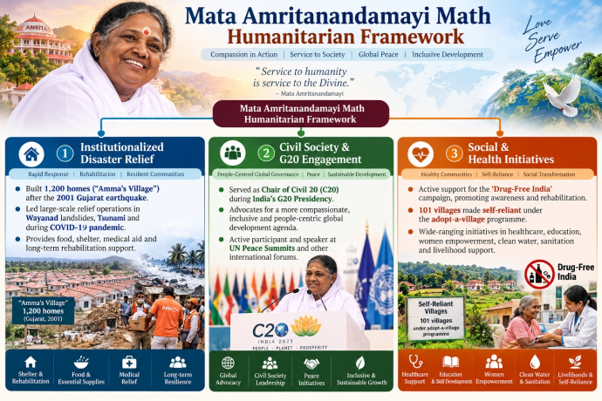
- Disaster Response & Reconstruction: Institutionalized rapid-response disaster relief protocols, demonstrated during the 2001 Gujarat earthquake (rebuilding an entire township with hospitals and schools), the 2004 Indian Ocean Tsunami, Uttarakhand floods, Wayanad landslides, and COVID-19 relief operations.
- Global Civil Society Leadership: During India’s G20 Presidency, Mata Amritanandamayi Ji served as the Chair of Civil 20 (C20), facilitating dialogue between global civil society organizations and G20 governments on sustainable development, technology, and human values.
- Support for National Health Campaigns: Endorsed the Government of India’s national campaign for a Drug-Free India (Nasha Mukt Bharat Abhiyaan), leveraging youth networks across educational institutions to combat substance abuse.
- Gram Panchayat Self-Reliance: Adopted over 101 villages across India to drive grassroots self-reliance through renewable energy access, clean drinking water installations, and skill development for rural women.
UPSC Quick Reference Table
| Feature | Detailed Specification |
| Event & Venue | 73rd Birthday Celebrations (‘Vishwa Seva Dinam’), Kollam, Kerala |
| Chief Guest | Shri Amit Shah (Union Minister of Home Affairs & Cooperation) |
| Key NGO Body | Mata Amritanandamayi Math (MAM) (ECOSOC Consultative Status) |
| G20 Engagement | Chair of Civil 20 (C20) during India’s G20 Presidency |
| Major Disaster Relief | 2001 Gujarat Earthquake (Amma’s Village), Tsunami 2004, Wayanad Landslides |
| Educational Footprint | 86 Amrita Vidyalayas & Amrita Vishwa Vidyapeetham |
Conclusion:
The observance of Vishwa Seva Dinam in Kollam highlights the role of faith-based non-governmental organizations in complementing public governance. Institutionalizing disaster management, primary healthcare, self-reliant village development, and civil society mobilization demonstrates how non-state actors support socio-economic welfare and national development.
TOPIC-2: India’s First Port-Based e-Methanol Production Facility at Kandla
-
- UPSC Relevance: GS Paper 2 (Inter-State Cooperation & Governance — Ek Bharat Shreshtha Bharat) & GS Paper 3 (Environment & Renewable Energy — Green Hydrogen, Maritime Decarbonization, Net Zero 2070, and Port Infrastructure / PM Gati Shakti).
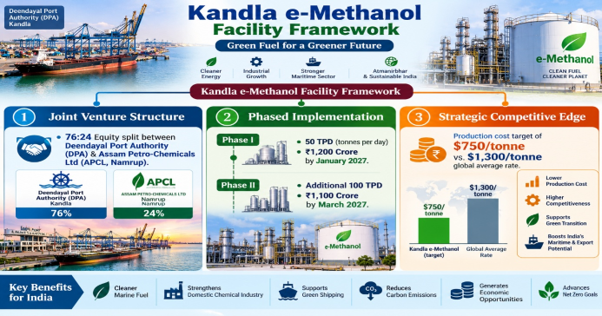
Introduction: India laid the foundation stone for India’s first port-based e-methanol production facility at Deendayal Port Authority (DPA) in Kandla, Gujarat. Involving an investment of ₹2,300 crore plant will produce 150 tonnes per day (TPD) of green fuel to supply vessels plying the Asia-Europe International Trade Corridor.
About e-Methanol:
-
- e-Methanol (synthetic green methanol) is produced by combining green hydrogen (generated via electrolysis powered by renewable energy) with captured biogenic carbon dioxide (CO2).
- As the International Maritime Organization (IMO) tightens global shipping emission norms, e-methanol serves as a clean alternative fuel for long-haul maritime transport.
- The project establishes Kandla as a key green-fuel bunkering and export hub along the high-density Singapore–Rotterdam trade route.
Key Highlights:
-
- Inter-State Collaboration (Ek Bharat Shreshtha Bharat): A joint initiative combining Western maritime infrastructure (DPA, Gujarat) with Northeastern public enterprise expertise (Assam Petro-Chemicals Ltd., Namrup).
- DPA Equity & Resource Contribution: DPA holds a 76% equity stake (investing ₹567.32 crore) and provides 75 acres of land, desalinated water, and green hydrogen sourced from renewable power.
- Employment & Ecosystem Development: Expected to generate over 3,500 direct and indirect jobs while stimulating local supply chains for green hydrogen, storage, transport, and bunkering ancillaries.
- Complemented Maritime Push: Complements broader maritime projects including the DPA–Cochin Shipyard Limited (CSL) shipbuilding facility at Vadinar (₹1,520 crore) and a greenfield shipbuilding cluster at Porbandar.
UPSC Quick Reference Table
| Feature | Detailed Specification |
| Nodal Ministry | Ministry of Ports, Shipping and Waterways (MoPSW) |
| Location | Deendayal Port Authority (DPA), Kandla, Gandhidham, Gujarat |
| Promoting Entities | DPA (76% share) & Assam Petro-Chemicals Ltd. (24% share) |
| Total Investment | ₹2,300 Crore (Phase I: ₹1,200 Cr | Phase II: ₹1,100 Cr) |
| Production Capacity | 150 Tonnes Per Day (TPD) (Phase I: 50 TPD by Jan 2027; Phase II: +100 TPD by Mar 2027) |
| Production Feedstock | Green Hydrogen, desalinated water, & biogenic |
| Target Cost Edge | US$ 750/tonne (Compared to ~US$ 1,300/tonne globally) |
Conclusion:
Thus, integrating green hydrogen production with port infrastructure supports India’s Net Zero 2070 target, promotes energy self-reliance (Atmanirbhar Bharat) and positions nation as an exporter of clean maritime fuels.
TOPIC-3: Exercise Tarang Shakti 2026
-
- UPSC Relevance: GS Paper 2 (Bilateral, Regional and Global Groupings and Agreements involving India; Defense Diplomacy) & GS Paper 3 (Security Challenges & Their Management; Defense Technology, Interoperability, and Indigenous Aerospace Industry).
Introduction: The Indian Air Force (IAF) commenced the operational phase of Exercise Tarang Shakti 2026 at Air Force Station Jodhpur, Rajasthan, on September 27, 2026. This major multilateral air exercise is organized under theme “Power in Partnership” emphasizing joint operational training, interoperability and defense cooperation among partner nations.
About Exercise Tarang Shakti:
-
- Exercise Tarang Shakti is the largest international multilateral air exercise hosted by the Indian Air Force.
- The 2026 iteration brings together air contingents from multiple continent-spanning partner nations to train across complex air-combat scenarios, strategic airlift, and mid-air refueling drills.
Key Highlights:
-
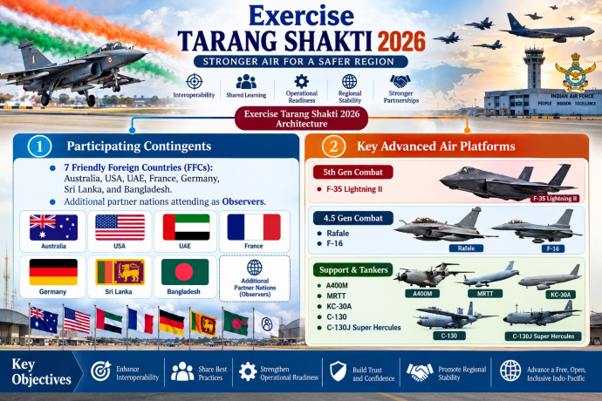
- Diverse Air Fleet Integration: Features advanced 5th-generation stealth fighters (F-35 Lightning II), 4.5-generation multi-role combat aircraft (Rafale, F-16), strategic tactical transport (A400M, C-130, C-130J), and Multi-Role Tanker Transports (MRTT, KC-30A).
-
- Operational Scope & Focus Areas: Focuses on mission planning, large-force engagements (LFE), air-to-air refueling protocols, low-altitude tactical maneuvers, and aerospace safety best practices.
- Beyond Flying Engagement: Integrates a dedicated defense seminar, an industrial tour for foreign contingents highlighting India’s domestic aerospace ecosystem, the Sekhon Marathon, heritage tours, and joint yoga sessions.
- Defense & Industrial Diplomacy: Showcases India’s growing indigenous defense manufacturing capabilities (Make in India / Atmanirbhar Bharat) while strengthening multilateral strategic ties for regional peace and maritime-aerospace stability.
UPSC Quick Reference Table
| Feature | Detailed Specification |
| Host Force | Indian Air Force (IAF) |
| Exercise Theme | “Power in Partnership” |
| Dates & Venue | 26 September – 12 October 2026 (Air Force Station Jodhpur, Rajasthan) |
| Participating Nations | 7 FFCs: Australia, USA, UAE, France, Germany, Sri Lanka, & Bangladesh |
| Key Aircraft | F-35 Lightning II, Rafale, F-16, A400M, Airbus A330 MRTT, KC-30A, C-130J |
| Core Objective | Multi-domain air interoperability, joint tactical training, & defense diplomacy |
Conclusion:
Exercise Tarang Shakti 2026 highlights India’s expanding role in regional defense architecture and international air mobility and supports stability across the Indo-Pacific and broader global commons.
TOPIC-4: World Congress on Nanomedicine 2026 & India’s Precision Healthcare Ecosystem
-
- UPSC Relevance: GS Paper 3 (Science & Technology — Developments and Applications in Nanoscience, Biotechnology, Healthcare Innovation, Precision Medicine, and Start-Up Ecosystems [BIRAC]).
Introduction: World Congress on Nanomedicine 2026 hosted by the Institute of Nano Medical Sciences (INMS), University of Delhi highlighted nanomedicine as the foundation for precision healthcare. It revealed that the Department of Biotechnology (DBT) is currently funding 210 R&D projects with ₹174 crore to accelerate indigenous translational research.
About Nanomedicine:
-
- Nanomedicine applies nanotechnology to healthcare, using engineered materials and devices at the nanoscale (1 to 100 nanometers).
- It enables targeted drug delivery, early-stage diagnostics, targeted gene therapy and cellular-level imaging.
- India has established a structured regulatory environment through the “Guidelines for Evaluation of Nanopharmaceuticals in India,” jointly developed by the Department of Biotechnology (DBT), Indian Council of Medical Research (ICMR) and Central Drugs Standard Control Organisation (CDSCO) under Ministry of Health and Family Welfare.
Key Highlights:
-
- Indigenous Breakthroughs:
- Oral Insulin Nanoparticles: Encapsulates insulin to shield it from gastrointestinal enzymatic degradation, enabling oral delivery for diabetic management.
- Cancer Nanobots: Specialized nanoscale robotics designed to navigate vascular pathways and deliver localized chemo-therapeutics directly to breast cancer tumor sites, minimizing systemic toxicity.
- Public R&D Support: DBT’s ₹174 crore commitment covers nucleic-acid delivery systems, nano-diagnostics, tissue engineering, wound healing, and nanotoxicology evaluation.
- Biotechnology Industry Research Assistance Council (BIRAC) Integration: Promotes commercialization through schemes like the Biotechnology Ignition Grant (BIG), Promoting Academic Research Conversion to Enterprise (PACE), Small Business Innovation Research Initiative (SBIRI), and Biotechnology Industry Partnership Programme (BIPP).
- Clinical Balance: Emphasized that advanced technological interventions like AI and nanomedicine must complement, rather than replace, clinical judgment, diagnostic physical examination, and doctor-patient interaction.
- Indigenous Breakthroughs:
UPSC Quick Reference Table
| Feature | Detailed Specification |
| Event & Host | World Congress on Nanomedicine 2026 (INMS, University of Delhi at Vigyan Bhawan) |
| Nodal Department | Department of Biotechnology (DBT), Ministry of Science & Technology |
| R&D Outlay | ₹174 Crore allocated across 210 active R&D projects |
| Key Innovations | Oral insulin nanoparticles & breast cancer targeting nanobots |
| Regulatory Framework | Joint DBT-ICMR-CDSCO Guidelines for Evaluation of Nanopharmaceuticals |
| Commercialization Body | BIRAC (BIG, PACE, SBIRI, and BIPP schemes) |
Conclusion:
Developing indigenous nanomedicine capabilities strengthens India’s transition toward precision, personalized healthcare. Hence combining research funding with a regulatory framework and BIRAC-backed start-up incubation supports the national vision for Atmanirbhar Bharat in bio-pharmaceuticals.
TOPIC-5: India Secures 10th Rank at WorldSkills Shanghai 2026
-
- UPSC Relevance: GS Paper 2 (Government Policies & Interventions for Skill Development; Human Resource Development) & GS Paper 3 (Employment, Skilling Ecosystem, Industrial Competitiveness, National Skill Development Corporation [NSDC], & Industry 4.0 Integration).
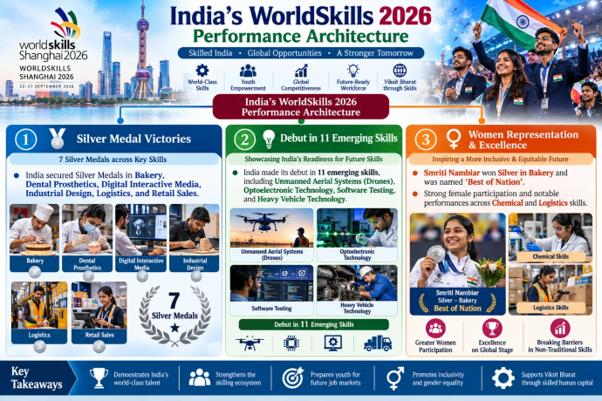
Introduction: Team India achieved an impressive 10th rank overall at the 48th WorldSkills Competition held in Shanghai, China (September 22–27, 2026) marking a significant improvement from its 13th-place finish at WorldSkills Lyon 2024. The 70-member Indian contingent its largest to date won 6 Silver Medals and 20 Medals for Excellence across 63 skill disciplines.
About the WorldSkills Competition:
-
- WorldSkills also known as the “Olympics of Vocational Skills,” is a biennial international competition that brings together young professionals from over 70 countries to benchmark vocational standards, technical proficiency and craftsmanship.
- India’s participation is coordinated by National Skill Development Corporation (NSDC) under aegis of the Ministry of Skill Development and Entrepreneurship (MSDE) supported by Sector Skill Councils (SSCs) and industry partners.
Key Highlights:
-
- Silver Medal Successes: Won by Smriti Nambiar (Bakery; also awarded Best of Nation), Mohammed Salam (Dental Prosthetics), Kovid Ajay Gangrade (Digital Interactive Media Design), Parth Vohra (Industrial Design Technology), Mehrunissa Begum (Logistics & Freight Forwarding), and Saniya Joshi (Retail Sales).
- Entry into Future-Oriented Skills: India competed for the first time across 11 emerging and technical categories, including Unmanned Aerial Systems (Drones), Software Testing, Optoelectronic Technology, Intelligent Security Technology, and Heavy Vehicle Technology.
- Medals for Excellence (20 Disciplines): Recognised high professional standards against global benchmarks in Industry 4.0, Additive Manufacturing, Autonomous Mobile Robotics, Mechatronics, Cyber Security, and IT Network Administration.
- Gender Inclusivity in Vocational Education: Women represented India across non-traditional domains such as Chemical Laboratory Technology, Logistics, Health & Social Care, and Fashion Technology.
UPSC Quick Reference Table
| Feature | Detailed Specification |
| Nodal Ministry | Ministry of Skill Development and Entrepreneurship (MSDE) |
| Coordinating Body | National Skill Development Corporation (NSDC) |
| Event & Location | 48th WorldSkills Competition 2026 (Shanghai, China) |
| Overall Rank | 10th Place (Up from 13th in Lyon 2024) |
| Medal Tally | 6 Silver Medals + 20 Medals for Excellence |
| Best of Nation | Smriti Nambiar (Silver Medallist, Bakery) |
| Contingent Size | 70 Competitors across 63 Skill Categories (Largest ever) |
Conclusion:
India’s performance at WorldSkills Shanghai 2026 reflects the growing competitiveness of its youth and skilling ecosystem which translate international standards into national vocational curricula. Thus, expanding training in emerging technologies and partnering with industry will help build a future-ready workforce aligned with global industry demand.
Spread the Word