What is PMKKKY?
The Pradhan Mantri Khanij Kshetra Kalyan Yojana (PMKKKY) was launched on 17 September 2015 to implement welfare and development projects in mining-affected areas through DMFs.
Core objectives
-
- Improve the quality of life in mining-affected areas.
- Minimise adverse impacts of mining on health, environment and socio-economic conditions.
- Create sustainable livelihoods for affected populations.
- Complement existing Central and State government programmes rather than duplicate them.
Why is it important?
-
- Mineral extraction is essential for industrialisation, infrastructure and employment, but its costs are often concentrated locally in the form of displacement, pollution, health risks and disruption of traditional livelihoods.
- The PMKKKY seeks to address this distributive imbalance by directing a share of mining-generated revenues towards the welfare and development of mining-affected communities.
Thus, PMKKKY represents an important shift from merely extracting mineral wealth towards sharing the developmental benefits with communities bearing the social and environmental costs of extraction.
District Mineral Foundation:
The scheme operates through District Mineral Foundations (DMFs), statutory non-profit trusts created under the Mines and Minerals (Development and Regulation) Act, 1957, following its 2015 amendment. DMFs have been established in 656 districts across 23 States. DMFs were introduced through the 2015 amendment to the MMDR Act, 1957. They are:
-
- Non-profit trusts.
- Established in every district affected by mining operations.
- Intended to work for persons and areas affected by mining.
- Governed within the framework prescribed by State Governments.
The model is therefore based on a simple principle “Those who bear the local costs of mineral extraction should receive a share of the benefits generated from that extraction.”
How are DMFs Funded?
Mining leaseholders contribute to DMFs as a proportion of royalty.
| Mining lease | DMF contribution |
| Lease/licence granted on or after 12 January 2015 | 10% of royalty |
| Lease granted before 12 January 2015 | 30% of royalty |
-
- Royalty: Payment associated with mineral extraction to the government.
- DMF contribution: Additional statutory contribution intended for the welfare of mining-affected communities.
Thus, DMF is not simply another general-revenue mechanism rather it has a specific distributive and developmental purpose.
Special Protection for Tribal & Scheduled Areas:
-
- Vulnerable communities: Mining often occurs in remote and relatively less-developed regions, where Scheduled Tribes and traditional forest-dependent communities may face disproportionate social, economic and environmental impacts.
- Constitutional safeguards: DMF implementation in Scheduled and Tribal Areas must align with the constitutional provisions relating to the administration of these areas, including Article 244 and the Fifth and Sixth Schedules.
- Participatory governance: Implementation must also take into account:
- Panchayats (Extension to Scheduled Areas) Act, 1996 (PESA)
- Forest Rights Act, 2006
- Developmental significance: This gives PMKKKY an important tribal-governance, participatory-development and social-justice dimension.
Revised PMKKKY Guidelines, 2024:
The January 2024 revision seeks to shift DMF functioning from a predominantly expenditure-oriented approach towards targeted, transparent and outcome-oriented development.
Key changes:
-
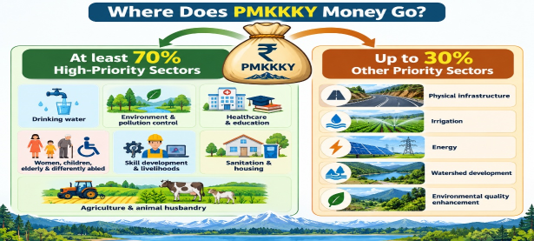
- At least 70% of funds for high-priority sectors.
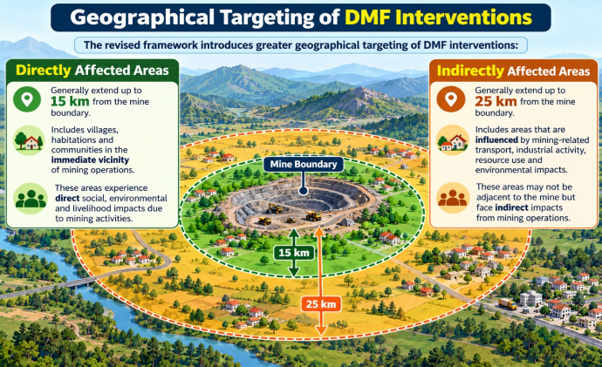
- Greater focus on directly mining-affected areas.
- Convergence with Central and State government schemes.
- Strengthening of State-Level Monitoring Committees.
- Greater emphasis on audit and transparency.
- Focus on impact-oriented DMF governance.
- Provision for Gram Sabha/local-body participation in planning.
- Strengthened grievance-redressal mechanisms.
- Provision for C&AG audit.
- Greater public disclosure of DMF-related information.
Scale of Implementation
PMKKKY/DMF implementation has acquired substantial financial and physical scale. As of July 2026
-
- 4,70,020 projects
- ₹1,09,938 crore worth of projects sanctioned.
- 2,92,156 projects
- ₹49,973 crore worth of completed projects.
- 78,809 projects under implementation.
- ₹30,512 crore committed to ongoing projects.
PMKKKY and Aspirational District Approach
-
- Aspirational DMF Programme: Operationalised in July 2025, it seeks to align District Mineral Foundation (DMF) expenditure with the themes of the Aspirational District Programme (ADP) and Aspirational Blocks Programme.
- Convergence-based approach: Encourages convergence of DMF resources with existing Central and State Government schemes to avoid duplication and maximise developmental outcomes.
- Strategic significance: This approach can transform DMF from merely a fund collection and expenditure mechanism into a more strategic instrument of local development and outcome-oriented governance.
PMKKKY vs Aspirational District Initiative (ADI/ADP)
| Parameter | PMKKKY | Aspirational District Programme (ADP/ADI) |
|---|---|---|
| Basic nature | Welfare and development framework for mining-affected areas | Development-oriented programme for underdeveloped/aspirational districts |
| Nodal Ministry | Ministry of Mines | NITI Aayog |
| Institutional mechanism | District Mineral Foundations (DMFs) | District administration with NITI Aayog-led monitoring and convergence |
| Primary target area | Mining-affected districts/areas | Selected aspirational districts across India |
| Primary beneficiaries | People and communities affected by mining | Residents of identified aspirational districts |
| Funding source | Statutory contributions from mining leaseholders | Primarily convergence of existing Central/State schemes and administrative interventions |
| Core objective | Reduce adverse impacts of mining and promote welfare and sustainable livelihoods | Accelerate development in relatively underdeveloped districts through measurable outcomes |
| Key focus | Welfare, infrastructure, health, education, livelihoods, environment and mining-affected communities | Key social and economic development indicators |
| Approach | Area- and impact-based | Outcome- and indicator-based |
| Local participation | Strong emphasis on affected communities and Gram Sabha/local participation | District-level administration and stakeholder participation |
| Convergence | Increasingly encourages convergence with Central/State schemes | Core feature of the programme |
PMKKKY as an Instrument of Cooperative & Participatory Governance
-
- Ministry of Mines: Provides the national policy framework and overall oversight.
- State Governments: Frame rules and establish the institutional architecture.
- District Mineral Foundations: Undertake planning and implementation of projects.
- District Administration: Coordinates and facilitates execution.
- Gram Sabhas: Enable local participation and identification of beneficiaries and priorities.
- Mining Companies/Leaseholders: Provide statutory financial contributions to DMFs.
- Civil Society & Universities: Can contribute through independent assessment, expertise and social monitoring.
- Mining-affected Communities: Remain the primary beneficiaries as well as stakeholders in planning and implementation.
Major Challenges
1. Despite substantial allocations, many projects remain incomplete. The Parliamentary Committee noted that a large backlog of incomplete projects raises concerns regarding project selection, execution and monitoring.
2. The Parliamentary Committee observed that Gram Sabha participation should extend beyond consultation during five-year planning to active involvement in DMF planning, decision-making and monitoring.
3. DMFs have historically faced concerns regarding disclosure, audits, project information and public accountability. The 2024 framework has strengthened transparency requirements, but implementation across States remains uneven.
4. DMFs are implemented within State-specific rules. The Parliamentary Committee noted that the revised 2024 guidelines were incorporated into State DMF rules at different speeds, creating uneven institutionalisation.
5. The Parliamentary Committee flagged instances of DMF funds being used for purposes outside their stipulated objectives, highlighting the need for stronger compliance and financial controls.
6. Counting projects sanctioned or completed does not establish whether mining-affected households actually experience better health, education, livelihoods, water security or environmental conditions. The Parliamentary Committee has therefore stressed independent social audits and third-party impact assessment.
Way Forward:
1. Gram Sabhas and affected communities should participate meaningfully in beneficiary identification, project selection, monitoring and review, particularly in Scheduled Areas. The Parliamentary Committee has specifically supported deeper community involvement.
2. Independent social audits and third-party impact assessments should assess beneficiary coverage, project quality, completion, timeliness and actual improvement in quality of life.
3. A DMF District Ranking Index, using indicators such as fund utilisation, project completion, transparency and impact assessment, has been recommended by the Parliamentary Committee; the Ministry has indicated that it will initiate work on such a framework.
4. Districts should identify stalled projects, diagnose administrative and technical bottlenecks and establish time-bound completion mechanisms rather than allowing funds to remain locked in incomplete works.
5. DMF resources should supplement rather than substitute normal government expenditure, and projects should converge with existing Central and State schemes to create multiplier effects. The Ministry’s Aspirational DMF Programme explicitly seeks such convergence.
6. District-level disclosure of fund receipts, project lists, beneficiaries, expenditure, progress, audits and impact assessments should be timely and accessible through the National DMF Portal and local platforms. The 2024 guidelines already provide for proactive disclosure.
However, Pradhan Mantri Khanij Kshetra Kalyan Yojana embodies an important principle of mineral governance i.e. the benefits of resource extraction should reach the communities that bear its costs.
Conclusion:
Yet the next phase must move beyond fund accumulation and project counting towards participatory planning, timely execution, transparency and measurable outcomes. Parliamentary scrutiny has particularly highlighted the need for stronger Gram Sabha participation, social audits, convergence and performance monitoring.
Spread the Word