
ANS.
STRUCTURE
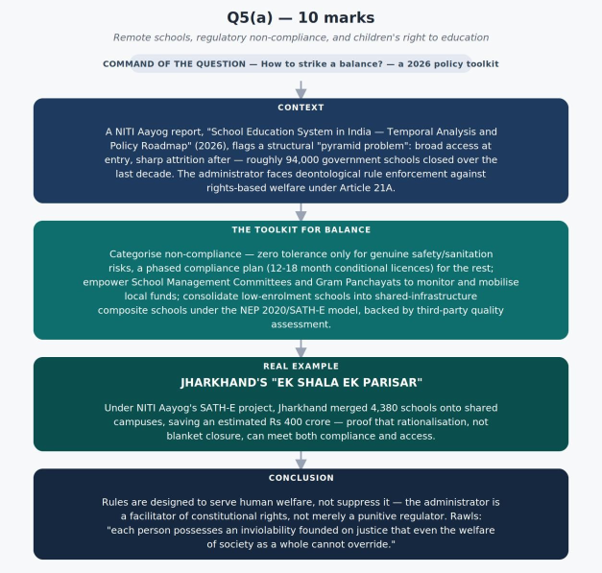
1. Explain the statement CONTEXT in brief
2. Then explain administrator strike a balance between enforcement of rules and educational rights of children with examples
3. Conclusion with a philosophy or quote
THE CONTEXT (INTRODUCTION)
A NITI Aayog report, “School Education System in India — Temporal Analysis and Policy Roadmap for Quality Enhancement” (2026), flags this as a structural “pyramid problem”: broad access at entry, sharp attrition thereafter, both in schools and students. Roughly 94,000 government schools closed over the last decade.
An administrator in this scenario faces a classic dilemma between deontological rule enforcement (strict compliance) and utilitarian/rights-based welfare (ensuring access to the fundamental Right to Education under Article 21A).
BODY
Remote schools often fall short of RTE Act, 2009 norms — pupil-teacher ratio, infrastructure, trained-teacher requirements — not from neglect but from genuine resource scarcity.
Administrator striking a balance between enforcement of rules and educational rights of children:
1. Categorization of Non-Compliance Norms (Zero Tolerance): Structural safety (fire safety, stable buildings), basic sanitation (functional toilets, drinking water), and child protection policies. Failure here poses an immediate threat to life and dignity; non-compliant schools must rectify these immediately or face temporary suspension.
2. Implementation of a Phased Compliance Plan: Issue conditional operational licenses giving schools a realistic timeframe (e.g., 12–18 months) to meet mandatory benchmarks, rather than summary closures.
3. School Management Committees (SMCs): Empower SMCs and Gram Panchayats to monitor compliance, mobilize local funds, and report genuine field constraints.
4. Alternative Transition Mechanisms Before Closure
5. School rationalisation/merger drives: consolidating low-enrolment schools into composite schools with shared infrastructure and staff (SATH-E model).
6. Third-party quality assessment and strengthened governance structures in state education
7. NEP 2020 structural reform: 5+3+3+4 curricular structure, stronger focus on Early Childhood Care and Education (ECCE).
8. Composite/cluster schools and proposals for a NIRF-like school ranking system and PISA-type Class 10 assessment.
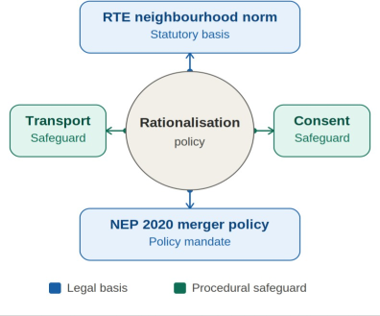
JHARKHAND — “EK SHALA EK PARISAR” (ONE SCHOOL, ONE CAMPUS): Under NITI Aayog’s SATH-E project, Jharkhand merged 4,380 schools onto shared campuses, saving an estimated ₹400 crore.
CONCLUSION
Rules are designed to serve human welfare, not suppress it. The role of an administrator is not merely that of a punitive regulator, but of a facilitator of constitutional rights. As Rawls held, “each person possesses an inviolability founded on justice that even the welfare of society as a whole cannot override” — a remote child’s access to her only school is exactly the kind of individual claim that a system-wide compliance target cannot simply override.
Spread the Word