TOPIC-1: India and MERCOSUR Sign First Additional Protocol for Electronic Certificates of Origin
-
- UPSC Relevance: GS Paper 2 (Bilateral, Regional, and Global Groupings involving India; India–Latin America Trade Policy) & GS Paper 3 (Indian Economy — Trade Facilitation, Digital Public Infrastructure, Foreign Trade Agreements, and Paperless Customs).
Introduction: India and MERCOSUR trade block (Argentina, Brazil, Paraguay, and Uruguay) signed the First Additional Protocol to the India–MERCOSUR Preferential Trade Agreement (PTA) on September 14, 2026. The protocol formally updates the existing trade agreement to allow the exchange and acceptance of electronic Certificates of Origin (e-CoO). Thus, facilitating paperless cross-border trade and modernizing customs procedures.
About India–MERCOSUR PTA:
-
- The India–MERCOSUR PTA was originally signed on January 25, 2004, and came into force on June 1, 2009. The existing agreement provides preferential tariff concessions across 450 tariff lines from India and 452 tariff lines from MERCOSUR.
- The First Additional Protocol amends Article 16 of Annex III (Rules of Origin) of the PTA.
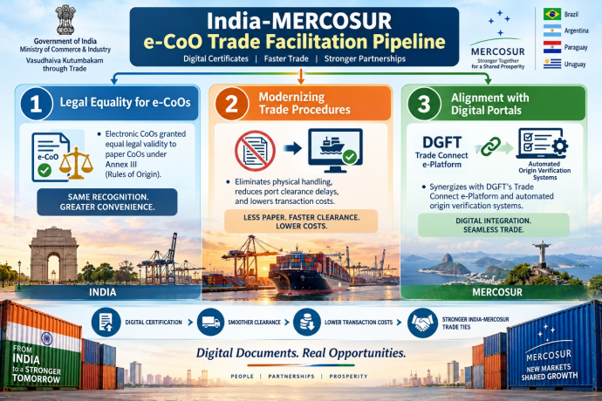
- It establishes that Certificates of Origin issued in an electronic format and signed digitally by authorized entities hold identical legal validity to traditional paper certificates. Thereby, directly cutting administrative overheads and transaction latency.
Key Highlights
-
- Legal Recognition of Digital Documents: Amends the 2004 PTA framework to grant e-CoOs issued under domestic digital signature laws the exact same legal status as hard-copy paper documentation.
- Paperless Customs Efficiency: Dramatically lowers processing time, mitigates document verification delays at ports of entry, and cuts administrative compliance costs for Indian exporters entering South American markets.
- Institutional Consensus: Follows formal agreements reached during the 4th (Nov 2025) and 5th (April 2026) meetings of the Joint Administrative Committee of the India–MERCOSUR PTA.
- Synergy with DGFT Digital Infrastructure: Directly complements India’s recently launched DGFT Open API facility on the Trade Connect e-Platform, enabling seamless ERP-to-customs electronic submission for MERCOSUR shipments.
UPSC Quick Reference Table
| Feature | Detailed Specification |
| Nodal Ministry | Ministry of Commerce & Industry, Government of India |
| Trade Block Partner | MERCOSUR (Argentina, Brazil, Paraguay, Uruguay) |
| Lead Signatories | Shri Rajesh Agarwal (Commerce Secy, India) & H.E. Mr. Alberto Guani (Ambassador of Uruguay) |
| Key Instrument | First Additional Protocol to the India–MERCOSUR PTA |
| Legal Amendment | Article 16 of Annex III (Rules of Origin) |
| Core Objective | Paperless trade, digital signatures for e-CoOs, and modern customs clearance |
Conclusion:
First Additional Protocol to India–MERCOSUR PTA modernizes trade infrastructure between South Asia and South America. Paperless customs verification and digital documentation cut transaction costs, accelerate trade execution and establish a foundation for expanding the scope of the PTA in future negotiations.
TOPIC-2: PM Pays Homage to Saratchandra Chattopadhyay on his 150th Birth Anniversary
-
- UPSC Relevance: GS Paper 1 (Indian Culture, Modern Indian Literature, Social Reform Movements, Freedom Struggle & Nationalist Literature).
Introduction: Prime Minister Shri Narendra Modi paid homage to iconic Bengali novelist and short-story writer Saratchandra Chattopadhyay on his 150th birth anniversary (September 15, 2026).
About Saratchandra Chattopadhyay (1876–1938)
-
- Born on September 15, 1876, in Debanandapur, Hooghly district, West Bengal.
- Saratchandra Chattopadhyay is among the most widely translated and adapted authors in Indian literature.
- His literary works challenged rigid caste structures, feudal oppression, patriarchally enforced widowhood, and colonial rule.
- His acute psychological realism and focus on marginalization established him as a key figure of modern Indian literature.
Key Highlights:
-
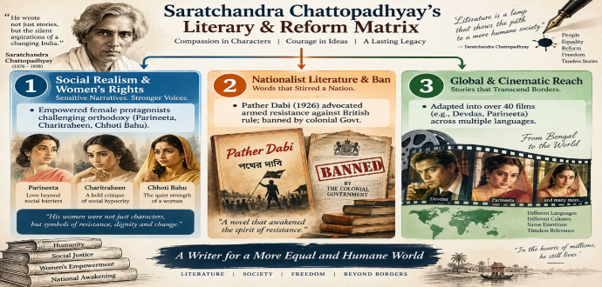
- Focus on Social Reform & Women’s Emancipation: Portrayed complex female characters who questioned social orthodoxy, widow discrimination, and patriarchal norms in works like Parineeta (1914), Charitraheen (1917), Bada Didi (1907), and Grihadaha (1920).
- Nationalist Awakening & British Ban: His famous political novel Pather Dabi (Demand for a Pathway, 1926)—which depicted a secret revolutionary society fighting colonial rule—was banned by the British Government for its anti-colonial themes.
- Semi-Autobiographical & Rural Realism: Captured rural agrarian distress and human relationships in novels like Palli Samaj (1916), Ramer Sumati, and his four-part semi-autobiographical masterpiece Srikanta (1917–1933).
- Pan-Indian Cultural & Cinematic Footprint: Translated into almost every major Indian language, his stories served as the baseline for numerous stage plays and over 40 cinematic adaptations across Indian cinema.
UPSC Quick Reference Table
| Feature | Detailed Specification |
| Literary Figure | Saratchandra Chattopadhyay (15 September 1876 – 16 January 1938) |
| 150th Birth Anniversary | September 15, 2026 |
| Birthplace | Debanandapur, Hooghly District, West Bengal |
| Notable Masterpieces | Devdas, Parineeta, Srikanta, Charitraheen, Palli Samaj, Grihadaha |
| Banned Political Novel | Pather Dabi (1926) — Banned by the British Colonial Administration |
| Core Ideological Themes | Anti-feudalism, Women’s Rights, Anti-colonial Nationalism, and Rural Social Reform |
Conclusion:
Commemorating Saratchandra Chattopadhyay’s 150th birth anniversary highlights the role of literature in driving social reform and national consciousness. His emphasis on human dignity, gender equity, and freedom continues to serve as an important reference point for Indian cultural and social history.
TOPIC-3: Indian Parliamentary Delegation Participates in 69th Commonwealth Parliamentary Conference in Cape Town
-
- UPSC Relevance: GS Paper 2 (Bilateral, Regional, and Global Groupings involving India; Commonwealth Parliamentary Association [CPA]; Inter-Parliamentary Diplomacy; Governance & Legislative Procedures).
Introduction: An Indian Parliamentary Delegation led by Shri Harivansh, Hon’ble Deputy Chairman of Rajya Sabha, is participating in the 69th Commonwealth Parliamentary Conference (CPC) held in Cape Town, South Africa, from September 12 to 19, 2026. The conference serves as a global forum for Commonwealth legislators to deliberate on democracy, legislative governance, and international law.
About the Commonwealth Parliamentary Association (CPA):
-
- The Commonwealth Parliamentary Association (CPA) connects parliamentarians across 180 national, state, provincial, and territorial legislatures.
- The 69th CPC delegation includes Member of Parliament Dr. D. Purandeswari, MPs from both Houses, Rajya Sabha Secretary General Shri P. C. Mody as well as 32 Presiding Officers and 18 Secretaries from Indian State and UT Legislatures.
Key Highlight:
-
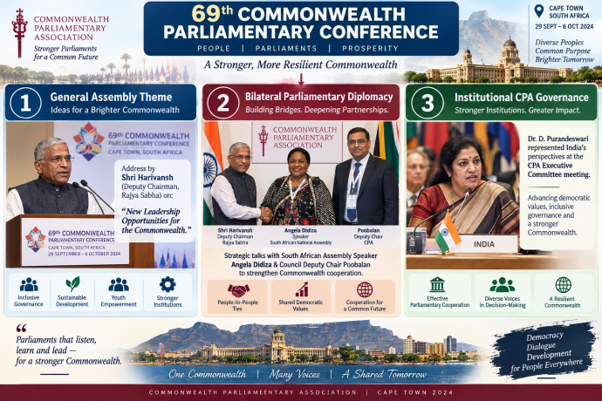
- Plenary Address Theme: Shri Harivansh will address the CPC General Assembly on “New Leadership Opportunities for the Commonwealth: Parliamentary Action to Strengthen Democracy and International Law.”
- Bilateral Inter-Parliamentary Engagement: Held bilateral talks with South Africa’s Speaker of the National Assembly (Hon. Angela Thokozile Didiza), Deputy Chairperson of the National Council of Provinces (Hon. Poobalan Govender), and Deputy Speaker (Hon. Annelie Lotriet) to deepen bilateral legislative ties.
- CPA Governance & Executive Committee: Dr. D. Purandeswari represented India at the CPA Executive Committee meeting, contributing to institutional policy, agenda setting, and regional representation.
- Multi-Tiered Delegation Presence: Features representation from both the Union Parliament and State/UT Legislative Assemblies, reinforcing federal legislative coordination on international platforms.
UPSC Quick Reference Table
| Feature | Detailed Specification |
| Global Event | 69th Commonwealth Parliamentary Conference (CPC) |
| Dates & Venue | September 12–19, 2026 (Cape Town, South Africa) |
| Delegation Leader | Shri Harivansh (Hon’ble Deputy Chairman, Rajya Sabha) |
| Key Members | Dr. D. Purandeswari, Shri C. Sadanandan Master, Shri Vishnu Datt Sharma, Shri P. C. Mody |
| State Representation | 32 Presiding Officers & 18 Secretaries from Indian State/UT Assemblies |
| Core Plenary Theme | Parliamentary Action to Strengthen Democracy & International Law |
Conclusion:
India’s active engagement at the 69th CPC in Cape Town highlights its commitment to inter-parliamentary diplomacy, democratic governance and South–South legislative cooperation. Exchanging best practices with Commonwealth nations strengthens bilateral parliamentary ties with South Africa while advancing democratic standards across member states.
TOPIC-4: World Circular Economy Forum (WCEF) 2026
-
- UPSC Relevance: GS Paper 2 (Government Policies & Interventions; International Environmental Governance) & GS Paper 3 (Environment & Ecology — Sustainable Consumption and Production, Extended Producer Responsibility [EPR], Mission LiFE, and Circular Economy).
Introduction: Union Minister for Environment, Forest and Climate Change Shri Bhupender Yadav and Chief Minister of Gujarat Shri Bhupendrabhai Patel inaugurated the World Circular Economy Forum (WCEF) 2026 at Gandhinagar on September 15, 2026. Marking the first time WCEF is hosted in South Asia, the forum runs from September 15–18 under the theme “Circular Economy: Transition for People and Prosperity.”
About WCEF 2026:
-
- WCEF is a global platform dedicated to accelerating the transition from linear “take-make-waste” models toward a regenerative, resource-efficient circular economy.
- The 2026 summit is jointly organized by the Central Pollution Control Board (CPCB), Ministry of Environment, Forest and Climate Change (MoEF&CC), Government of Gujarat & GPCB alongside the Finnish Innovation Fund Sitra and Government of Finland.
Key Highlights:
-
- Mission LiFE & Traditional Ethos: Positions India’s traditional circularity—encapsulated by Mission LiFE—as an everyday cultural practice (Vasudhaiva Kutumbakam), highlighting local initiatives like converting Somnath Temple offerings into bio-resources.
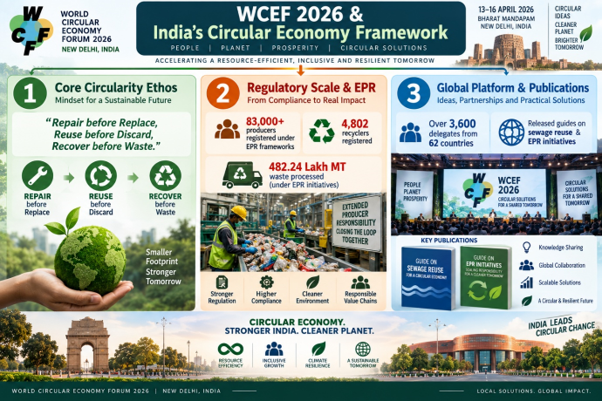
- Extended Producer Responsibility (EPR) Scale: Highlighted regulatory progress where over 83,000 producers and 4,802 recyclers are registered under EPR frameworks, processing 482.24 Lakh Metric Tonnes (LMT) of regulated waste.
- International Collaboration: Promoted cross-border flows of technology, finance, and knowledge, highlighting international frameworks like the Resource Efficiency and Circular Economy Industry Coalition (RECEIC) launched under India’s G20 Presidency.
- Publications Released: Launched two flagship technical reports:
1. Best Practices for Reuse of Treated Sewage
2. Driving Sustainability – A Guide to India’s Circular Economy and EPR Initiatives
-
- Side Events & Expo: Features an exhibition showcasing 135 national and international circular innovators and hosts the in-person meeting of the 10-Year Framework of Programmes (10 YFP) Board co-chaired by India.
UPSC Quick Reference Table
| Feature | Detailed Specification |
| Nodal Ministry | Ministry of Environment, Forest and Climate Change (MoEF&CC) |
| Co-Organizers | CPCB, Govt of Gujarat, GPCB, Finnish Innovation Fund Sitra, & Govt of Finland |
| Event & Theme | WCEF 2026 — “Circular Economy: Transition for People and Prosperity” |
| Regional First | First edition hosted in South Asia (Gandhinagar, Gujarat) |
| Key Metrics | 83,000+ Producers registered under EPR; 482.24 Lakh MT waste processed |
| Global Alignment | Mission LiFE, RECEIC (G20), 10 YFP Board, & BRICS Circular Economy Priority |
Conclusion:
Hosting WCEF 2026 establishes India’s role in advancing international circular economy governance. Integrating Extended Producer Responsibility (EPR) digital compliance with Mission LiFE provides a practical model to decouple economic growth from resource depletion across the Global South.
Spread the Word