Introduction:
The Pradhan Mantri Janjatiya Vikas Mission (PMJVM) launched in 2021-22 seeks to convert tribal gatherers into value-adding entrepreneurs through community-owned Van Dhan Vikas Kendras (VDVKs), Minimum Support Price (MSP) procurement and market linkages. Thereby, advancing Sabka Saath, Sabka Vikas and India’s vision of Viksit Bharat @2047.
What is Minor Forest Produce (MFP)?
The Scheduled Tribes and Other Traditional Forest Dwellers (Recognition of Forest Rights) Act, 2006 (Forest Rights Act) defines MFP as all non-timber forest produce of plant origin i.e. bamboo, brushwood, tussar, cocoons, honey, wax, lac, tendu/kendu leaves, medicinal plants, roots and tubers.
-
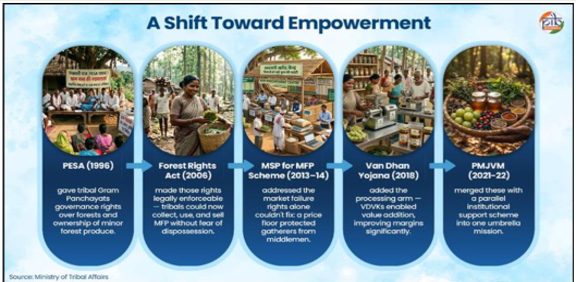
- Forest Rights Act, 2006: Recognises that forest-dwelling communities have historically depended on forest produce for livelihood; grants tribals the right to procure and sell non-timber MFP.
- PESA Act, 1996: Grants tribal Gram Panchayats ownership rights over minor forest produce in Scheduled Areas.
- Minimum Support Price (MSP): The government has notified MSP for 87 MFP items under PMJVM, so gatherers have a guaranteed price floor regardless of market fluctuations.
How PMJVM Works:
-
- TRIFED (Tribal Cooperative Marketing Development Federation of India): Nodal agency mandated to market and develop tribal products; purchases MFP at MSP through State Implementing Agencies (tribal development cooperatives, forest development corporations), regardless of prevailing market price.
- Van Dhan Vikas Kendra (VDVK): 15 tribal SHGs (~300 members, at least 60% Scheduled Tribe) are clustered into one Kendra. The basic community-owned enterprise unit under Van Dhan Yojana (launched 14 April 2018) which forms PMJVM’s implementation backbone.
- Skilling, funding and equipment: VDVKs receive scientific-harvesting training, primary processing equipment (decorticators, dryers, packaging tools), working capital via banks/NSTFDC tie-ups and rental storage-transport support.
- Market linkage support: Modernised Haat Bazaars (over 5,000 in tribal areas), TRIFED market intelligence, branding via melas and exhibitions, geo-tagging, Geographical Indication (GI) tagging, and e-commerce platform integration.
Implementation Experience:
| Parameter | Current Status |
| VDVKs sanctioned | 4,172 |
| VDVKs functional | 2,911 (as on 31 July 2026) |
| Tribal members linked | 12.48 lakh |
| Reported VDVK sales | ~₹168 crore (as on 31 July 2026) |
| Cumulative MFP procurement (since 2013-14) | 2,67,954 tonnes worth ₹693.98 crore |
| MFP items with notified MSP | 87 items |
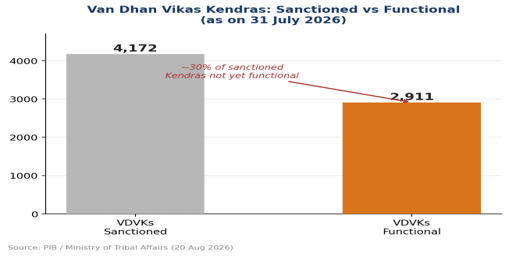
Fig. 1 — Nearly 30% of sanctioned Van Dhan Vikas Kendras are yet to become functional.
| Case Study: Women-Led Enterprise in Arunachal Pradesh-
The Nyigamane, Ho Yorbe, Medumhagdum VDVK in Leparada district (established October 2021, 300 women SHG members) converts local produce like King Chilli, bamboo shoots, turmeric, ginger, pineapple and orange into pickles, powders, jams and squashes. Thus, generating ₹11 lakh in sales since 2022-23. Members jointly own the enterprise and brand. It shows PMJVM’s role in tribal women’s financial empowerment beyond seasonal agricultural income. |
Challenges
-
- PIB’s own implementation data (20 Aug 2026) shows that of the 4,172 VDVKs sanctioned only 2,911 (about 70%) are functional. Thus, pointing to persistent gaps in operationalising sanctioned Kendras.
- Down To Earth citing Ministry of Tribal Affairs’ March 2026 Monthly Progress Report found that nearly 48,000 Community Forest Resource (CFR) claims have been rejected nationwide under the Forest Rights Act. Since CFR titles are what formally vest MFP-collection rights in Gram Sabhas, large-scale rejections undermine the legal foundation on which PMJVM’s MFP-sourcing model rests.
- Rajya Sabha data (reported June 2026, e.g. Jammu & Kashmir) shows extremely high FRA claim-rejection rates in several states i.e. 39,924 of 46,090 claims rejected in J&K alone. This reflecting weak ground-level implementation capacity and inconsistent verification standards across states.
- Sectoral practitioners and TRIFED’s own transition strategy acknowledge that many VDVKs remain confined to primary processing (sorting, grading, drying) rather than higher-value branding and finished-product manufacture.
- Long-standing structural critique (repeated across Forest Rights Act commentary) is that MSP-based procurement and Van Dhan enterprises cannot fully substitute for secure land and resource tenure.
Significance
-
- Corrects a structural market failure i.e. middleman-driven distress pricing that historically kept tribal gatherers below subsistence returns for their own labour.
- Moves tribal communities up the value chain from raw-produce sellers to producer-entrepreneurs who own their brand and enterprise.
- MSP for 87 MFP items functions as an income safety net independent of market price volatility.
- Particularly empowers tribal women who dominate MFP collection and VDVK operations.
- Preserves a forest-based, chemical-free, community-owned economic model as a distinctive counter-offer to mass-manufactured goods.
Way Forward
-
- Ministry of Tribal Affairs / TRIFED should prioritise converting sanctioned-but-dormant VDVKs into functional units before sanctioning new ones using time-bound state-wise action plans and public dashboards to track the sanctioned-to-functional conversion ratio.
- State governments and District Level Committees under the Forest Rights Act should undertake a time-bound review of rejected Community Forest Resource claims as directed after the 2019 Supreme Court proceedings.
- TRIFED should accelerate the VDVK-to-VDPE (Van Dhan Producer Enterprise) transition nationally with dedicated handholding for legal registration like GST compliance and access to institutional credit.
- NSTFDC and public sector banks should design tailored, lower-collateral working-capital products for VDVK clusters to reduce dependence on informal moneylenders between harvest seasons.
- Ministry of Tribal Affairs should commission independent, state-wise performance audits of VDVK sales and member incomes beyond sanctioning and functional counts to identify and replicate administrative practices behind high-performing states such as Odisha and Madhya Pradesh.
Conclusion:
PMJVM represents a structural attempt to correct a century-old market failure in India’s tribal forest economy. But scheme’s foundation of secure forest and MFP-collection rights is weakened by large-scale rejection of Forest Rights Act claims. Hence, while resolving the underlying tenure question will determine whether PMJVM truly transforms India’s forest gatherers into forest entrepreneurs on the path to Viksit Bharat @2047.
Spread the Word