Introduction:
India is committed to building a secure, sustainable, and self-reliant energy future to support its journey towards Viksit Bharat. India’s nuclear energy program rests on three pillars i.e.
i. Technological self-reliance through the indigenous three-stage program.
ii. Defense-in-depth safety architecture.
iii. Diversification into non-power applications (healthcare, agriculture, food preservation, semiconductors, green hydrogen).
Understanding Nuclear Energy Key Concepts
-
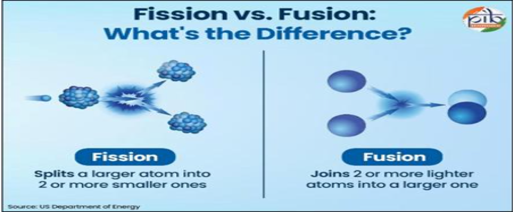
- Nuclear fission: A neutron strikes a heavy nucleus (uranium/plutonium), splitting it and releasing heat plus more neutrons that sustain a controlled chain reaction. The heat converts water to steam that drives a turbine-generator.
- Nuclear fuel: India predominantly uses Natural Uranium in Pressurised Heavy Water Reactors (PHWRs), unlike most countries that use Low-Enriched Uranium (LEU) in Light Water Reactors. India also uses Mixed Oxide (MOX) fuel in its Prototype Fast Breeder Reactor.
- Baseload power: The minimum, round-the-clock power a grid needs to stay operational which nuclear supplies this reliably complementing intermittent renewables like solar and wind.
- Closed fuel cycle: India reprocesses spent fuel to recover reusable plutonium and uranium rather than treating it as waste directly.
India’s Three-Stage Nuclear Power Programme: Proposed by Dr. Homi J. Bhabha in 1954 to convert India’s uranium scarcity and thorium abundance into a long-term energy security strategy:
Stage 1 — PHWRs: Use natural uranium & spent fuel is reprocessed to recover plutonium.
Stage 2 — Fast Breeder Reactors (FBRs): Use recovered plutonium, “breed” more fissile material, and convert thorium into Uranium-233. India’s Prototype FBR at Kalpakkam achieved first criticality in April 2026 i.e. nearly 90% indigenously manufactured & formally starting Stage 2.
Stage 3 — Thorium reactors: Use Uranium-233 to finally harness India’s vast thorium reserves (Kerala, Tamil Nadu, Odisha, Jharkhand coastal sands) are among the world’s largest.
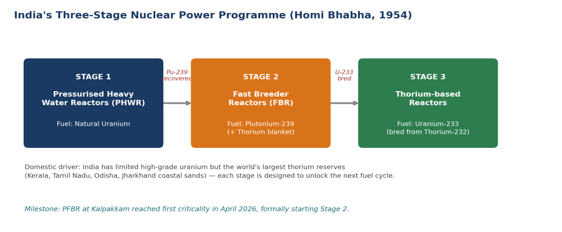
Fig. 1 — India’s Three-Stage Nuclear Power Program and April 2026 PFBR milestone.
Recent Developments
i. SHANTI Act, 2025: It replaces the Atomic Energy Act, 1962 and Civil Liability for Nuclear Damage Act, 2010 with a single framework. It ends the state monopoly by allowing Indian private companies and joint ventures to build, own and operate nuclear plants strategic activities like enrichment/reprocessing remain government-controlled. It grants statutory status to the AERB & replaces the flat ₹1,500 crore liability cap with a tiered cap (₹100–3,000 crore) linked to reactor capacity.
ii. Nuclear Energy Mission for Viksit Bharat: ₹20,000 crore allocated in Union Budget 2025-26 for indigenous Small Modular Reactors (SMRs). It targets operationalizing at least five indigenous SMRs by 2033 including the 220 MWe BSMR-200 and 55 MWe SMR-55.
iii. PFBR criticality (April 2026): Kalpakkam Prototype Fast Breeder Reactor formally began Stage 2 of the three-stage programme.
iv. World’s first nuclear-process-heat hydrogen plant (2026, Kalpakkam): Uses nuclear high-temperature heat for carbon-free hydrogen production, supporting the National Green Hydrogen Mission.
v. First Certified Reference Material for Rare Earth Elements (BARC B1401): India’s first, world’s fourth — strengthens critical mineral exploration and processing standards.
vi. Electronics-grade Boron-11 Enrichment Facility (Talcher): First of its kind in India, feeding the India Semiconductor Mission and cutting import dependence on critical electronic materials.
Applications Beyond Electricity
i. Healthcare: Indigenous radiopharmaceuticals, imaging and cancer therapies via BARC, TMC, TIFR. Tata Memorial Centre registered 1.3 lakh patients and screened ~5 lakh women (FY 2024-25). Its radiation sterilised 1.53 crore medical devices.
ii. Agriculture: 70 BARC-developed crop varieties (e.g., TBM-9 banana, RTS-43 sorghum) via radiation-induced mutagenesis, improving yield, drought/salinity tolerance.
iii. Food preservation: Radiation processing extends shelf life (mangoes, onions, potatoes). 40 operational gamma processing facilities after 6 new commissionings and 17 MoUs signed in 2025.
iv. Mining and critical minerals: Nuclear analytical techniques improve rare-earth ore assessment and processing accuracy.
v. Semiconductors: High-purity isotopes/boron enrichment support India’s semiconductor self-reliance push.
vi. Green hydrogen: Nuclear process heat offers a carbon-free hydrogen production pathway, demonstrated at Kalpakkam in 2026.
Safety Architecture for nuclear emergencies:
-
- Integrated National Framework:Nuclear and radiological emergencies are covered under National Disaster Management Plan and integrated into district disaster management plans.
- Dedicated National Coordination:The DAE leads technical preparedness and response through a dedicated Crisis Management Plan.
- Mandatory Emergency Preparedness:Every nuclear power plant maintains mandatory On-site and Off-site Emergency Response Plans approved by the AERB.
- Multi-Agency Emergency Planning: Nuclear power plants, District Administration and District Disaster Management Authorities conduct regular mock drills and emergency exercises.
- Capacity Building and Public Protection:Police, emergency responders and other agencies receive specialised training. Radiation detection equipment has been deployed at key locations.
- Medical Preparedness:The Ministry of Health and Family Welfare, Department of Atomic Energy and Nuclear Power Corporation of India Limited train medical professionals and maintain Radiation Emergency Medical Networks for specialised care.
- Exclusion and Emergency Planning Zones:Nuclear power plants are located in low-population areas, with dedicated safety zones and a 16-kilometre Emergency Planning Zone to support coordinated emergency response, if ever required.
- Monitoring:Every nuclear power plant has an Environmental Survey Laboratory that continuously monitors air, water, soil, vegetation and food during normal operations and any unlikely emergency.
- Post-Fukushima review: Every Indian nuclear plant underwent a comprehensive safety review after 2011. All short/medium-term upgrades completed, long-term upgrades ongoing.
Implementation Experience:
| Parameter | Current Status |
| Operating reactors | 24 reactors, 7 sites, 8.78 GW installed capacity |
| Under construction | 9 reactors, ~7.5 GW combined capacity |
| Approved pipeline | 10 PHWRs in fleet mode; pre-project work on two 500 MW Fast Breeder Reactors |
| 2047 target | 100 GW nuclear capacity (Nuclear Energy Mission for Viksit Bharat) |
| Cumulative CO₂ avoided (since 1969) | 851 million tonnes CO₂-equivalent |
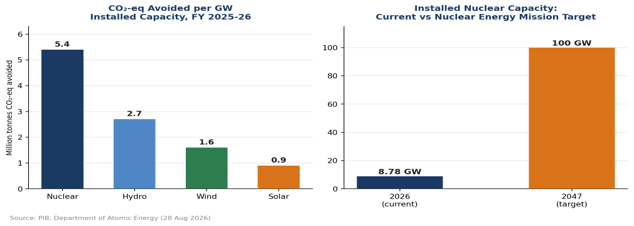
Fig. 2 — Nuclear’s carbon-avoidance edge per unit capacity and 2026→2047 capacity roadmap.
Challenges:
-
- PRS Legislative Research analysis of the SHANTI Bill/Act, 2025 notes that Act replaces the earlier flat ₹1,500 crore liability cap with a tiered cap of just ₹100-3,000 crore linked to reactor capacity and removes operator’s statutory right of recourse against equipment suppliers. Thus, leaving risk allocation to private contracts and reducing accountability for technology vendors.
- It had found that domestic insurance markets currently lack the capacity to fully cover large-scale nuclear liability. So, risks beyond the operator’s cap would fall on the state-funded Nuclear Liability Fund.
- Meghalaya Legislative Assembly resolution (August 2026) and past Parliamentary Standing Committee observations highlight that India’s richest uranium deposits (Meghalaya, historically also Jharkhand and Andhra Pradesh) remain unmined due to sustained local and tribal opposition over health and environmental concerns. Thereby, continued reliance on imports from Kazakhstan, Canada and Russia.
- IEA (“The Path to a New Era for Nuclear Energy”) finds that nuclear projects worldwide are prone to cost overruns and delays.
- World Bank–IAEA nuclear financing partnership (2025) acknowledges that financing remains the single biggest hurdle for nuclear expansion in developing countries.
Way Forward
-
- AERB / Department of Atomic Energy should operationalise SHANTI Act’s statutory safety mandate transparently. Thereby, ensuring fast-tracked private licensing never dilutes independent regulatory scrutiny.
- IRDAI / GIC Re should recapitalise and expand the existing India Nuclear Insurance Pool to match the SHANTI Act’s higher tiered liability caps.
- Ministry of Power / DAE should diversify and lock in long-term uranium supply agreements (building on existing Kazakhstan, Canada and Russia pacts) while accelerating Stage-2/3 progress, so import dependence structurally declines as thorium-based capacity scales up.
- Government of India should actively engage the World Bank-IAEA nuclear financing partnership and other multilateral development banks to co-finance indigenous SMR deployment.
Conclusion:
India’s nuclear programme is transitioning from a state-monopoly to a diversified, partly private, thorium-oriented future anchored by the SHANTI Act. Yet realising 100 GW by 2047 target will depend on resolving liability-insurance gaps, domestic uranium mining trust deficits and project financing and cost-overrun risks.
Spread the Word