Introduction:
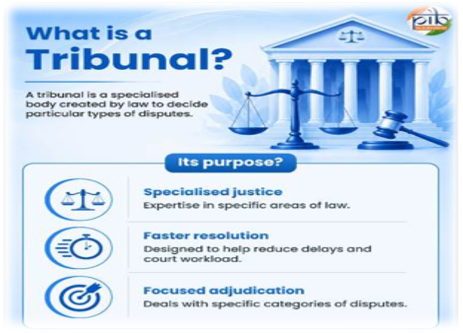
Tribunals are specialised judicial or quasi-judicial bodies created to provide faster and expert adjudication in areas requiring technical knowledge. However, concerns over executive influence, vacancies, delays and fragmented administration have weakened their effectiveness. The Tribunal Reforms Bill, 2026 seeks to address these concerns by establishing a National Tribunals Commission (NTC).
Evolution of the Tribunal System in India
India’s tribunal system acquired a constitutional foundation through the 42nd Constitutional Amendment Act, 1976, which inserted Articles 323A and 323B.
| Period | Major Development |
|---|---|
| 1976 | 42nd Amendment inserted Articles 323A & 323B providing constitutional recognition to tribunals. |
| 1985 | Administrative Tribunals Act, 1985 led to the establishment of the Central Administrative Tribunal (CAT) and State Administrative Tribunals. |
| 1990s onwards | Sector-specific tribunals expanded with economic liberalisation and regulatory governance. |
| 2010 | Union of India v. Madras Bar Association clarified that Parliament's power to establish tribunals is not confined narrowly to Article 323B subjects. |
| 2017 | Tribunals Reforms Commission/changes sought to rationalise the growing tribunal structure. |
| 2021 | Tribunals Reforms Act, 2021 attempted to streamline tribunals but faced major constitutional challenges. |
| 2026 | Tribunal Reforms Bill proposes a National Tribunals Commission and a more independent institutional framework. |
Major Tribunals
-
- Administrative: CAT, State Administrative Tribunals
- Economic/Financial: NCLT, NCLAT, DRT, DRAT, ITAT, CESTAT
- Regulatory: TDSAT, SAT, APTEL
- Sectoral/Specialised: NGT, AFT, Railway Claims Tribunal, Consumer Commissions
Key Provisions of Tribunal Reforms Bill, 2026
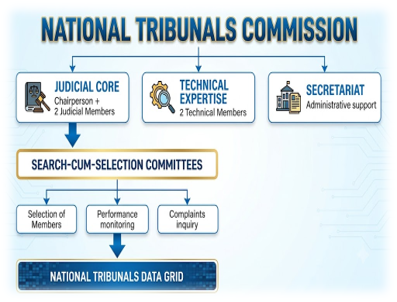
i. The Bill proposes a permanent National Tribunals Commission (NTC) to oversee appointments, performance, complaints and administrative functioning of tribunals.
ii. Secretariatsupport headed by a Secretary to the GoI which will serves as the administrative support system for the National Tribunals Commission. It will function under the general and administrative oversight of the Commission’s Chairperson.
iii. Judiciary-led appointments i.e. selection architecture gives greater weight to judicial members, with Chairperson of the NTC and judicial members drawn from the higher judiciary.
iv. Search-cum-Selection Committees-Tribunal Chairpersons and Members will be selected through specialised committees consisting of judicial, technical and government representatives.
v. The Bill provides a five-year term subject to the prescribed age limits while allowing reappointment based on previous service and performance.
vi. A common National Tribunals Data Grid will maintain case-related information covering the tribunals under the framework.
vii. CAG will audit the Commission’s accounts with the audit report being laid before Parliament.
Composition
-
- Chairperson: Former Supreme Court Judge or Chief Justice of a High Court.
- Two Judicial Members: Former Chief Justices/Judges of High Courts.
- Two Technical Members: At least 25 years’ experience in fields such as law, finance, public administration, banking, management or technology.
Supreme Court Judgments
1. S.P. Sampath Kumar (1986):
Tribunals can substitute High Courts if equally effective.
2. L. Chandra Kumar (1997):
Overruled Sampath and said tribunals are supplementary, not substitutes. Important verdicts in this case are as follows-
-
- A tribunal substituting a High Court must have the same status as the High Court.
- It should function as a court of first instance, but its decisions must be reviewed by a division bench of the concerned High Court.
- Any dominance of non-judicial members makes the tribunal less effective than a High Court.
- Only persons with judicial experience should be appointed as tribunal members.
- An independent mechanism should manage the appointment and administration of tribunals.
3. R. Gandhi Case (2010):
Advocated judicial dominance in appointments. Only Secretary level officers with specialised knowledge and skills should be appointed as technical members.
4. Rojer Mathew Case (2019):
Key verdict in this case are as follows:-
-
- Technical members cannot perform judicial functions.
- Provisions to allow the removal of judges by the Executive are unconstitutional.
- There should be a uniform age of retirement for all members of all the tribunals.
- Short tenures lead to control of executives over tribunals, causing adverse effects on the independence of the judiciary.
- The impact of the amalgamation of tribunals should be analysed with judicial impact assessment.
5. Madras Bar Association Cases (2014, 2020, 2021):
Opposed short tenure, executive control, and supported National Tribunal Commission (NTC).
How Does the Bill Strengthen Tribunal Independence?
-
- The Bill shifts a substantial part of the appointment architecture away from direct executive control towards a judicially dominated NTC and judicially chaired selection committees.
- The judicial Chairperson has a casting vote which strengthen judicial element in appointment decisions.
- Two technical members and empanelled experts bring domain expertise into tribunal appointments instead of relying exclusively on conventional judicial credentials.
- A five-year tenure provides greater institutional stability and reduces the possibility that short or uncertain appointments may affect decisional independence.
- A permanent NTC can address appointments, complaints, performance and administrative requirements in a unified manner rather than leaving each tribunal dependent on its parent ministry.
The reform is therefore broadly aligned with the Supreme Court’s repeated emphasis that tribunals performing judicial functions must enjoy independence comparable to that expected of the judiciary.
Challenges
i. The proposed NTC is strongly judiciary-led while Central Government formally appoints its Chairperson and judicial members after consultation with the CJI. The challenge is to balance judicial independence with institutional accountability.
ii. Although tribunals can assess their financial requirements, grants will continue to flow through Central Government allocations and parliamentary appropriation. Thus, administrative autonomy may not translate into complete financial independence.
iii. Reappointment may affect decisional independence Without transparent criteria, a member’s dependence on future reappointment could potentially affect perceived independence. Central Government formally appoints the Chairperson and judicial members of the Commission. This leaves some scope for executive influence.
iv. Pendency and vacancies remain the real test of effectiveness. For example, 91,643 cases in ITAT, 18,829 in AFT and 7,312 in Central Government Industrial Tribunals in the cited periods.
v. The fundamental question of “tribunalisation” remains unresolved
International Experience
i. United Kingdom — First-tier & Upper Tribunals: The UK’s tribunal system operates through a structured, unified framework with First-tier Tribunal dealing with specialised disputes and Upper Tribunal providing appellate review. This offers lessons in institutional coherence and specialised adjudication.
ii. Australia — Administrative Review Tribunal: Australia’s Administrative Review Tribunal (ART) provides a centralised mechanism for reviewing government administrative decisions. Its unified structure seeks to reduce fragmentation and provide a consistent administrative-review process.
iii. United States — Specialised Administrative Adjudication: The US uses Administrative Law Judges and specialised adjudicatory bodies within the administrative state. The model demonstrates the importance of combining technical expertise with procedural safeguards and adjudicatory independence.
Conclusion:
However, Tribunal Reforms Bill 2026 represents a shift from fragmented and executive-dependent tribunal administration towards a more independent, judicially led and professionally managed system. Its success, however, will depend not merely on institutional design but on timely appointment.
Spread the Word