TOPIC-1: Official Launch of Central Bank Digital Currency (CBDC)-Based Direct Benefit Transfer (DBT)
-
- GS Paper 3 (Indian Economy – Public Distribution System (PDS), Food Security, Direct Benefit Transfer (DBT), Central Bank Digital Currency (CBDC), and Digital Public Infrastructure (DPI)).
Overview: The officially launched the CBDC-based Direct Benefit Transfer (DBT) system under the Pradhan Mantri Garib Kalyan Anna Yojana (PMGKAY) at Tagore Theatre, Chandigarh. The launch marks the formal operational rollout of programmable Digital Rupee () tokens to food subsidy beneficiaries in Chandigarh, establishing it as a testbed and model city for nationwide adoption.
Policy Highlights:
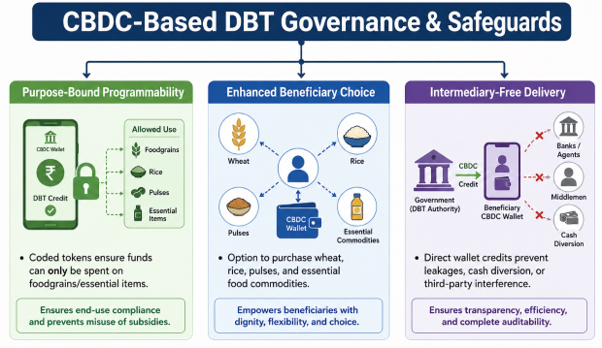
1. Programmability & Misuse Prevention: Unlike traditional cash/bank account DBT—where cash transfers risk being diverted toward non-essential expenditures—CBDC tokens carry built-in technological safeguards. Tokens can be redeemed exclusively for foodgrains and essential commodities at empanelled merchants/fair-price shops.
2. Expanded Beneficiary Autonomy: Rather than limiting subsidies to fixed grain allocations, the digital wallet framework empowers beneficiaries with a wider choice of commodities, including pulses, wheat, rice, and other essential foods.
3. PDS Transparency: Bypasses manual handling, reduces leakage, and streamlines real-time tracking from central allocations to end-consumer redemption.
4. Protection of Farmers’ Interests: Reaffirmed that national interest, farmers’ welfare, and public interest remain non-negotiable across all domestic agricultural policies and international trade agreements.
5. National Food Security Cushion: Emphasized that India maintains resilient buffer stocks of wheat and rice, ensuring complete domestic food security while supporting export opportunities when necessary.
6. PMGKAY Social Security Impact: Highlighted that free foodgrain delivery to over 800 million citizens under PMGKAY functions as a massive social safety net, freeing up household disposable income for healthcare and education.
7. Rural Livelihood Targets: Re-emphasized the Lakhpati Didi mission target to economically empower 60 million rural women by 2029 through Self-Help Group (SHG) networks and micro-enterprises.
UPSC Quick Reference Table
| Component | Detailed Specification |
| Nodal Ministries | Minstry of Consumer Affairs, Food and Public Distribution; Ministry of Agriculture & Farmers’ Welfare |
| Model Launch City | Chandigarh (Serving as a template for national scaling) |
| Target Scheme | Pradhan Mantri Garib Kalyan Anna Yojana (PMGKAY) |
| Primary Technology | Central Bank Digital Currency (CBDC / Digital Rupee ()) |
| Key Innovation | Programmable tokens restricting spending strictly to food items |
| Beneficiary Base (PMGKAY) | >800 Million People across India |
Conclusion:
The launch of the CBDC-based DBT pilot in Chandigarh leverages digital public infrastructure to strengthen the Public Distribution System (PDS). Integrating purpose-bound Digital Rupee tokens with food subsidy delivery ensures end-to-end transparency, prevents fund diversion, and expands food choice for vulnerable households.
TOPIC-2: First-Ever Drone Delivery of Tiranga by India Post
-
- GS Paper 2 (Government policies and interventions, e-governance applications)
- GS Paper 3 (Science & Technology – Drone technology applications, last-mile connectivity, infrastructure development).
Introduction:
The first-ever drone delivery of the National Flag (Tiranga) by India Post. The drone carried a parcel containing the Tiranga from Mandi Head Post Office and successfully landed at Rehardhar Branch Post Office, where postal officials received it and handed it over to an army veteran.
Key Highlights of the Initiative
1. Overcoming Geographical Barriers: Demonstrates the operational feasibility of using Unmanned Aerial Vehicles (UAVs) to strengthen last-mile connectivity in remote, hilly, and inaccessible terrains where traditional road logistics face operational delays.
2. Expansion to 150 Routes: As part of the Department of Posts’ broader technology integration roadmap, drone-based mail transmission will be deployed across 150 identified routes in Himachal Pradesh and Assam.
3. National Commemorative Context: The event coincided with the Har Ghar Tiranga campaign and marked the national commemoration of 150 years of Vande Mataram.
UPSC Quick Reference Table
| Component | Detailed Specification |
| Nodal Ministry | Ministry of Communications (Department of Posts) |
| Origin & Destination | Mandi Head Post Office Rehardhar Branch Post Office (Himachal Pradesh) |
| Inaugurating Authority | Union Minister Shri Jyotiraditya M. Scindia |
| Future Deployment | 150 designated drone routes across Himachal Pradesh and Assam |
| Core Ethos | “Dak Sewa, Jan Sewa” (Service to Post, Service to People) |
Conclusion:
Deploying drone-based mail transmission across 150 remote routes in the Northeast and Himalayan regions supports inclusive digital governance and infrastructure connectivity in hard-to-reach areas.
TOPIC-3: FutureSkills PRIME Initiative
-
- GS Paper 2 (Government policies and interventions for development; Skill development, E-governance, and education);
- GS Paper 3 (Indian Economy & employment generation, Industry & Infrastructure – IT & Electronics, Science & Technology – Artificial Intelligence, Big Data, Semiconductors).
Context: In a written reply in the Lok Sabha, Union Minister of Electronics and Information Technology gave detailed progress of FutureSkills PRIME (FSP) developed jointly by the Ministry of Electronics and Information Technology (MeitY) and NASSCOM. The programme aims to position India as a global digital talent hub by training candidates in emerging technologies like Artificial Intelligence (AI), Big Data Analytics, Cyber Security, te Internet of Things (IoT), Blockchains, AR/VR, and Semiconductors.
Development:
1. Digital Public Infrastructure for Skilling
-
- Portal Reach: Over 34 Lakh candidates registered, 23 Lakh+ enrolled/trained, and 13 Lakh+ certified.
- Inclusivity Metrics: 41% of certified candidates are women, and over 86% originate from Tier-2 and Tier-3 cities.
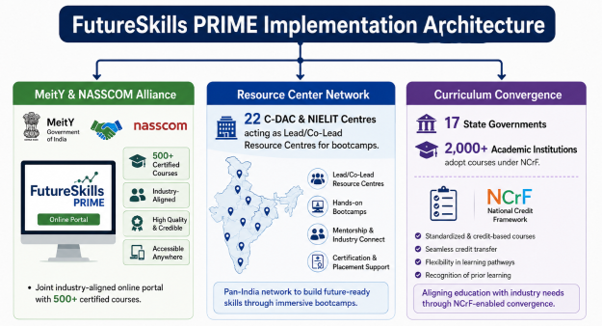
- Academic Integration: SSC-NASSCOM has partnered with 17 State Governments and 2,000+ academic institutions to integrate FSP courses into university curricula aligned with the National Credit Framework (NCrF).
2. Role of C-DAC & NIELIT Resource Centres
-
- Specialized Training: 22 C-DAC/NIELIT Lead and Co-Lead Resource Centres have trained 32,700+ Government officials, 2,367 trainers, and 40,400+ candidates across 420+ bootcamps in 10 emerging technologies.
- Year-Wise Financial Allocation (Central Sector Scheme)
As a Central Sector Scheme, funds are allocated centrally without state-wise earmarking.
| Financial Year | Funds Allocated (₹ Crore) | Funds Utilized (₹ Crore) |
| FY 2022–23 | ₹26.59 Cr | ₹25.72 Cr |
| FY 2023–24 | ₹23.58 Cr | ₹23.55 Cr |
| FY 2024–25 | ₹55.97 Cr | ₹51.94 Cr |
| FY 2025–26 | ₹98.479 Cr | ₹80.81 Cr |
| FY 2026–27 | ₹137.17 Cr | Implementation ongoing |
Top 5 States by Candidate Certifications
1. Tamil Nadu: 3,61,336 certified (5,89,429 enrolled)
2. Andhra Pradesh: 2,44,096 certified (4,34,489 enrolled)
3. Karnataka: 1,51,701 certified (2,10,043 enrolled)
4. Maharashtra: 1,15,703 certified (2,23,044 enrolled)
5. Kerala: 94,920 certified (1,42,732 enrolled)
UPSC Quick Reference Table
| Aspect | Detailed Specification |
| Nodal Body | Ministry of Electronics & IT (MeitY) in partnership with NASSCOM |
| Implementation Type | Central Sector Scheme |
| Key Platform | FutureSkills PRIME (futureskillsprime.in)[cite: 1] |
| Total Candidates | 34 Lakh+ Registered; 23 Lakh+ Enrolled; 13 Lakh+ Certified
[cite: 1] |
| Demographic Highlights | 41% Women; 86% Tier-2/Tier-3 Coverage[cite: 1] |
| Curriculum Framework | Integrated with National Credit Framework (NCrF)
[cite: 1] |
| AI Infrastructure | 27 IndiaAI Data & AI Labs established through NIELIT. |
Conclusion:
By Combining digital course delivery with physical resource centers like C-DAC/NIELIT and aligning with the National Credit Framework helps build talent pipelines and support the broader Digital India initiative.
TOPIC-4: Key Highlights of the Prime Minister’s Address on the 80th Independence Day
-
- GS Paper 2 (Government policies and interventions; Governance reforms; Welfare schemes for vulnerable sections; Foreign policy and FTAs);
- GS Paper 3 (Economic growth and Aatmanirbhar Bharat; Sapt Dhara framework; Manufacturing, Agriculture, Energy, Infrastructure, Space, Defence, and Emerging Technologies like AI and Semiconductors).
Summary: Prime Minister Shri Narendra Modi outlined the national roadmap toward Viksit Bharat @2047 from the ramparts of the Red Fort on the 80th Independence Day. The address commemorated 150 years of Vande Mataram and emphasized a transition from incremental progress to transformational reform through the “Sapt Dhara” (Seven Streams of Strength) framework.
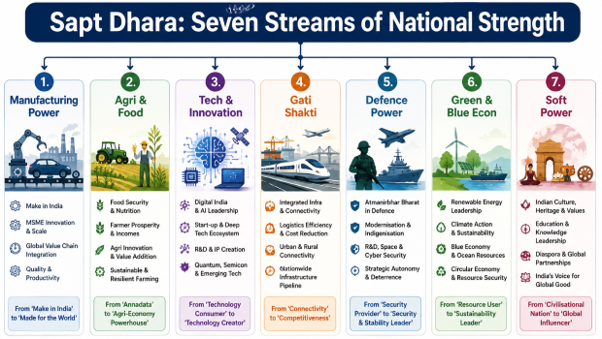
“Sapt Dhara” (Seven Streams of Strength):
1. Aiming for complete value-chain integration (component manufacturing to final design) to make India a trusted node in global supply chains.
2. Protecting farmers by subsidizing international fertilizer costs (providing ₹3,000 urea bags at ₹300 and ₹5,000 DAP bags at ₹1,350). Promoting chemical-free organic farming to meet global FTA market standards.
3. Technology & Innovation:
-
-
-
- Semiconductors: Following 3 initial plants, 5 to 8 new semiconductor fabrication/assembly plants will be established within 7–8 years.
- Digital Public Infrastructure (DPI) & 6G: Exporting UPI/DPI models globally and leading next-generation communication with Made-in-India 6G.
-
-
4. Gati Shakti & Infrastructure:
-
-
-
- Railways: Achieved near-total electrification (~70% completed in 10 years vs. 30% in 90 years). Unveiled the world’s longest and most powerful hydrogen-powered train.
- Aviation: Successful flight of the ‘Made in India’ C295 Defence Transport Aircraft.
-
-
5. Defence Power & Security:
-
-
-
- Exports & Indigenization: Defence production grew nearly 4-fold; defence exports expanded 50-fold, reaching ~100 countries.
- Next-Gen Defence: Focus on hypersonic technology, counter-drone systems, cybersecurity, and the Mission Sudarshan Chakra.
- Civil Defence Network: Announced the creation of a modern, technology-enabled Vibrant Civil Defence Network to prepare citizens for modern, non-line-of-sight warfare.
- Internal Security: Highlighted the near-elimination of Naxalite/Maoist violence across former hotspots.
-
-
6. Green & Blue Economy:
-
-
-
- Nuclear Energy: Passing the SHANTI Act paves the way toward a target of 100 GW nuclear capacity by 2047, supported by mastering indigenous Fast Breeder Reactor (FBR) technology and commissioning 5 new reactors this decade.
- Renewable Energy: Solar capacity reached 160 GW (up from 2 GW in 2014). Over 50 lakh households adopted rooftop solar under PM Surya Ghar Muft Bijli Yojana.
- Electric Vehicles: EV sales surged from 1.5 lakh (2009–10) to 25 lakh units (2025–26).
- Blue Economy: Leveraging coastal infrastructure for port-led development, seafood/shrimp exports, and ocean technology.
-
-
7. Soft Power: Expanding global reach through Yoga, Heal in India (Ayurveda/holistic healthcare), handicrafts, VFX/gaming, and the World Audio Visual and Entertainment Summit (WAVES).
Announcement:
-
- National AI Skilling Mission: Announced an initiative to train 1 crore youth in AI skills over the next year.
- Innovation & Startups: Supported by a ₹1 Lakh Crore Innovation Fund, registered startups crossed 2.5 lakh. The bioeconomy expanded from ₹60,000 crore to ₹20 Lakh Crore.
- Education: Added nearly 650 new universities over the past 12 years (nearing 1,000 total) and expanded medical seats to 850. Deployed over 10,000 Atal Tinkering Labs and introduced free online coaching networks for competitive exams.
- Women-Led Development: Elevated the Lakhpati Didi rural target to 6 crore women. Reiterated the call to implement 33% reservation for women in State Assemblies and the Lok Sabha.
- Sports & Olympics Roadmap: Preparing for the 2030 Commonwealth Games and mounting a bid for the 2036 Olympics. Launching a nationwide Talent-Hunt Campaign for children aged 5–15 across villages and schools to groom future Olympic athletes.
UPSC Quick Reference Table
| Component | Detailed Specification |
| Pivotal Framework | Sapt Dhara (7 Streams: Manufacturing, Agriculture, Tech, Gati Shakti, Defence, Green/Blue Economy, Soft Power) |
| Nuclear Power Goal | 100 GW by 2047 (Paved by the SHANTI Act & Fast Breeder Reactor technology) |
| Semiconductor Target | 5 to 8 new plants planned over the next 7–8 years |
| AI Skilling Target | 1 Crore youth to be trained in AI skills within one year |
| Women Empowerment | 6 Crore Lakhpati Didis target; 33% legislative reservation push |
| Rooftop Solar Scale | >50 Lakh households covered under PM Surya Ghar Muft Bijli Yojana |
| Defence Progress | 4x production growth; 50x export surge reaching ~100 nations; C295 flight |
| Sports Pipeline | Talent-hunt for ages 5–15 targeting 2030 CWG and 2036 Olympics |
Conclusion:
The 80th Independence Day address sets a policy roadmap for Viksit Bharat @2047 by linking self-reliance (Aatmanirbhar Bharat) with manufacturing quality, green energy expansion, semiconductor/AI capabilities, and social security reforms.
Spread the Word