
TOPIC-1: Bilateral Meeting Between India and Kenya
-
- GS Paper 2 (Bilateral, regional, and global groupings and agreements involving India and/or affecting India’s interests; Effect of policies and politics of developed and developing countries on India’s interests; Parliament and State Legislatures — structure, functioning, conduct of business, powers & privileges).
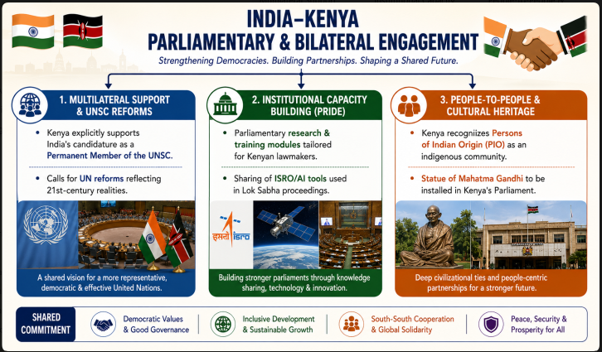
Context: A high-level Kenyan Parliamentary Delegation held bilateral talks at the Parliament House Complex in New Delhi. The bilateral engagement highlighted the shared democratic heritage, multilateral alignment—including Kenya’s explicit support for India’s permanent seat on a reformed United Nations Security Council (UNSC) and parliament-to-parliament capacity building using Artificial Intelligence (AI).
Core Pillars of the Bilateral Engagement
1. UNSC Reform & Multilateral Alignment
-
- Permanent UNSC Seat: Speaker Wetang’ula called for structural, democratic reforms of the United Nations Security Council and reaffirmed Kenya’s support for India’s inclusion as a Permanent Member of the UNSC to reflect 21st-century geopolitical realities.
- Global South Coordination: Reaffirmed joint positions across multilateral bodies, including the United Nations, Commonwealth, and the G20.
2. Parliamentary Cooperation & Technology Integration
-
- PRIDE Capacity Building: Highlighted ongoing training initiatives conducted by the Parliamentary Research and Training Institute for Democracies (PRIDE) for Kenyan MPs and parliamentary officials.
- Leveraging Artificial Intelligence (AI): Lok Sabha Speaker Om Birla offered to share India’s experience in deploying AI tools for real-time translation, speech-to-text digitization, record management, and public engagement to enhance transparency and parliamentary efficiency.
- Parliamentary Friendship Groups: Encouraged frequent exchange visits of legislative delegations between the two nations to deepen institutional ties.
3. Cultural Heritage & Diaspora Contribution
-
- Indigenous Community Recognition: Welcomed the decision by the Government of Kenya to formally recognize Persons of Indian Origin (PIOs) as an indigenous community in Kenya, acknowledging their contributions across commerce, administration, and parliament.
- Mahatma Gandhi Statue: Speaker Wetang’ula agreed to the installation of a statue of Mahatma Gandhi inside the Parliament of Kenya, honoring his role as an enduring symbol of peaceful anti-colonial struggle across East Africa.
UPSC Quick Reference Table
| Component | Detailed Specification |
| Nodal Institution | Lok Sabha Secretariat / Parliament of India |
| Kenyan Delegation Leader | Rt. Hon. (Dr.) Moses M. Wetang’ula (Speaker, National Assembly of Kenya) |
| Key Multilateral Stance | Kenya supports India’s permanent membership in a reformed UNSC |
| Capacity Building Body | Parliamentary Research and Training Institute for Democracies (PRIDE) |
| Tech Transfer Offer | Sharing AI tools and digital public infrastructure used in Lok Sabha |
| Diaspora Milestone | Recognition of Persons of Indian Origin (PIO) as an indigenous community in Kenya |
Conclusion:
The bilateral meeting by combining shared positions on UNSC reform & institutional capacity building through PRIDE and AI technology sharing both nations continue to strengthen their bilateral partnership.
TOPIC-2: ISRO’s Strategy on LEO Constellations and Space Debris Mitigation
-
- GS Paper 3 (Science and Technology – Developments and their applications in daily life; Awareness in the field of Space; Conservation, environmental pollution, and degradation – Space Environment).
Context: A central highlight is ISRO’s Debris Free Space Mission (DFSM), which aims to achieve zero space debris generation from Indian space missions by 2030 through proactive post-mission disposal, on-orbit maneuvering, and Active Debris Removal (ADR) technologies.
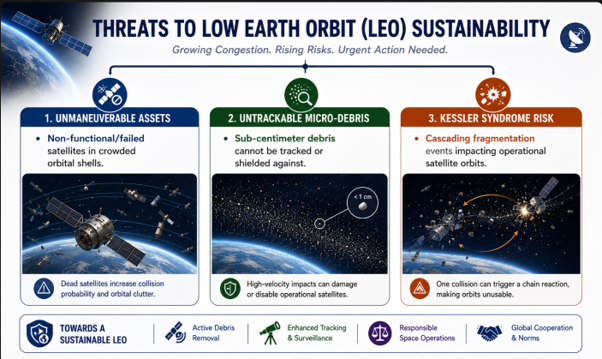
1. Orbital Crowding: Mega-constellations operating thousands of satellites significantly increase collision risks within specific LEO altitude shells.
2. Untrackable Micro-Debris: Small-sized debris () poses the highest risk to active spacecraft because it cannot be tracked for collision-avoidance maneuvers or fully protected against by physical shielding.
3. Cascading Fragmentation: Accidental break-ups or collisions near populated orbital shells risk triggering cascading fragmentation events, rendering specific LEO zones unusable.
India’s Policy for Space Sustainability
1. Debris Free Space Mission (DFSM)
-
- Spearheaded by ISRO, the DFSM initiative sets a target to ensure all Indian space missions (both satellite and launch vehicle upper stages) leave zero orbital debris by 2030.
- Key Components:
- Passivation: De-energizing batteries and venting leftover propellant from spent upper stages () to prevent accidental on-orbit explosions.
- Post-Mission Disposal (PMD): Lowering the perigee of satellites at the end of their operational lifecycle to ensure atmospheric re-entry within 25 years (or accelerated de-orbiting).
- Active Debris Removal (ADR): Developing indigenous robotic arms, tethering systems, and servicing satellites for active de-orbiting of defunct space objects.
2. Regulatory Alignment (Indian Space Policy 2023 & IN-SPACe)
-
- Indian Space Policy 2023: Mandates strict adherence to internationally recognized guidelines on space debris mitigation for all domestic space activities.
- IN-SPACe Norms, Guidelines, and Procedures (NGP 2024): Compels Non-Government Entities (NGEs) and private space startups to incorporate end-of-life disposal capabilities or limit on-orbit lifetimes via natural atmospheric decay.
3. Space Situational Awareness (SSA) & IS4OM
-
- Project NETRA & IS4OM: ISRO’s System for Safe and Sustainable Space Operations Management (IS4OM) at Bengaluru continuously monitors space objects, assesses collision risks for Indian assets, and coordinates Collision Avoidance Maneuvers (CAMs).
International Cooperation
-
- Inter-Agency Space Debris Coordination Committee (IADC): ISRO has been a primary member of IADC since 1996, helping shape global space debris mitigation guidelines.
- UN-COPUOS: Active participation in the UN Committee on the Peaceful Uses of Outer Space Working Group on the Long-Term Sustainability (LTS) of Outer Space Activities.
- ISO & IAA Interoperability: Coordination with the International Academy of Astronautics (IAA) Space Debris Working Group and ISO Working Group 7 for international standard-setting.
UPSC Quick Reference Table
| Component | Detailed Specification |
| Nodal Department | Department of Space (DoS) / ISRO |
| Primary Initiative | Debris Free Space Mission (DFSM) (Target Year: 2030) |
| ISRO IADC Membership | Member since 1996 |
| Indigenous SSA Hub | IS4OM (ISRO System for Safe & Sustainable Space Operations Management) |
| Private Sector Rules | IN-SPACe Norms, Guidelines, and Procedures (NGP 2024) |
| Key Technological Focus | Active Debris Removal (ADR) & Precision Post-Mission Disposal (PMD) |
Conclusion:
As Low Earth Orbit experiences unprecedented growth in satellite numbers. Thus, by combining active debris removal and international cooperation through IADC helps protect India’s space assets.
TOPIC-3: Launch of Indigenous ‘GARUD’ High-Resolution Binoculars for Civil Market
-
- GS Paper 3 (Indigenization of Technology, Aatmanirbhar Bharat in Defence & Precision Manufacturing, Defence Public Sector Undertakings – DPSUs).
Introduction: India Optel Limited (IOL), a Category-I Mini Ratna Defence Public Sector Undertaking (DPSU) under the Department of Defence Production (Ministry of Defence) has launched the indigenous ‘GARUD’ High Resolution Binoculars for the civilian market. It is developed and manufactured at the Ordnance Factory, Dehradun
Key Features:
-
- Magnification & Field of View (FoV): Features 8x magnification combined with a 7.6-degree wide field of view, balancing target detail with broad spatial awareness.
- Eyesight Accommodation: Equipped with a diopter adjustment range to accommodate individual visual variances without sacrificing image sharpness.
- Build & Portability: Weighs approximately 610 grams with an ergonomic grip, making it portable for field deployment.
- Civilian Applications: Suitable for forestry, marine operations, private security, wildlife conservation, nature exploration, and sports.
Significance
-
- Defence-to-Civil Technology Transfer: Marks IOL’s strategic entry into the civilian optics market by commercializing proven military-grade optical manufacturing capabilities (dating back to Ordnance Factory Dehradun’s establishment in 1943).
- Diversification of DPSUs: Demonstrates how restructured Defence PSUs (created post-corporatization of the Ordnance Factory Board) are expanding their revenue streams through dual-use technologies.
UPSC Quick Reference Table
| Component | Detailed Specification |
| Manufacturing DPSU | India Optel Limited (IOL) / Ordnance Factory, Dehradun |
| Parent Department | Department of Defence Production, Ministry of Defence |
| Product Name | ‘GARUD’ High Resolution Binoculars |
| Technical Specs | 8x Magnification; FoV; Diopter adjustment; 610g weight |
| Strategic Thrust | Aatmanirbhar Bharat (Defence-grade technology adaptation for civil market) |
Conclusion:
The launch of the ‘GARUD’ high-resolution binoculars highlights the commercialization of defence-grade manufacturing capabilities by India Optel Limited (IOL). Adapting military-grade precision optics for civilian use supports the goals of Aatmanirbhar Bharat and helps diversify the revenue streams of Defence Public Sector Undertakings.
TOPIC-4: Special Assistance to States for Capital Investment (SASCI) Scheme
-
- GS Paper 2 (Governance & Cooperative Federalism — Financial transfers and scheme execution between Centre and States)
- GS Paper 3 (Economic Development, Tourism Sector Infrastructure, Capital Expenditure, Employment Generation, and Digital Governance).
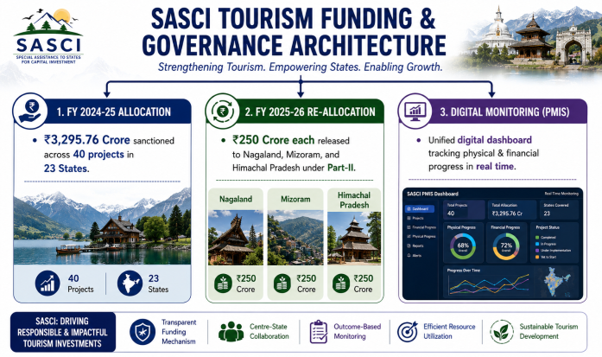
Context: The initiative supports State Governments in developing world-class tourist destinations through 100% central funding in the form of 50-year interest-free loans for capital expenditure.
Governance Convergence
1. National Institutional Framework: The scheme is governed by a Central Sanctioning and Monitoring Committee (CSMC) and a Mission Directorate (MD).
2. Inter-Ministerial Convergence: Representatives from key central departments—including Culture, Housing and Urban Affairs (MoHUA), Civil Aviation, MoRTH, Ports, Ministry of Environment, Forest and Climate Change (MoEFCC), Rural Development, Railways, and the Archaeological Survey of India (ASI)—are integrated into the monitoring body to streamline cross-sectoral approvals.
3. Program Management Information System (PMIS): A unified digital platform used by the Ministry of Tourism, State Governments, and Union Territory Administrations to track physical progress, monitor funds, and ensure timely project completion.
Prominent Sanctioned Projects (FY 2024-25 Breakdown)
| State | Selected Project / Destination | Focus Area | Sanctioned Cost (₹ Cr) |
|---|---|---|---|
| Andhra Pradesh | Gandikota Fort & Gorge Experience | Heritage & Eco-Adventure | 77.91 |
| Assam | Rang Ghar Beautification, Sivasagar | Ahom Dynasty Heritage | 94.76 |
| Bihar | Matsyagandha Lake, Saharsa | Lake Restoration & Tourism | 97.61 |
| Goa | Chhatrapati Shivaji Maharaj Museum, Ponda | Cultural Heritage Museum | 97.46 |
| Gujarat | Tented City & Convention Centre, Dhordo | MICE & Desert Eco-Tourism | 51.56 |
| Karnataka | Devika Rani Estate Tataguni, Bengaluru | Cultural & Eco-Hub | 99.17 |
| Madhya Pradesh | Orchha Medieval Splendour & MICE Bhopal | Heritage & MICE Tourism | 199.30 |
| Maharashtra | INS-Guldar Underwater Museum, Sindhudurg | Underwater & Submarine Tourism | 46.91 |
| Rajasthan | Amber-Nahargarh & Jal Mahal, Jaipur | Fort & Palace Circuit | 145.92 |
| Uttar Pradesh | Bateshwar (Agra) & Shrawasti | Heritage & Buddhist Circuit | 154.29 |
UPSC Quick Reference Table
| Component | Detailed Specification |
| Nodal Ministry | Ministry of Tourism (in coordination with Dept. of Expenditure, Ministry of Finance) |
| Scheme Sub-title | Special Assistance to States for Capital Investment (SASCI) — Part III / Part II |
| Financial Nature | 100% Central Funding via 50-year interest-free loans |
| FY 2024-25 Outlay | ₹3,295.76 Crore for 40 projects across 23 States |
| FY 2025-26 Release | ₹250 Crore each to Himachal Pradesh, Mizoram, and Nagaland |
| Digital Monitoring Portal | Program Management Information System (PMIS) |
Conclusion:
The SASCI scheme for developing Iconic Tourist Centres helps build sustainable tourism infrastructure, promote lesser-known heritage and eco-destinations and drive local economic development across India.
TOPIC-5: Launch of the Science & Technology (S&T) Clusters Annual Report 2025–2026
-
- GS Paper 3 (Science & Technology — Indigenization of technology, public-private partnerships, research hubs, technology translation, and academic-industry linkages).
Introduction: The Office of the Principal Scientific Adviser (PSA) to the Government of India launched the “Science and Technology (S&T) Clusters Annual Report 2025–26”. The S&T Clusters act as “National Technology Accelerators” and regional innovation ecosystems. They operate under a consortium-based model connecting academia, research institutes, industry, startups, and local governments to drive high Technology Readiness Levels (TRLs), commercialization, and societal impact.
The Eight S&T Clusters Operating Under the Office of PSA:
1. Andhra Pradesh Medtech Zone (AMTZ Vizag): Specializes in medical technology manufacturing, regulatory support, and testing infrastructure.
2. Bengaluru Science and Technology Cluster (BeST): Focuses on emerging technologies, healthtech, and AI-enabled diagnostics.
3. Bhubaneswar City Knowledge and Innovation Cluster (BCKIC): Drives biotechnology, material science, and regional natural resource management.
4. Delhi Research Implementation and Innovation Cluster (DRIIV): Coordinates urban sustainability, green mobility, and air quality technology projects.
5. Jodhpur City Knowledge and Innovation Cluster (JCKIC): Leads traditional knowledge digitization, handicraft technology, and arid zone research.
6. Panjab University–IIT Ropar Regional Accelerator for Holistic Innovations (PI-RAHI): Focuses on agritech, water management, and deep-tech incubation.
7. Pune Knowledge Cluster (PKC): Centers on environment, sustainable mobility, health surveillance, and STEM education.
8. Research and Innovation Circle of Hyderabad (RICH): Facilitates life sciences, aerospace, and agricultural innovation networks.
Key Initiatives:
-
- Healthcare & MedTech Interventions: Development of indigenous pacemaker components, patient-specific 3D-printed implants, E-Yantram and One Health platforms.
- Agritech & Climate Intelligence: AI-enabled digital podiatry clinics, AI-driven agricultural advisory, and weather intelligence tools.
- Cross-Cluster Replications:
- Digital Podiatry Clinics: Expanded from BeST (Bengaluru) to PI-RAHI (Panjab/IIT Ropar).
- Kalaanubhav.in: Cultural and artisan technology portal developed by JCKIC (Jodhpur), scaled nationwide across other clusters.
- i-Passport: Developed by AMTZ (Vizag) to give innovators shared access to testing facilities, mentorship, and regulatory networks; slated for national scale-up.
- I-RISE (under I-STEM): Enables shared access to high-end scientific equipment across the clusters.
UPSC Quick Reference Table
| Component | Detailed Specification |
| Nodal Agency | Office of the Principal Scientific Adviser (PSA) to GoI |
| Total S&T Clusters | 8 Active Clusters across India |
| Operational Philosophy | Consortium-based regional innovation & technology translation hubs |
| Flagship Shared Portal | i-Passport (AMTZ) & I-RISE (I-STEM equipment access) |
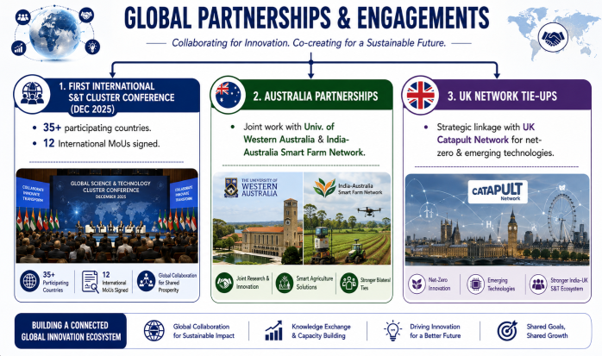
| Key Global Links | UK Catapult Network, University of Western Australia, India-Australia Smart Farm |
Conclusion:
The S&T Clusters under the Office of the PSA bridge the gap between academic research and commercial technology deployment. Scaling innovations like Digital Podiatry Clinics, AMTZ’s i-Passport, and JCKIC’s Kalaanubhav.in across regions helps drive indigenous technology translation, public-private partnerships, and sustainable economic growth.
TOPIC-6: NITI Aayog Report on “Key Sectors to Position India as a Global Manufacturing Hub”
- GS Paper 3 (Indian Economy & Issues relating to Planning, Mobilization of Resources, Growth, Development, Employment, Industrial Policy, and Global Value Chains).
Introduction: NITI Aayog’s report, Key Sectors to Position India as a Global Manufacturing Hub (Volume I), evaluates 62 manufacturing sectors using a data-driven 4-phase relative attractiveness framework to identify 12 priority sectors for global leadership. Volume I details the baseline manufacturing environment and presents comprehensive roadmaps for the first four sectors.
Finding-
-
- GVA Contribution: India’s manufacturing sector accounts for ~17% of Gross Value Added (GVA), remaining rangebound between 16–18% over the past two decades.
- Global Share: India’s share of global manufacturing GVA grew from 1.5% (1995) to 3.2% (2023), whereas China’s share expanded from 4.9% to 31.8% over the same period.
- Employment & Exports: Manufacturing employs 1.95 crore formal workers and generates $437 billion in merchandise exports (~70% manufactured goods).
Volume I Sectoral Findings:
| Sector | Current Economic Footprint | FY30 Targets & Outlook | Key Structural Challenges | Strategic Recommendations |
|---|---|---|---|---|
| Chemicals | Market size of $200–$220B (FY25); accounts for 3–3.5% of global output. | Market to reach $290–$310B by FY30 (6–8% CAGR), targeting a 5–6% global market share. | Heavy import reliance for core feedstocks: Methanol (85–90%), Acetic Acid (85–90%), and Phenol (41%). | Implement coal gasification/bamboo-to-methanol schemes, front-load PCPIR infrastructure, and build integrated chlor-alkali complexes. |
| Textiles & Apparel | Contributes 2% to GDP, 11% to manufacturing GVA, and 9% to exports ($37.7B in FY25). | Target of $100B in exports and $350B overall market size by FY30. | Inverted GST duty structure (PTA/MEG taxed at 18% vs downstream at 5%); low cotton yield (436 kg/ha vs world avg 789 kg/ha). | Rationalize raw material GST/customs duties, accelerate next-gen Bt cotton seed adoption, and expand PM MITRA parks. |
| Telecom & Network Equipment | Exports reached $25.87B in FY25 (~6% of export basket); supports 1.2B+ subscribers. | NTP-2025 targets doubling sector GDP contribution and exports by 2030. | Assembly-heavy growth with low component localization (4–5% in 4G/5G RAN base stations); >80% sub-components imported. | Enforce phased component localization, incentivize component Joint Ventures (JVs), and expand testing/certification hubs. |
| Solar PV Manufacturing | Domestic market at $3.7B; installed solar capacity at 106 GW (March 2025). | Market growing at 17–20% CAGR; target of 280 GW installed capacity by 2030. | Strong downstream module capacity (>100 GW under ALMM), but major upstream gaps in polysilicon, ingots, and wafers. | Provide performance-linked support for high-efficiency cells (TOPCon/HJT), build clean-tech clusters, and form international G2G tech ties. |
Cross-Sectoral Policy Recommendation
-
- Connect regional manufacturing hubs directly to the PM Gati Shakti National Master Plan and expand specialized port tankage/mechanization for liquid and bulk raw materials.
- Address the 1,570-day average timeline required to exit/close businesses by establishing single-window liquidation and automated tax/provident fund clearance systems.
- Establish cluster-level testing and certification centers to help MSMEs (which account for 80% of textile capacity) meet global ESG and quality norms.
UPSC Quick Reference Table
| Component | Detailed Specification |
| Nodal Agency | NITI Aayog (in collaboration with CRISIL Intelligence) |
| Total Sectors Identified | 12 Sectors across the full study (4 covered in Volume 1) |
| First Edition Focus | Chemicals, Textiles, Telecom & Network Equipment, Solar PV |
| Textile Export Share | 6th largest globally ($37.7B exported in FY25; 4.1% global share) |
| Telecom Bottleneck | Assembly-led PLI growth; low component localization (4%–5% in 4G/5G RAN) |
| Solar PV Bottleneck | Strong downstream modules, but weak upstream polysilicon/wafer manufacturing |
Conclusion:
NITI Aayog’s report emphasizes that becoming a global manufacturing hub requires by addressing structural bottlenecks in these high-potential sectors, India can build resilient supply chains and advance toward its Viksit Bharat targets.
Spread the Word