Introduction:
National Handloom Day, observed on 7 August, commemorates the launch of the Swadeshi Movement in 1905, which promoted indigenous goods and self-reliance. Since 2015, day has provided a national platform to celebrate India’s weaving traditions and the contribution of handloom workers.
Why Handloom Matters for India
i. Handloom traditions have evolved over centuries through region-specific fibres, motifs, techniques and weaving knowledge.
ii. Nearly nine out of every ten handlooms are located in rural India.
iii. Women constitute over 72% of the handloom workforce.
iv. The sector provides livelihoods to significant numbers of SC, ST and OBC workers.
v. Handloom production is largely based on manual craftsmanship and can support small-batch, resource-efficient and eco-conscious production.
People Behind India’s Handlooms:
The Fourth All India Handloom Census 2019–20 provides the most comprehensive official picture of the sector.
-
- 45 lakh handloom households were recorded.
- 22 lakh weavers and allied workers were counted.
- 48 lakh workers were engaged in pre-loom and post-loom activities such as winding, warping, dyeing and calendaring.
- The Pehchan/e-Pehchan system seeks to provide formal identification to handloom workers. Around 84,000 additional workers had been approved for e-Pehchan cards by July 2026.
Government Support Architecture:
The handloom support system is centred around two major programmes:
1. National Handloom Development Programme (NHDP): The NHDP adopts a need-based and integrated approach towards handloom development, combining productivity, infrastructure, marketing, credit and welfare interventions. It is implemented through government handloom organisations, State corporations, cooperatives, producer companies and participating banks.
2. Raw Material Supply Scheme (RMSS): The scheme improves access to yarn by:
-
-
-
- Reimbursing freight charges on different types of yarn.
- Providing 15% price subsidy on specified yarns, subject to prescribed limits.
- For 2026–27, allocations were ₹205 crore for NHDP and ₹200 crore for RMSS.
-
-
Social Security
-
- Weaver MUDRA Scheme provides loans at a concessional 6% interest rate for three years.
- PMJJBY: ₹2 lakh life insurance benefit.
- PMSBY: ₹2 lakh for accidental death/permanent total disability and ₹1 lakh for permanent partial disability.
- Scholarships of up to ₹2 lakh annually for eligible children pursuing recognised textile courses.
- Mega Cluster Development Programme covers at least 10,000 handlooms/clusters.
Recent Initiatives for promotion of Handloom
-
- Breathing Threads – Bharat Tex 2025: Presented 30 contemporary looks using handloom fabrics from five states, including Chanderi, Maheshwari, Jamdani, Banarasi and Kota Doria.
- Handloom Sarees in Motion – IFFI 2025: More than 40 sarees showcased regional weaving traditions through contemporary fashion and cinema.
- Weave The Future 4.0: Promoted upcycling, repair, circular design and responsible consumption, bringing together 100+ brands, artisans, recyclers and innovators.
- Handloom Hackathon 2026 – “Weaving Innovation”: Invites students, weavers, startups and researchers to develop solutions in design, sustainability, digital technology, productivity, branding and entrepreneurship.
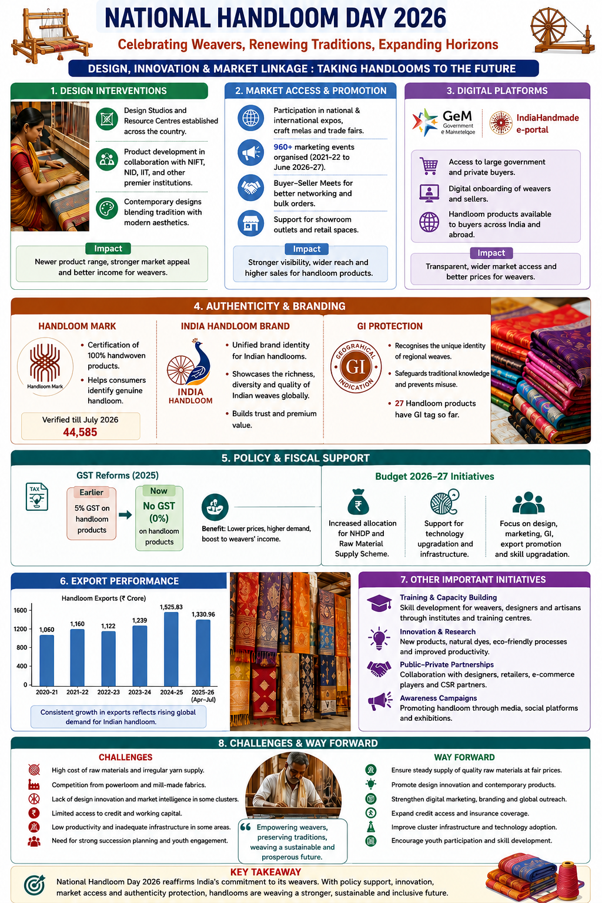
- The GI Act, 1999 protects products whose quality, reputation or characteristics are linked to a particular geographical region. Till date it covered 106 handloom products and 6 product logos.
Recent Developments
-
- India’s handloom exports stood at approximately ₹1,330.96 crore in 2025–26.
- Major destinations include UAE, USA, France, UK and Spain.
- Around 1.50 lakh weavers and handloom entities have joined GeM, providing access to government procurement.
- IndiaHandmade enables verified weavers and producer groups to sell directly to consumers; 4,186 weavers and artisans were onboarded between 2023–24 and June 2026.
- More than 960 marketing events were organised during 2021–22 to June 2026–27, including expos, craft melas and trade fairs.
- The Handlooms (Reservation of Articles for Production) Act, 1985 protects traditional handloom production from competition through powerlooms and mills.
Significance of the Handloom Sector
i. With 35.22 lakh weavers and allied workers and nearly 90% of handlooms located in rural areas.
ii. Women-led Economic Empowerment as it over 72% of the handloom workforce.
iii. Handloom also protects India’s intangible cultural heritage.
iv. The sector provides livelihoods to substantial numbers of SC, ST and OBC workers.
v. Handloom’s natural fibres can support India’s transition towards resource-efficient and sustainable textiles.
Challenges
i. High and fluctuating raw-material costs remain a concern as highlighted by NITI Aayog.
ii. The Fourth Handloom Census identified lack of market demand, inadequate capital and limited credit availability among major constraints facing weavers.
iii. Handloom products face competition from cheaper machine-made substitutes. Thus, weak differentiation and imitation can reduce the premium received by genuine weavers.
iv. Small household-based production often limits access to market intelligence and organised procurement.
Way Forward
i. Strengthen design, branding and market linkages around clusters rather than treating these as isolated interventions.
ii. The NITI Aayog–UNDP Sahaspur model demonstrates the value of product diversification and forward/backward linkages.
iii. Scale platforms such as IndiaHandmade and GeM.
iv. Producer companies, SHGs and cooperatives should be strengthened for bulk procurement, common facilities and collective marketing.
v. Handloom Mark, India Handloom Brand and GI protection should simultaneously safeguard authenticity.
Conclusion:
The next phase must connect traditional craftsmanship with technology, design, organised markets and global branding. It should ensure that the primary beneficiary of this transformation remains the weaver.