Indian Polity & Governance
Public Examinations (Prevention of Unfair Means) Amendment Bill, 2026:
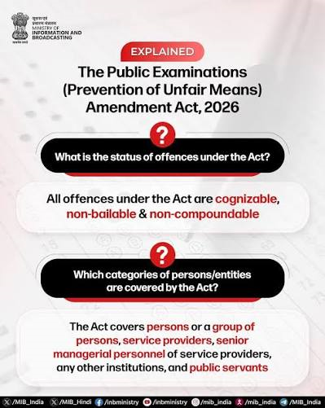
Context: Following passage by both Houses of Parliament, details of the Public Examinations (Prevention of Unfair Means) Amendment Bill, 2026 were published, establishing strict timelines and Special Fast Track Courts for exam paper leak cases.
-
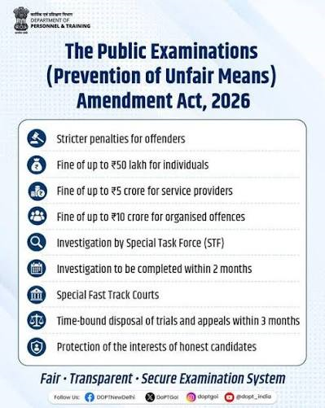
- The 2026 Amendment mandates a strict two-month investigation deadline for FIRs referred to the CBI or Special Task Forces (STF), and a three-month trial completion deadline.
- States/UTs must designate a Court of Session in consultation with the Chief Justice of the respective High Court as a Special Fast Track Court for continuous day-to-day hearings.
- Empowers the Central Government to constitute a dedicated Special Task Force (STF) having exclusive investigative jurisdiction across state boundaries.
- Current Nodal Ministry: Ministry of Personnel, Public Grievances and Pensions.
- Parent Legislation: The base law- Public Examinations (Prevention of Unfair Means) Act, 2024 was India’s first specific central statute targeting organized syndicates involved in competitive exam fraud.
- Scope of Covered Bodies: Applies to exams conducted by UPSC, SSC, RRBs, IBPS, NTA, and central ministry recruitments.
- Penal Structure (2024 Base Act): Organized crime in paper leaks carries imprisonment from 5 to 10 years and a minimum fine of ₹1 crore; candidates themselves are dealt with under individual exam body rules rather than criminalized as organized offenders.
- Seventh Schedule Context: While ‘Public Services’ under Union/State fall under List I and List II respectively, criminal law and procedure fall under the Concurrent List (List III, Entries 1 & 2), enabling Central legislation over public exam offences.
- Legal Nature of Offences: All offences under this Act are non-bailable, cognizable, and non-compoundable.
- Appellate Mechanism: Under the 2026 Framework, appeals against Special Court decisions lie before a Division Bench (two judges) of the High Court within 3 months of admission.
(PIB)
Supreme Court Framework for Accessing Livestreamed Judicial Content:
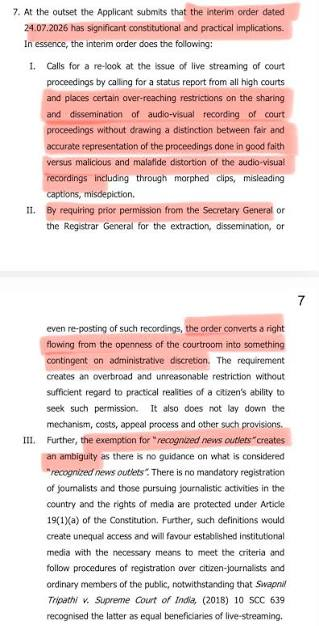
Context: SC proposed framing an official protocol establishing an “Archive-Gated Model” under which users and platforms sharing live court proceedings must source them strictly through authenticated court archives.
-
- The proposed model seeks a balanced approach between an interim blanket ban on redistributing court livestreams and unrestricted commercial/social media clipping.
- The Bench invited digital platforms (Meta, WhatsApp), High Courts, and Bar Associations to contribute inputs for the protocol.
- Landmark Precedent (Swapnil Tripathi v. Supreme Court of India, 2018): SC held that livestreaming court proceedings is an extension of the “Open Court” principle.
- (Article 19(1)(a)): Right to freedom of speech and expression includes the right of citizens to receive and disseminate information regarding judicial proceedings.
- (Article 21): Open justice and public scrutiny of judicial decision-making are core facets of procedural due process and fair trial guarantees.
- Article 145(1): Empowers the Supreme Court to make rules for regulating the practice and procedure of the Court with the approval of the President.
- Court of Record (Article 129): The Supreme Court is a Court of Record having powers to punish for contempt of itself and maintain permanent authentic records of its proceedings.
- Historical Exception (Naresh Shridhar Mirajkar v. State of Maharashtra, 1967): Affirmed that open court hearings are the general rule, though courts possess inherent power to hold in-camera proceedings in exceptional circumstances.
- Copyright in Judicial Records: Transcripts and official recordings generated by courts are public records; however, contextual distortion or commercial misrepresentation can attract contempt jurisdiction.
- E-Courts Integrated Mission Mode Project: Phase III focuses on digitization, AI-assisted translation, virtual courts, and secure digital archiving across the Indian judiciary.
(TH)
Indian Society & Social Justice
PM-AJAY (Pradhan Mantri Anusuchit Jaati Abhyuday Yojana) Progress:
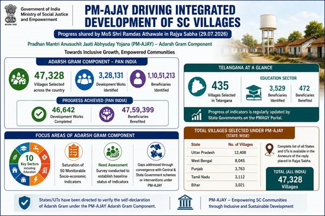
Context: Ministry of Social Justice & Empowerment submitted a status update to Parliament on the Adarsh Gram Component of PM-AJAY, covering 47,328 selected villages nationwide.
-
- Current Coverage: 47,328 Scheduled Caste majority villages selected under Adarsh Gram component; over 3.28 lakh development works identified.
- Current Objective: Targets complete saturation of 50 monitorable socio-economic indicators across 10 vital sectors including education, health, and sanitation.
- Scheme Restructuring: PM-AJAY was formed by merging three former Centrally Sponsored Schemes:
- Pradhan Mantri Adarsh Gram Yojana (PMAGY)
- Special Central Assistance to Scheduled Castes Sub Plan (SCA to SCSP)
- Babu Jagjivan Ram Chhatrawas Yojana (BJRCY)
- Three Components of PM-AJAY:
- Development of SC-dominated villages into Adarsh Grams.
- Grants-in-Aid for District/State-level Socio-Economic Projects.
- Construction of Hostels for SC students in higher educational institutions.
- Selection Criterion for Adarsh Gram: Villages with a Scheduled Caste population exceeding 50% as per census data.
- Administrative Ministry: Ministry of Social Justice and Empowerment.
- (Article 46): Directive Principle urging the State to promote with special care the educational and economic interests of the weaker sections, particularly SCs and STs.
- (Article 338): Establishes the National Commission for Scheduled Castes (NCSC) to monitor constitutional safeguards for SC communities.
- Convergence Strategy: PM-AJAY operates on scheme convergence, blending resources from MGNREGA, Jal Jeevan Mission, Poshan Abhiyaan, and PMGSY to eliminate development deficits in selected villages.
- Funding Mechanism: 100% central grant provided for critical gap-filling activities that cannot be financed through existing sector schemes.
(PIB)
Economy
Upstream Hydrocarbon Framework and HELP Policy Assessment:
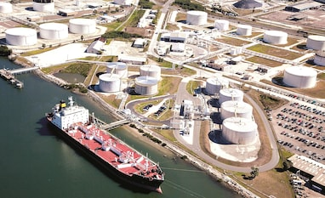
Context: Government reviews operational outcomes of Open Acreage Licensing Policy (OALP) bid rounds under the Hydrocarbon Exploration Licensing Policy (HELP) to boost deepwater exploration and indigenous oil production.
-
- Current Deepwater Push: Government financial assistance for deepwater drilling is structured up to 50% of eligible costs (capped at ₹675 crore per well) to encourage high-risk offshore basin exploration.
- Current Production Goal: Aims to accelerate reserve accretion to reduce India’s crude oil import dependency (currently hovering around 85–87%).
- Transition from NELP to HELP (2016): HELP replaced the New Exploration Licensing Policy (NELP, 1997).
- Profit vs. Revenue Sharing: NELP operated on a Profit-Sharing Model (cost recovery before government share), which led to administrative disputes; HELP introduced a Revenue-Sharing Model (government gets a share of gross revenue immediately upon production).
- Single Uniform License: Unlike NELP, HELP offers a single license to explore and produce all forms of hydrocarbons (conventional oil, gas, coalbed methane, shale gas, gas hydrates).
- Open Acreage Licensing Policy (OALP): Investors can carve out and submit expressions of interest (EoI) for any unallocated block round-the-year, which are then put to competitive bidding.
- Marketing and Pricing Freedom: HELP grants freedom to operators for marketing and pricing of gas produced from blocks, subject to ceiling limits for specific difficult fields.
- National Data Repository (NDR): Set up by the Directorate General of Hydrocarbons (DGH) to provide seamless geoscientific data to prospective bidders worldwide.
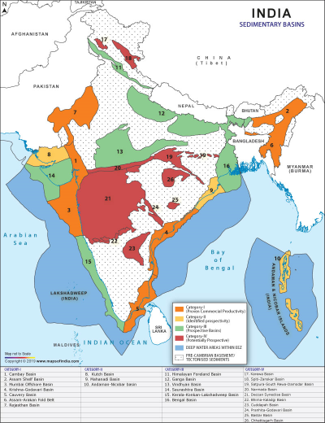
- Sedimentary Basins Classification: India’s 26 sedimentary basins are categorized into Category I (established commercial production), Category II (known accumulation/contingent resources), and Category III (unexplored/prospective).
-
- Regulatory Body: Directorate General of Hydrocarbons (DGH) under the Ministry of Petroleum and Natural Gas serves as the technical regulator for upstream activities.
(IE)
Extension of Pradhan Mantri Kisan Samman Nidhi (PM-KISAN):
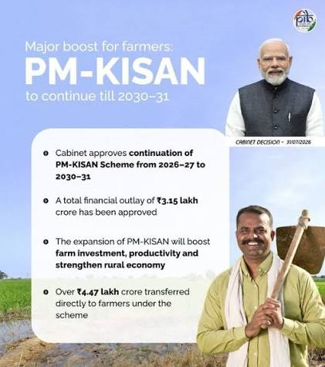
Context: The Union Cabinet approved the continuation of the PM-KISAN scheme for the five-year block of FY 2026–27 to 2030–31 with an outlay of ₹3.15 lakh crore.
-
- Current Outlay & Reach: Total allocation of ₹3.15 lakh crore over five years; cumulative transfers since inception surpassed ₹4.47 lakh crore across 23 instalments.
- Current Beneficiary Scale: Over 9.49 crore farmers benefited under recent instalments, with women farmers receiving over ₹1.06 lakh crore (nearly 1 in 4 beneficiaries).
- Scheme Architecture: PM-KISAN is a Central Sector Scheme (100% funded by the Government of India) launched in February 2019 (effective from 1st December 2018).
- Benefit Structure: Provides ₹6,000 per year per eligible family, paid in three equal instalments of ₹2,000 every four months via Direct Benefit Transfer (DBT).
- Definition of Family: For the scheme, a landholder farmer family is defined as husband, wife, and minor children owning cultivable land as per land records.
- Identification Responsibility: Identification of eligible landholder families rests entirely with State/UT Governments.
- Aadhaar Integration: PM-KISAN is mandatory Aadhaar-seeded; payment is routed through the Public Financial Management System (PFMS) linked to Aadhaar Payment Bridge (APB).
- Major Exclusion Criteria: Excludes institutional landholders, former/present constitutional post holders, serving/retired government officers, pensioners with monthly pension ₹10,000, and income-tax payers.
- Structural Limitation: Tenant farmers, sharecroppers, and landless agricultural labourers remain outside PM-KISAN’s domain due to its land-ownership linkage.
- Economic Significance: Serves as direct income support to alleviate liquidity constraints for purchasing agricultural inputs during crop cycles, mitigating reliance on non-institutional money lenders.
(TH/PIB)
Defence
Launch of Diving Support Craft (DSC) ‘A24’:
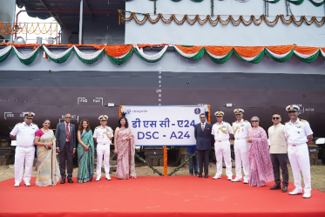
Context: The Indian Navy launched ‘A24’, the fifth and final vessel in the series of five Diving Support Crafts (DSC), built by Titagarh Rail Systems Limited (TRSL) at Kolkata.
-
- Current Milestone: DSC ‘A24’ is a catamaran-hull vessel engineered to undertake specialized underwater repair, diving operations, and coastal search and rescue.
- Current Indigenous Level: Built with over 70% indigenous content, utilizing local MSMEs and domestic supply chains under the ‘Make in India’ framework.
- Current Ship Class Standards: Designed and constructed in compliance with the naval rules of the Indian Register of Shipping (IRS).
- Catamaran Hull Advantage: A twin-hull structure providing higher transverse stability, reduced hydro-dynamic drag, larger deck footprint, and superior sea-keeping performance during diving activities.
- Defense Procurement Procedure (DPP / DAP 2020): Emphasizes categories like Buy (Indian-IDDM) Indigenously Designed, Developed and Manufactured requiring at least 50% indigenous content.
- Role of Indian Register of Shipping (IRS): An independent internationally recognized classification society that formulates technical standards for ship safety and structural integrity.
- Strategic Significance of Diving Support Vessels: Essential for clearance diving, underwater hull inspection, seabed clearance, and assisting submarine rescue operations.
- Make in India in Defense Sector: Target of achieving $25 billion defense turnover with $5 billion exports through indigenized manufacturing and positive indigenization lists.
- Public-Private Partnership in Warship Building: Inclusion of private shipbuilders (like Titagarh, L&T) alongside Defense PSUs (GRSE, Mazagon Dock, Goa Shipyard) to shorten warship delivery cycles.
- Coastal Security Tri-Tier Architecture: Diving Support Crafts support the inner coastal surveillance grid, working in tandem with the Indian Coast Guard and Marine Police.
(PIB)
Internal Security
Multi-Agency Center (MAC) Framework & Maritime Domain Awareness:
Context: In light of security challenges in commercial shipping lanes across the Western Indian Ocean/Red Sea and regional counter-terrorism imperatives, the institutional role of the Multi-Agency Center (MAC) was highlighted.
-
- Diplomatic and naval efforts continue to safeguard commercial sea lanes of communication (SLOCs) against asymmetric maritime threats and drone strikes in the Red Sea and Gulf of Aden.
- Current Intelligence Architecture: Strengthening real-time data integration between MAC, Subsidiary Multi-Agency Centers (SMACs), and maritime monitoring grids.
- Establishment of MAC: Formed in the aftermath of the Kargil War (1999) following recommendations of the Kargil Review Committee and the Group of Ministers (GoM) report on reforming the national security system.
- Institutional Home: Functions under the Intelligence Bureau (IB), Ministry of Home Affairs.
- Core Function: Serves as a 24×7 multi-agency intelligence fusion center where central intelligence agencies, military intelligence, state police, and specialized enforcement bodies share real-time actionable inputs.
- SMACs: Subsidiary Multi-Agency Centers established in state capitals to ensure vertical integration from state police stations up to the central intelligence apparatus.
- Maritime Domain Counterpart (IFC-IOR): The Information Fusion Centre – Indian Ocean Region (IFC-IOR), located at Gurugram under the Indian Navy, coordinates international maritime intelligence sharing.
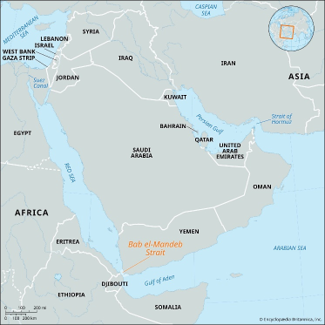
- Bab-el-Mandeb: Connects the Red Sea to the Gulf of Aden / Arabian Sea; a vital energy choke point for international trade between Asia and Europe.
-
- Operation Sankalp: Indian Navy’s persistent maritime security deployment in the Gulf of Oman and Persian Gulf to ensure safe passage of Indian-flagged commercial vessels.
- UNCLOS Framework: UN Convention on the Law of the Sea guarantees Freedom of Navigation on the High Seas and innocent passage through territorial waters while providing international legal basis for anti-piracy operations.
(IE)
History, Art & Culture
Lokmanya Tilak National Award 2026 & Cultural Nationalism:
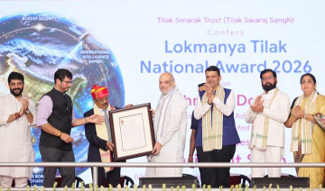
Context: The Lokmanya Tilak National Award 2026 was presented to National Security Advisor (NSA) Ajit Doval in Pune on the occasion of Bal Gangadhar Tilak’s 106th death anniversary.
-
- The award, conferred by the Tilak Smarak Mandir Trust, recognizes lifetime national service and contribution to public security architectures.
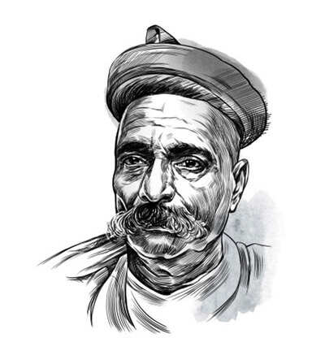
- Title & Legacy: Bal Gangadhar Tilak was given the title “Lokmanya” (Accepted by the People); Mahatma Gandhi called him “The Maker of Modern India”, while British colonial authorities termed him “The Father of Indian Unrest”.
-
- Slogan: Coined the historic phrase: “Swaraj is my birthright and I shall have it!”
- Newspaper Publications: Founded two prominent newspapers in 1881- Kesari (in Marathi) and The Mahratta (in English).
- Community Mobilization: Transformed private celebrations into public festivals to foster national unity: Ganesh Utsav (1893) and Shivaji Jayanti (1895).
- Triumvirate (Lal-Bal-Pal): Formed the Extremist tri-leadership within the Indian National Congress alongside Lala Lajpat Rai and Bipin Chandra Pal.
- Surat Split (1907): Led the Extremist faction during the Surat session split from the Moderates over methods of agitation (boycott, swadeshi vs. constitutional methods).
- Literary Works: Authored Gita Rahasya (written in Mandalay Jail, Myanmar, expounding Karma Yoga) and The Arctic Home in the Vedas (proposing the Arctic origin of Aryans).
- Home Rule League Movement (1916): Launched the Indian Home Rule League at Belgaum in April 1916, operating in Maharashtra (excluding Bombay city), Karnataka, Central Provinces, and Berar.
- Lucknow Pact (1916): Played a pivotal role alongside Muhammad Ali Jinnah in bringing together the Congress and the Muslim League, as well as readmitting Extremists into the Congress fold.
(PIB)
Government Schemes & Initiatives
‘Nasha Mukt Yuva for Viksit Bharat’ National Campaign:
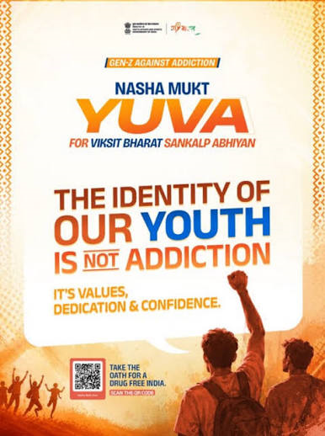
Context: PM launched the ‘Nasha Mukt Yuva for Viksit Bharat Sankalp Abhiyan’ as a focused youth-centric extension of the Nasha Mukt Bharat Abhiyaan (NMBA).
-
- Current Focus: Mobilizes youth organizations (NYKS, NSS), educational institutes, and local Panchayats to drive community-led prevention against substance abuse.
- Parent Campaign: Nasha Mukt Bharat Abhiyaan (NMBA) was launched on 15th August 2020 in identified vulnerable districts based on inputs from the Narcotics Control Bureau (NCB).
- Responsible Nodal Ministry: Ministry of Social Justice and Empowerment (handles demand reduction, rehabilitation, and awareness), whereas supply control is handled by the Ministry of Home Affairs.
- (Article 47): Directive Principle specifying that the State shall endeavour to bring about prohibition of the consumption (except for medicinal purposes) of intoxicating drinks and drugs harmful to health.
- International Conventions Signed by India:
- UN Single Convention on Narcotic Drugs (1961)
- UN Convention on Psychotropic Substances (1971)
- UN Convention Against Illicit Traffic in Narcotic Drugs and Psychotropic Substances (1988).
- Statutory Framework: Narcotic Drugs and Psychotropic Substances (NDPS) Act, 1985 provides stringent punishment for illicit trafficking and possession of controlled substances.
- Institutional Enforcement: Narcotics Control Bureau (NCB) constituted in 1986 under the NDPS Act as the premier national intelligence and enforcement coordinator.
- Inter-Ministerial Mechanism: NCORD (NARCO Coordination Centre) a four-tier mechanism (National, State, Executive, District) setup for seamless coordination among police, customs, health, and intelligence units.
- Geographic Vulnerability (Golden Crescent & Triangle): India is geographically sandwiched between two major opium-producing corridors the Golden Crescent (Iran-Afghanistan-Pakistan) to the west and the Golden Triangle (Myanmar-Laos-Thailand) to the east.
- Rehabilitation Portal: Tele-MANAS and national helplines integrated under the National Action Plan for Drug Demand Reduction (NAPDDR).
(TH/PIB)
Pradhan Mantri Surya Sarovar Yojana (PM-SSY):
Context: The Union Cabinet approved the Pradhan Mantri Surya Sarovar Yojana (PM-SSY) with an outlay of ₹5,070 crore to scale up Floating Solar Photovoltaic (FSPV) capacity across reservoirs and inland water bodies in India.
-
- Current Objective: PM-SSY targets developing 5,000 MW of floating solar capacity along with minimum 2-hour Co-located Energy Storage Systems (ESS) (10,000 MWh) between FY 2026–27 and FY 2030–31.
- Current Financial Structure: Central Financial Assistance (CFA) provides ₹1 crore per MW after project commissioning, plus feasibility study support up to ₹50 lakh per project.
- Nodal & Assessment Agency: The National Institute of Solar Energy (NISE), an autonomous institute under the Ministry of New and Renewable Energy (MNRE), estimated India’s total FSPV potential at 102.18 GWp.
- Current Installed Base: India’s existing FSPV installed capacity is approximately 700 MW; PM-SSY will expand this capacity to over 5,700 MW.
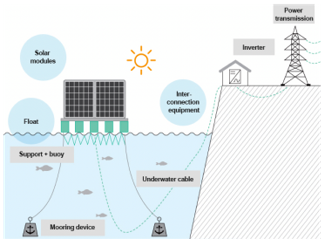
- Concept of FSPV: Floating solar panels are mounted on buoyant structures anchored on bodies of water (reservoirs, dams, lakes) instead of land.
-
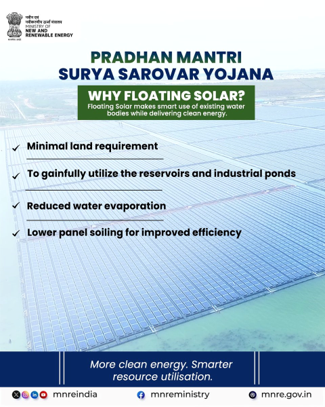
- Ecological Advantages: FSPVs reduce water evaporation loss, shield algae from direct sunlight (reducing algal blooms), and benefit from higher PV efficiency due to the cooling effect of underlying water.
- Operational Synergies: Hydro-floating solar hybrid systems utilize existing dam grid-evacuation infrastructure, reducing land acquisition delays and balancing grid intermittency.
- Domestic Manufacturing Mandate: Aligned with Aatmanirbhar Bharat, FSPV projects mandate the use of domestically manufactured floatation systems, PV cells, and modules.
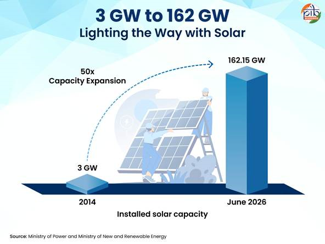
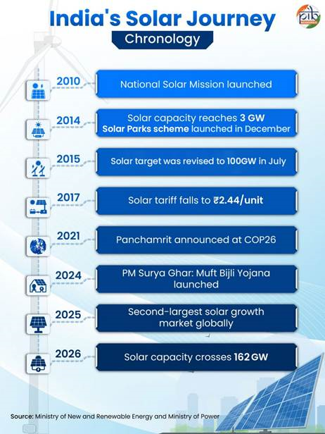
- Target Emissions Impact: PM-SSY is projected to abate ~10 million tonnes of emissions annually, contributing toward India’s COP26 Panchamrit target of 500 GW non-fossil energy capacity by 2030.
- Associated Schemes: FSPV complements other MNRE initiatives like PM-KUSUM (solarization of agricultural pumps) and PM Surya Ghar: Muft Bijli Yojana (rooftop solar).
(PIB)
Spread the Word