
Topic-1: National Coal Logistics, Gasification Targets, & Import Substitution Architecture
-
- GS Paper 2: Government policies and interventions for development in various sectors and issues arising out of their design and implementation; Statutory, regulatory, and administrative bodies (Ministry of Coal, CIL, SCCL).
- GS Paper 3: Infrastructure: Energy, Ports, Roads, Airports, Railways; Indian Economy and issues relating to planning, mobilization of resources, growth, development, and employment; Conservation, environmental pollution, and degradation.
Context: In written replies delivered to the Rajya Sabha, the Union Minister of State for Coal and Mines outlined the state of India’s energy transition, logistical upgrades, and coal self-reliance initiatives. The announcements focus on three key operational pillars: First Mile Connectivity (FMC), the National Coal Gasification Mission, and regulatory reforms to curb coal imports.
Pillar 1: First Mile Connectivity & Logistical Architecture
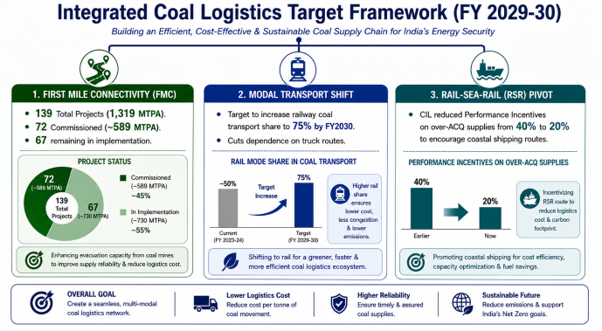
To lower logistics costs and eliminate environmental degradation caused by road transport, the Ministry of Coal is executing a massive infrastructure pivot:
-
- Critical Rail Interventions: Out of 8 core railway projects dedicated to coal evacuation, 5 are fully commissioned. Additionally, the Ministry of Coal and Ministry of Railways identified 33 critical railway projects to clear pithead bottlenecks.
- Efficiency Gains: Mechanized loading via rapid loading systems and high-capacity silos has cut rake loading times, improved wagon turnaround, and reduced transit and handling losses.
Pillar 2: National Coal Gasification Mission Expansion
To promote clean coal technologies and meet the national target of 100 Million Tonnes (MT) of coal gasification capacity by 2030:
-
- Operational & Active Pipeline: Approximately 22.6 MTPA capacity is currently operational or under implementation:
1. Jindal Steel Limited (JSL): ~8 MTPA (Operational).
2. Talcher Fertilisers Limited (TFL): ~2.6 MTPA (Under Implementation).
3. Scheme 1 (₹8,500 Crore Outlay): ~12 MTPA across 8 approved projects.
-
- The Expanded Capital Incentive Scheme: A second scheme was approved featuring a ₹37,500 crore financial outlay. It is designed to utilize 75 MTPA of coal/lignite.
- Upgraded Incentive Subsidies: The new scheme increases financial incentives to up to 20% of eligible Plant & Machinery costs (up from 15% capex support under the previous ₹8,500 crore framework).
Pillar 3: Import Substitution & Regulatory Reforms
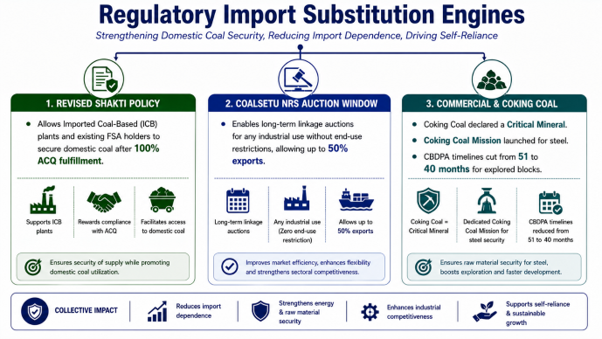
To reduce non-essential coal imports and optimize domestic supply, the government implemented several structural policy updates:
-
- Commercial Mining Momentum: Out of 132 commercial coal blocks allocated since June 2020, 23 have obtained Mine Opening Permissions (MOP) and 15 are actively producing.
- Environmental & Rehabilitation Integrity: Mandates blast-free mining via surface miners, robotic water sprayers, and continuous ecological assessments. Land compensation and R&R benefits are tied strictly to the RFCTLARR Act, 2013 and CBA Act, 1957.
UPSC Prelims Fodder: Fact-Check
| Feature | Details |
| FMC Project Target | 139 Projects handling 1,319 MTPA capacity by FY 2029-30. |
| Rail Transport Target | 75% share of total coal movement through railways by FY 2030. |
| Gasification Target | 100 MTPA of coal gasified by 2030. |
| Expanded Gasification Outlay | ₹37,500 Crore scheme (Offering up to 20% P&M financial incentive). |
| CoalSETU Feature | Auction window allowing up to 50% export of allotted coal linkages. |
| Critical Mineral Declaration | Coking Coal officially classified as a Critical Mineral. |
| Exploration Timeline | CBDPA mine development timeline cut to 40 months (Explored) / 52 months (Partial). |
Conclusion:
The Ministry of Coal’s updates reflect a balanced approach: accelerating domestic production while modernizing transportation. By shifting coal transport from road to rail and sea, offering ₹37,500 crore in incentives for coal gasification, and opening up non-regulated linkages via CoalSETU, India is systematically reducing import dependence.
Topic-2: Regulatory Frameworks, Cyber Security, & Consumer Protection in the Fintech Sector
-
- GS Paper 2 (Government policies and interventions for development in various sectors and issues arising out of their design and implementation);
- GS Paper 3 (Indian Economy – Fintech, Digital Payments; Basics of Cyber Security).
What is the FinTech Regulatory and Cyber Safety Ecosystem?
The FinTech Regulatory and Cyber Safety Ecosystem comprises a set of statutory, technological, and institutional frameworks established jointly by the Ministry of Finance, the Reserve Bank of India (RBI), MeitY, and MHA. It aims to foster technological innovation in financial services while enforcing strict standards for consumer data protection, fraud prevention, and operational integrity across digital lending platforms and payment aggregators.
Key Regulatory and Supervisory Interventions
1. Self-Regulatory Organisation Framework (SRO-FT)
-
- Meaning: An industry-led governance framework issued by the RBI on May 30, 2024, to promote ethical self-regulation among fintech entities.
- Core Functions: Establishes regulatory standards, enforces ethical conduct, ensures market integrity, resolves intra-sectoral disputes, and improves operational transparency without restricting innovation.
2. Security Controls & AI-Based Fraud Detection
-
- Master Directions on Digital Payment Security Controls (2021): Mandates banks to maintain baseline security protocols across internet banking, mobile applications, and card payment gateways.
- NPCI Fraud Monitoring Solution: Uses Artificial Intelligence (AI) and Machine Learning (ML) models to analyze Unified Payments Interface (UPI) transactions in real time, automatically flagging risks and declining suspicious transactions.
3. Regulatory Sandbox Framework
-
- Meaning: A controlled environment set up by the RBI in August 2019 that allows fintechs to live-test innovative products and services with a limited set of real consumers, with or without regulatory relaxations.
- Objective: Helps regulators assess systemic risks and evaluate new technologies before granting full commercial rollout approvals.
4. Data Protection & Statutory Frameworks
-
- DPDP Act & Rules: Enforces statutory compliance for handling personal financial data under the Digital Personal Data Protection Act, 2023 and DPDP Rules 2025 notified by MeitY.
Consumer Protection & Cyber Incident Reporting Tools
-
- National Cybercrime Reporting Portal & Helpline: Operated by the Ministry of Home Affairs (MHA) via www.cybercrime.gov.in and dedicated helpline 1930 to report cyber frauds, including predatory or illegal loan apps.
- SACHET Portal & SLCC: Public-facing platforms monitored by the RBI and State Level Coordination Committees (SLCC) to lodge complaints against unauthorized deposit-taking or financial collection entities.
- Financial Literacy Programs: Execution of electronic-banking awareness and training (eBAAT) programs alongside SMS and radio campaigns to educate citizens on cyber threat mitigation.
UPSC Quick Reference Table
| Feature | Detailed Specification |
| Nodal Authorities | Ministry of Finance, RBI, MeitY, MHA |
| SRO-FT Framework | RBI framework (May 2024) for fintech self-regulation and dispute resolution |
| Cyber Helpline | 1930 (MHA National Cybercrime Helpline) |
| Fraud Monitoring Node | NPCI AI/ML real-time transaction decline engine for UPI |
| Illegal Deposit Reporting | SACHET Portal & State Level Coordination Committees (SLCC) |
| Data Privacy Base | Digital Personal Data Protection Act, 2023 & DPDP Rules 2025 |
Conclusion:
The government and RBI are using a balanced strategy combining AI-driven security, statutory data protection, and self-regulation through SRO-FT to safeguard the fintech sector. This approach ensures consumer security and mitigates cyber risks without slowing down financial innovation in India.
Topic-3: Kala Sanskriti Vikas Yojana (KSVY)
-
- GS Paper 1 (Indian Culture – Salient aspects of Art Forms, Literature, and Architecture from ancient to modern times);
- GS Paper 2 (Government policies and interventions for development in various sectors and issues arising out of their design and implementation).
What is Kala Sanskriti Vikas Yojana (KSVY)?
The Kala Sanskriti Vikas Yojana (KSVY) is an umbrella Central Sector Scheme implemented by the Ministry of Culture, Government of India. It provides direct financial assistance to eligible cultural organizations, traditional performing art troupes, research scholars, and individual artists (including rural and tribal practitioners) across the country to preserve, promote, and propagate Indian art, classical dance, music, theatre, and folk heritage.
Key Scheme Components & Financial Specifications
1. Financial Assistance for Promotion of Guru-Shishya Parampara (Repertory Grant)
-
- Meaning: A financial support mechanism to sustain regular master-disciple training across performing arts like theatre, music ensembles, and dramatic groups.
- Coverage: Supports 1 Guru and up to 18 Shishyas per group.
- Financial Assistance:
- Guru: ₹15,000 per month.
- Shishya: ₹2,000 to ₹10,000 per month (depending on age).
2. Financial Assistance for Promotion of Art and Culture
-
- Cultural Organizations with National Presence: Granted to registered cultural bodies operating across India that have spent ₹1 crore or more during 3 of the last 5 years on cultural activities.
- Grant Amount: ₹1.00 Crore (up to ₹5.00 Crore in exceptional cases).
- Cultural Function & Production Grant (CFPG): Financial support to NGOs, trusts, societies, and universities for organizing seminars, conferences, research, workshops, festivals, and stage productions.
- Grant Amount: ₹5 Lakh (up to ₹20 Lakh in exceptional cases).
- Preservation & Development of Cultural Heritage of the Himalayas: Supports research, training, and audio-visual dissemination in Himalayan regions (Jammu & Kashmir, Himachal Pradesh, Uttarakhand, Sikkim, Arunachal Pradesh).
- Grant Amount: ₹10 Lakh/year (up to ₹30 Lakh in exceptional cases).
- Development of Buddhist/Tibetan Culture and Art: Assists voluntary Buddhist/Tibetan organizations and Monasteries engaged in research and propagation of Buddhist culture.
- Grant Amount: ₹30 Lakh/year (up to ₹1.00 Crore in exceptional cases).
- Building Grants including Studio Theatres: Financial aid for creating or modernizing cultural infrastructure (auditoriums, studio theatres, lighting, acoustics, AC).
- Grant Amount: Up to ₹50 Lakh in metro cities; up to ₹25 Lakh in non-metro cities.
- Domestic Festivals and Fairs: Funds national cultural festivals like Rashtriya Sanskriti Mahotsavs (RSMs) executed through Zonal Cultural Centres.
- Cultural Organizations with National Presence: Granted to registered cultural bodies operating across India that have spent ₹1 crore or more during 3 of the last 5 years on cultural activities.
3. Construction of Tagore Cultural Complexes (TCC)
-
- Meaning: A capital-intensive infrastructure grant aimed at creating new large cultural spaces or restoring existing facilities (such as Rabindra Bhawans and Rangshalas).
- Financial Assistance: Maximum project grant up to ₹15.00 Crore.
- Cost Sharing Ratio:
- North Eastern Region (NER): 90:10 (Centre : State/NGO).
- Rest of India (Non-NER): 60:40 (Centre : State/NGO).
4. Scholarships and Fellowships for Promotion of Art and Culture
-
- Award of Senior/Junior Fellowships: Up to 400 fellowships (200 Junior, 200 Senior) awarded annually for cultural research.
- Age Criteria: 25–40 years (Junior) | Above 40 years (Senior).
- Stipend: Junior: ₹10,000/month | Senior: ₹20,000/month (for 2 years).
- Scholarships to Young Artistes in Different Cultural Fields: Up to 400 scholarships given to promising young artists for advanced training in India across traditional, folk, visual, and classical arts.
- Age Criteria: 18–25 years.
- Stipend: ₹5,000/month for 2 years.
- Tagore National Fellowship for Cultural Research: Encourages top scholars to affiliate with institutions under the Ministry of Culture.
- Fellowship: Up to 15 awards @ ₹80,000/month + contingency.
- Scholarship: Up to 25 awards @ ₹50,000/month + contingency.
- Award of Senior/Junior Fellowships: Up to 400 fellowships (200 Junior, 200 Senior) awarded annually for cultural research.
5. Financial Assistance for Veteran Artists
-
- Meaning: A social security pension scheme for senior artists and scholars who have made significant contributions to letters and arts.
- Eligibility: Age 60 years and above with an annual personal income not exceeding ₹72,000.
- Financial Assistance: Up to ₹6,000/month (transferred to the surviving spouse upon the beneficiary’s death).
New Policy Intervention: What is Rachnatmak Bharat?
Meaning & Definition
Rachnatmak Bharat is a targeted policy intervention launched by the Ministry of Culture for the promotion and development of India’s Cultural and Creative Economy. Rather than acting solely as a charity or grant-giving framework, it focuses on turning artistic heritage into viable, sustainable commercial livelihoods.
Core Execution Pillars
-
- Capacity Building: Training traditional, folk, and rural artists in modern presentation and execution techniques.
- Market Access: Linking grassroots artisans and performing groups directly with domestic and global markets.
- Digital Enablement & Innovation: Bringing heritage artists onto e-commerce networks, streaming services, and digital archives.
- Institutional Strengthening: Helping emerging creators build sustainable business models to ensure long-term self-reliance.
Institutional Delivery Mechanisms
-
- Zonal Cultural Centres (ZCCs): Seven regional centers operating in Patiala, Nagpur, Udaipur, Prayagraj, Kolkata, Dimapur, and Thanjavur preserve local art forms and organize nationwide events.
- Fund Flow Process: Operating as a Central Sector Scheme, funds are disbursed directly from the Consolidated Fund of India using the Central Nodal Agency (CNA) and Direct Benefit Transfer (DBT) modules of PFMS.
UPSC Quick Reference Table
| Feature | Detailed Specification |
| Scheme Name | Kala Sanskriti Vikas Yojana (KSVY) |
| Type of Scheme | Central Sector Scheme (100% funded by Central Govt) |
| Nodal Ministry | Ministry of Culture |
| New Initiative | Rachnatmak Bharat (Creative Economy Intervention) |
| 7 ZCC Locations | Patiala, Nagpur, Udaipur, Prayagraj, Kolkata, Dimapur, Thanjavur |
| Veteran Artist Pension | Age yrs | Annual Income | Stipend: Up to ₹6,000/pm |
| Young Artiste Scholarship | Age 18–25 yrs | Stipend: ₹5,000/pm for 2 years |
| Repertory Grant Rates | Guru: ₹15,000/pm | Shishya: ₹2,000–₹10,000/pm (1 Guru + 18 Shishyas) |
| TCC Funding Split | 90:10 (NER) | 60:40 (Non-NER States) |
Conclusion:
KSVY protects traditional Indian art forms by offering direct financial support and pensions to artists across the country. Through modern additions like Rachnatmak Bharat, the initiative turns cultural preservation into a sustainable, market-driven creative economy.
Topic-4: Meri Samiti Mera Patal Initiative
-
- GS Paper 2 (Government policies and interventions for development in various sectors and issues arising out of their design and implementation; Governance, transparency, and accountability);
- GS Paper 3 (Inclusive growth and issues arising from it; Agricultural credit and cooperative sector).
What is the “Meri Samiti Mera Patal” Initiative?
“Meri Samiti Mera Patal” is a regional digital profiling and capacity-building initiative conceptualized and launched independently by the Regional Institute of Cooperative Management (RICM), Chandigarh, under the National Council for Cooperative Training (NCCT). It aims to empower, modernize, and digitize Primary Agricultural Credit Societies (PACS) and Multi-Purpose Cooperative Societies (MPCS) by enhancing their public visibility, improving governance, and creating a real-time data system for informed decision-making.
Key Features and Operational Scope
1. Institutional Framework
-
- Conceptualizing Body: Regional Institute of Cooperative Management (RICM), Chandigarh.
- Parent Organization: National Council for Cooperative Training (NCCT), operating under the Ministry of Cooperation.
- National Expansion Status: Currently, there is no proposal to expand this portal across the entire country; it functions strictly as a regional initiative.
2. Geographical Jurisdiction
-
- The initiative covers states and Union Territories within RICM Chandigarh’s domain: Punjab, Haryana, Himachal Pradesh, Jammu & Kashmir, Delhi, Chandigarh, and Leh-Ladakh.
3. Primary Objectives and Tangible Benefits
-
- Digital Profiling: Creates a centralized digital profile for each PACS/MPCS detailing its history, membership size, offered financial/agricultural services, government schemes availed, and governance structure.
- Real-time Transparency: Establishes a centralized and transparent data ecosystem to offer real-time operational insights for stakeholders and administrators.
- Enhanced Visibility & Training: Addresses ground-level training needs of PACS personnel while improving public awareness and trust in cooperative societies.
UPSC Quick Reference Table
| Feature | Detailed Specification |
| Nodal Initiator | Regional Institute of Cooperative Management (RICM), Chandigarh (under NCCT) |
| Parent Ministry | Ministry of Cooperation |
| Target Entities | Primary Agricultural Credit Societies (PACS) & Multi-Purpose Cooperative Societies (MPCS) |
| Geographical Scope | Punjab, Haryana, HP, J&K, Delhi, Chandigarh, Leh-Ladakh |
| Pan-India Status | No nationwide expansion planned at present |
| Primary Digital Function | Digital profiling, real-time data accessibility, and governance transparency |
Conclusion:
The “Meri Samiti Mera Patal” initiative modernizes PACS across Northern India by creating digital profiles and ensuring real-time data transparency. By improving governance and public visibility, it strengthens the cooperative ecosystem at the grassroots level.
Topic-5: India’s First Approved Dengue Vaccine (Qdenga®)
-
- GS Paper 2 (Issues relating to development and management of Social Sector/Services relating to Health; Government policies and interventions);
- GS Paper 3 (Science and Technology – Developments and their applications in everyday life; Biotechnology, Vaccines, and Recombinant DNA Technology).
What is Qdenga®?
Qdenga® (Dengue Tetravalent Vaccine – Live, Attenuated) is India’s first approved dengue vaccine, cleared by the Central Drugs Standard Control Organisation (CDSCO). Manufactured by Takeda GmbH (Germany) and imported by Takeda Biopharmaceuticals India Pvt. Ltd., it is a recombinant vaccine designed to prevent dengue fever caused by any of the four dengue virus serotypes (DEN-1, DEN-2, DEN-3, and DEN-4).
Technical Specifications & Clinical Profile
1. Vaccine Architecture & Technology
-
- Type: Recombinant live-attenuated tetravalent vaccine containing Genetically Modified Organisms (GMOs).
- Development Platform: Culture-produced in Vero cells using recombinant DNA technology. It uses a dengue virus type-2 (DEN-2) backbone, engineered with genes encoding serotype-specific surface proteins for all four serotypes.
- Form & Route: Supplied as a freeze-dried (lyophilized) powder for reconstitution; administered via subcutaneous injection.
2. Dosage and Eligibility
-
- Age Group: Approved for individuals aged 4 to 60 years.
- Immunization Schedule: Two-dose regimen of 0.5 ml each, administered at a 3-month interval (Months 0 and 3).
3. Regulatory & Clinical Validation
-
- Statutory Compliance: Approved under the provisions of the Drugs and Cosmetics Act, 1940 and the Drugs Rules, 1945 following Phase III clinical trials in India and global trials (covering endemic regions like Brazil, Thailand, and Sri Lanka).
- Global Footprint: Prequalified by the World Health Organization (WHO) and regulatory-approved in 42 jurisdictions (including the European Union, UK, Indonesia, and Malaysia).
UPSC Quick Reference Table
| Feature | Detailed Specification |
| Vaccine Name | Qdenga® (Dengue Tetravalent Vaccine – Live, Attenuated) |
| Approval Body | Central Drugs Standard Control Organisation (CDSCO), MoHFW |
| Manufacturer / Importer | Takeda GmbH (Germany) / M/s Takeda Biopharmaceuticals India |
| Target Age Group | 4 to 60 years |
| Dosing Schedule | 2 Doses (0.5 ml each) given 3 months apart (0 and 3 months) |
| Underlying Tech | Recombinant DNA technology using a Dengue Virus Type-2 backbone |
| Global Status | WHO Prequalified; approved in 42 countries |
Conclusion:
The CDSCO’s approval of Qdenga® gives India its first medical tool to prevent dengue, helping reduce hospitalization risks across age groups. This vaccine complements existing public health efforts under the National Vector Borne Disease Control Programme to strengthen vector management and disease control.
Topic-6: Maritime India Vision 2030
-
- GS Paper 3 (Infrastructure: Ports, Shipping, Inland Waterways; Industrial Policy, Growth, Development, and Investment Models – PPP).
What is Maritime India Vision (MIV) 2030?
Maritime India Vision 2030 is a strategic blueprint released by the Ministry of Ports, Shipping and Waterways (MoPSW) to modernize India’s maritime infrastructure over a 10-year horizon. It focuses on expanding port capacity, increasing inland waterway transport, promoting cruise tourism, strengthening shipbuilding and recycling capabilities, and driving sustainable, green port operations.
Key Performance Indicators & Target Progress (2014 vs. 2026 vs. 2030)
| Parameter / KPI | 2013-14 (Baseline) | 2025-26 (Achieved) | Target 2030 |
|---|---|---|---|
| Total Port Capacity | 1,400 MTPA | 2,818 MTPA | 3,500 MTPA |
| Cargo Throughput | 972 MT | 1,668 MT | 2,200 MT |
| PPP Share in Major Ports Cargo | ~44% | 66% | 85% |
| Operational National Waterways | 3 | 32 | 16 (Target surpassed) |
| Inland Waterways Throughput | 18 MT | 218.24 MT | 200 MT (Target surpassed) |
| Cruise Calls | 102 | 224 | 1,000 |
| Global Ship Recycling Rank | 1st | 1st | 1st |
| Renewable Energy Share across Major Ports | < 1% | 28% | 60% |
| Average Vessel Turn Around Time (Major Ports) | 96 Hours | 48.8 Hours (49% improvement) | Standardized low benchmarks |
Strategic Sectoral Sub-Initiatives
1. Cruise Tourism Facilitation
-
- Upgraded Terminals: Operationalized international cruise terminals at Visakhapatnam, Mumbai, and Chennai.
- Regulatory Ease: Issued SOP-3, introduced a QR-based Immigration System (clearing passengers in ~30 seconds), waived cabotage for foreign cruise vessels, and exempted Customs Merchant Overtime (MOT) charges.
2. Revitalizing Domestic Shipbuilding (4-Pillar ₹69,725 Crore Package)
-
- Shipbuilding Financial Assistance Scheme (SBFAS): ₹24,736 crore outlay to offset cost disadvantages against foreign shipyards.
- Maritime Development Fund (MDF): ₹25,000 crore corpus (₹20,000 crore Investment Fund + ₹5,000 crore Interest Incentivization Fund).
- Shipbuilding Development Scheme (SbDS): ₹19,989 crore allocated to expand domestic capacity to 4.5 million Gross Tonnage (GT) per year.
- Infrastructure Status & Demand Aggregation: Accorded official infrastructure status to Indian-flagged commercial vessels (, and if constructed in India), supported by a fleet acquisition plan of 400+ vessels.
3. Ship Recycling & The Credit Note Engine
-
- Hong Kong Convention (HKC) Compliance: Supported by the Ferrous Scrap Development Fund (FSDF), 115 operational ship recycling yards at Alang (Gujarat) are now HKC-certified for safe, sustainable recycling.
- Shipbreaking Credit Note Scheme: Provides shipowners a credit note equal to 40% of scrap value when recycled at HKC-compliant Indian yards, usable to offset up to 5% of the cost of a new vessel built at an Indian shipyard.
4. Digital Port Management & Global Benchmarks
-
- Digital Public Platforms: Deployed tools like Maritime Single Window, MAITRI, e-Samudra, and Jal Samriddhi Portal to streamline trade logistics.
- World Bank CPPI 2025 Ranking: 3 Indian ports—Jawaharlal Nehru Port Authority (JNPA), Mundra, and Pipavav—rank among the top 30 container ports globally on the Container Port Performance Index.
UPSC Quick Reference Table
| Component | Key Figures / Milestones |
| Nodal Ministry | Ministry of Ports, Shipping and Waterways (MoPSW) |
| Shipbuilding Package Outlay | ₹69,725 Crore across SBFAS, MDF, and SbDS |
| Ship Recycling Global Rank | 1st place globally (115 HKC-compliant yards at Alang) |
| Inland Waterway Volume | 218.24 MT (Exceeded 2030 target of 200 MT) |
| Top Global Ports (CPPI 2025) | JNPA, Mundra, and Pipavav (Top 30 globally) |
| Vessel Turnaround Speed | Improved from 96 hrs to 48.8 hrs |
Conclusion:
Maritime India Vision 2030 is modernizing India’s port logistics by expanding capacity, streamlining digital processes, and backing shipbuilding with a ₹69,725 crore policy package. These efforts strengthen India’s supply chain infrastructure, helping establish the country as a major global maritime and ship recycling hub.
Spread the Word