Topic-1: Cyber Security in BFSI Sector, AI Asymmetry & Digital Governance Frameworks
GS Paper 2: Government policies and interventions for development in various sectors and issues arising out of their design and implementation; Important aspects of governance, transparency, and accountability (Digital Trust).
GS Paper 3: Challenges to internal security through communication networks, role of media and social networking sites in internal security challenges, basics of cyber security; Indian Economy (Banking and Financial Institutions).
Context: The Ministry of Electronics and Information Technology (MeitY), in tandem with the Indian Computer Emergency Response Team (CERT-In), the Computer Security Incident Response Team in Finance (CSIRT-Fin), and global forensic firm SISA, released the second edition of the Digital Threat Report 2025–26 for India’s Banking, Financial Services, Insurance (BFSI), and digital payments ecosystem.
The Shrinking Threat Timeline & AI Asymmetry
The core finding of the report reveals a drastic reduction in the time window between the discovery of a software vulnerability and its active weaponization by hackers.
-
- The Compression of Time: Adversarial groups are reducing exploitation windows from years to weeks or days. Six out of seven strategic threat predictions made in the 2024–25 edition have already reached full-scale realization.
- The Reality of AI Asymmetry: The deployment of offensive Gen-AI tools allows low-resource threat actors to launch automated, machine-speed cyber operations (e.g., highly customized phishing, deepfake voice-compromise workflows, automated code mutation). This offensive curve is currently outstripping the defensive capabilities and regulatory speed of financial institutions.
- Masked Penetration Trajectories: Attacks have shifted away from traditional, loud system intrusions. Instead, modern breaches operate via stealth camouflage—using stolen valid credentials, cloud misconfigurations, and manipulated automated API workflows to look exactly like legitimate, authorized user behavior.
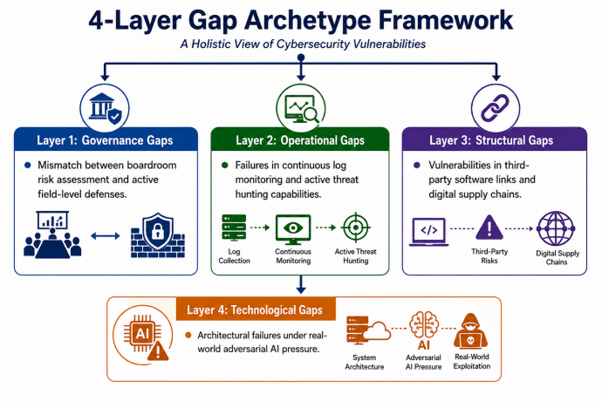
The Strategic Diagnosis: 4-Layer Gap Archetype Framework
To help financial security leaders look beyond individual errors, the report introduced the “Anatomy of Cyber Failure” through a specialized analytical matrix:
Nodal Enforcement Agencies: Mandates and Operational Roles
1. CERT-In (National Nodal Apex)
-
- Designated under the Information Technology (Amendment) Act, 2008.
- Acts as the apex national body for collecting, analyzing, and sharing information on cyber incidents; forecasting threats; issuing safety advisories; and leading emergency response coordination across all sectors.
2. CSIRT-Fin (Specialized Financial Wing)
-
- Functions as a sector-specific node reporting under the national cyber security framework.
- Focuses entirely on the financial matrix, managing incident response and security quality across banking systems, digital wallets, stock market infrastructures, insurance corporations, and pension funds.
UPSC Prelims Fodder: Fact-Check
| Feature | Details |
| Report Title | Digital Threat Report 2025-26 (2nd Edition for India’s BFSI Sector). |
| Joint Publishing Nodes | MeitY, CERT-In, CSIRT-Fin, and SISA (Private Forensic Partner). |
| Core Technical Risk | AI Asymmetry (Offensive AI capabilities moving faster than defenses). |
| Diagnostic Framework | 4-Layer Gap Archetype Framework (Anatomy of Cyber Failure). |
| CERT-In Statutory Base | Statutory standing under the Information Technology (Amendment) Act, 2008. |
| CSIRT-Fin Target Core | Sector-specific oversight for Banking, Securities Markets, Insurance, and Pensions. |
| Implementation Curve | Mandates an 18-month roadmap for continuous threat-hunting deployment. |
Conclusion:
The 2025-26 Digital Threat Report emphasizes that cyber security can no longer be treated as a simple technical checkbox for Indian banks. As adversarial AI shortens the window for exploitation, India’s financial stability relies on moving away from periodic safety reviews toward a model of continuous threat hunting, synchronized inter-agency information sharing, and building resilient digital public infrastructure.
Topic-2: India-Spain Strategic Economic Partnership & Industrial Diplomacy
GS Paper 2: Bilateral, regional and global groupings and agreements involving India and/or affecting India’s interests; Effect of policies and politics of developed countries on India’s interests.
GS Paper 3: Indian Economy (International Trade, Free Trade Agreements, Foreign Direct Investment); Infrastructure and Manufacturing (Make in India).
Context: Union Minister of Commerce and Industry, Shri Piyush Goyal, commenced a high-level official visit to Spain. The visit marks a significant milestone as both nations commemorate 70 years of diplomatic relations and celebrate the India-Spain Dual Year of Culture, Tourism, and Artificial Intelligence 2026.
Key Bilateral Interventions & Policy Frameworks
The diplomatic discussions in Madrid targeted concrete structural reforms to enhance market access, strengthen supply chain resilience, and accelerate technology transfers:
1. Fast-Track Investment Mechanism & EU-FTA Integration
-
- Investment Facilitation: In talks with Spain’s First Vice-President, Carlos Cuerpo Caballero, both nations agreed to fully operationalize a Fast Track Mechanism designed to resolve regulatory bottlenecks for Spanish firms investing in India and vice versa.
- Trade Integration: The leaders reviewed the progress of the India-EU Free Trade Agreement (FTA) negotiations, exploring specific concessions to boost bilateral trade in digital services, renewable energy equipment, and green hydrogen technology.
- Joint Governance: Plans were set to convene the next session of the India-Spain Joint Commission on Economic Cooperation to structurally monitor trade commitments.
2. Co-Development & Manufacturing Alliances
-
- The Defense & Industrial Template: In a meeting with Spain’s Industry Minister, Jordi Hereu Boher, both sides praised the C-295 aircraft program (a joint venture between Airbus Defence and Space and Tata Advanced Systems) as the flagship success model for deep co-production under India’s “Make in India” initiative.
- Smart Infrastructure & Mobility: The discussions established a blueprint for collaborative investments in high-speed railways, advanced automotive manufacturing, and smart urban infrastructure.
The India-Spain Business Forum Ecosystem
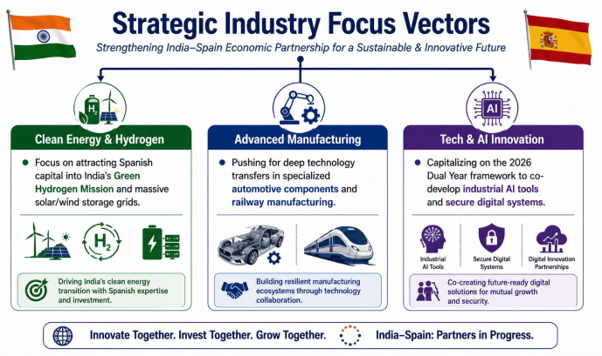
Jointly organized by apex industry bodies—the Federation of Indian Chambers of Commerce and Industry (FICCI), the Chamber of Commerce of Spain, the Confederation of Indian Industry (CII), and ICEX Spain Trade and Investment—the forum presented India’s macroeconomic profile to European investors:
UPSC Prelims Fodder: Fact-Check
| Feature | Details |
| Bilateral Summit Node | India-Spain High-Level Economic Engagements (July 2026). |
| Diplomatic Milestone | Commemorating 70 years of formal diplomatic relations. |
| Themed Bilateral Year | India-Spain Dual Year of Culture, Tourism, and Artificial Intelligence 2026. |
| Flagship Industrial Link | C-295 Aircraft Program (Flagship “Make in India” defense-industrial template). |
| Institutional Catalyst | Fast Track Mechanism for investment clearances. |
| Participating Trade Nodes | FICCI, CII, CEOE Spain, and ICEX Spain Trade and Investment. |
Conclusion:
By using the successful C-295 defense program as a template, setting up the Fast Track Investment Mechanism, and aligning with the 2026 Dual Year of AI and Technology framework, India is positioning itself as a key manufacturing and clean energy partner for Spain within the broader European market.
Spread the Word