Indian Polity & Governance
Additional Judges Appointed to Andhra Pradesh High Court:
Context: The President of India appointed three Additional Judges to the Andhra Pradesh High Court under constitutional provisions, addressing high case pendency rates and vacancy challenges.

-
- Constitutional Authority: Additional Judges are appointed by the President of India under Article 224(1) of the Constitution of India when there is a temporary increase in the business of a High Court or arrears of work.
- Tenure Limitations: An Additional Judge is appointed for a temporary period not exceeding two years, unlike permanent High Court judges who serve until the mandatory retirement age of 62.
- The Collegium System: The appointment process is initiated by the Collegium of the High Court (led by its Chief Justice), whose recommendation is forwarded to the Supreme Court Collegium (led by the Chief Justice of India) for binding concurrence before reaching the Union Ministry of Law and Justice.
- Qualifications Required: To be eligible for appointment as a High Court judge, a person must be a citizen of India and must have held a judicial office in the territory of India for at least ten years OR been an advocate of a High Court for at least ten years.
- The Second Judges Case (1993): This landmark ruling institutionalized the Collegium system, establishing that the word “consultation” with the Chief Justice of India in Articles 124 and 217 actually means “concurrence.”
- Oath of Office: Every person appointed to be a judge of a High Court must make and subscribe an oath or affirmation before the Governor of the state, or some person appointed by them, according to the Third Schedule of the Constitution.
- Removal Procedure: A High Court judge (including an Additional Judge during their tenure) can only be removed from office by an order of the President passed after an address by each House of Parliament supported by a special majority, on grounds of proved misbehaviour or incapacity.
- Transfer of Judges: Under Article 222, the President may, after consultation with the Chief Justice of India, transfer a judge from one High Court to any other High Court.
- Jurisdiction Scope: High Courts possess Original, Appellate, Supervisory, and Writ Jurisdictions. Under Article 226, High Courts have broader writ powers than the Supreme Court, as they can issue writs for both Fundamental Rights violations and ordinary legal rights.
- Court of Record: Under Article 215, every High Court is designated a Court of Record, meaning its judgments have evidentiary value for subordinate courts and it holds the inherent power to punish for contempt of itself.
(PIB)
Indian Society & Social Justice
Targeted Development via the National SC-ST Hub Scheme:
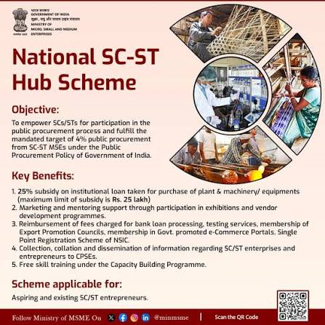
Context: Review meets held under the Ministry of Micro, Small and Medium Enterprises (MSME) highlighted the expanded deployment of the National SC-ST Hub (NSSH) scheme, a focused initiative designed to foster entrepreneurship and fulfill public procurement mandates for Scheduled Castes and Scheduled Tribes.
-
- NSSH Core Objective: The National SC-ST Hub is a dedicated initiative launched to cultivate an enterprise ecosystem that supports SC/ST entrepreneurs in fulfilling the obligations laid down in the Central Public Procurement Policy.
- Public Procurement Mandate: The Central Government’s Public Procurement Policy mandates that all Central Ministries, Departments, and Public Sector Undertakings (PSUs) must procure a minimum of 25% of their total annual procurement from MSEs; out of this, a specific 4% sub-target is earmarked for SC/ST-owned enterprises.
- Implementing Agency: The scheme is actively implemented by the National Small Industries Corporation (NSIC), a premier Mini-Ratna PSU operating under the Ministry of MSME.
- Capacity Building Focus: NSSH provides sponsored skill development training, financial credit linkage support, vendor development programs, and subsidies for participating in international and domestic trade exhibitions.
- Constitutional Safeguards for SCs/STs: Article 15(4) and Article 16(4) empower the State to make special provisions and reservations for the advancement of Scheduled Castes and Scheduled Tribes in education and public employment.
- Article 46 (Directive Principles): Instructs the State to promote with special care the educational and economic interests of the weaker sections of the people, and in particular, of the Scheduled Castes and the Scheduled Tribes, protecting them from social injustice.
- Article 338 and 338A: Establish the National Commission for Scheduled Castes (NCSC) and the National Commission for Scheduled Tribes (NCST) respectively as constitutional bodies to monitor safeguards provided to these groups.
- MSEs: Micro enterprise has investments up to ₹1 crore and turnover up to ₹5 crore; a Small enterprise has investments up to ₹10 crore and turnover up to ₹50 crore.
- The Udyam Registration Portal: A fully digital, paperless self-declaration platform launched by the Ministry of MSME to assign unique registration numbers to enterprises, acting as the gateway to access benefits under schemes like the NSSH.
- Financial Inclusion Linkages: NSSH works in tandem with financial programs like the Stand-Up India Scheme (which mandates banks to provide loans between ₹10 lakh and ₹1 crore to at least one SC/ST borrower per branch) to overcome credit access barriers.
(PIB)
International Relations
Evolution of India-US Strategic Dynamics:
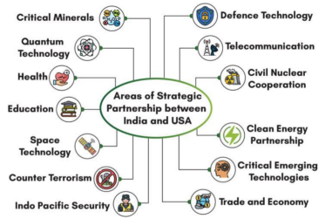
Context: As the United States marked its 250th Independence Day (Semiquincentennial) on 4 July 2026, foreign policy assessments highlighted the complete structural transformation of India-US relations from Cold War “estranged democracies” to tight technological and defence allies.

| Cold War Era Tensions | Modern Strategic Framework |
|---|---|
| Strict Non-Alignment policy by New Delhi | Comprehensive Global Strategic Partnership |
| 1971 deployment of USS Enterprise in Bay of Bengal | Joint military maneuvers (e.g., Malabar Exercise) |
| Post-1974 & 1998 nuclear sanctions | 2008 Civil Nuclear Agreement; Foundational Pacts |
-
- Historical Estrangement: Following 1947, India pursued a policy of strategic autonomy and Non-Alignment (NAM), refusing to join formal US-led cold war security blocs (like SEATO or CENTO), which strained early political trust with Washington.
- The 1971 Geopolitical Low: Relations reached a historical low point during the 1971 Bangladesh Liberation War when the US dispatched Task Force 74, centered around the nuclear-powered aircraft carrier USS Enterprise, into the Bay of Bengal to apply pressure on India.
- Nuclear Isolation & Pokhran Tests: India’s 1974 “Peaceful Nuclear Explosion” (Smiling Buddha) and subsequent 1998 Pokhran-II tests triggered severe economic and technological sanctions under US domestic laws like the Glenn and Symington Amendments.
- The Turning Point (2005-2008): The signing of the historic India-US Civil Nuclear Agreement (123 Agreement) effectively recognized India as a de facto nuclear weapon state, granting an exclusive waiver from the Nuclear Suppliers Group (NSG) despite India not signing the Non-Proliferation Treaty (NPT).
- Major Defence Partner Status: In 2016, the United States designated India as a “Major Defence Partner,” a unique status that elevates defence trade and technology sharing to a level on par with the closest allies of the US.
- LEMOA (Logistics Exchange Memorandum of Agreement): Signed in 2016, this foundational pact allows both militaries to access each other’s designated bases for replenishment, refuelling, and logistics support during joint exercises or humanitarian operations.
- COMCASA (Communications Compatibility and Security Agreement): Signed in 2018, COMCASA permits the transfer of highly encrypted, real-time communication equipment and secure data links between Indian and US platforms during combined operations.
- BECA (Basic Exchange and Cooperation Agreement): Signed in 2020, BECA enables the seamless sharing of unclassified and classified geospatial intelligence, satellite maps, and geodetic data, enhancing the targeting precision of Indian standalone platforms.
- The Quad Framework: India and the US, alongside Japan and Australia, form the Quadrilateral Security Dialogue, focusing on ensuring a free, open, inclusive, and rules-based Indo-Pacific maritime domain.
- iCET (Initiative on Critical and Emerging Technology): A recent paradigm shift moving the relationship from a transactional buyer-seller model into co-development and co-production across semiconductor supply chains, clean energy, space systems, and defence innovation.
(IE)
Economy
Infrastructure Push via Dedicated Multi-Sectoral Allocations:
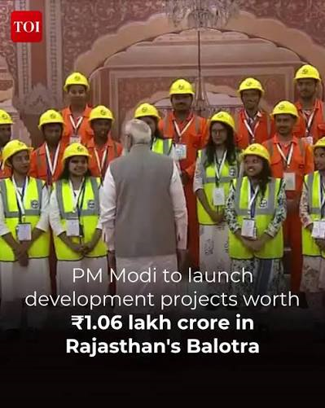
Context: The Union Government unveiled a comprehensive development package worth ₹1.06 lakh crore centered in Balotra, Rajasthan, targeting multi-modal transit corridors, standard-gauge high-speed rail development, and urban public transport infrastructure.
-
- Capital Expenditure Multiplier Effect: Economists estimate that public investment in infrastructure has a high multiplier effect (around 2.5 to 3.0), meaning every rupee spent generates multiple rupees of growth by stimulating demand for steel, cement, and employment.
- PM GatiShakti National Master Plan: A digital platform integrating 16 ministries (including Railways and Highways) to ensure synchronized planning and coordinated execution of infrastructure connectivity projects, reducing logistics costs.
- National Logistics Policy (NLP): Launched to complement GatiShakti, the NLP aims to lower India’s logistics costs from roughly 13–14% of GDP to par with global benchmarks (approx 8%) to enhance export competitiveness.
- Modified UDAN (Ude Desh ka Aam Nagrik) Scheme: A regional airport development program designed to enhance connectivity to unserved and underserved airports through central fiscal support and Viability Gap Funding (VGF).
- Viability Gap Funding (VGF) Mechanism: VGF is a one-time capital grant provided by the government to infrastructure projects that are economically justified but lack financial viability due to long gestation periods or low initial revenue.
- Rail Doubling Economics: Doubling single-track rail networks significantly boosts line capacity, eliminates operational bottlenecks where trains must wait for oncoming traffic, and increases the average speed of high-yield freight corridors.
- Metro Rail Financing Models: Modern urban transit grids utilize various financing structures, commonly a 50:50 joint venture equity sharing model between the Central Government and the respective State Government, coupled with multilateral soft loans.
- Transit-Oriented Development (TOD): A core element of modern city planning where high-density commercial and residential spaces are concentrated within walking distance of rapid transit stations to optimize public transit ridership.
- Standard Gauge vs. Broad Gauge: Indian Railways primarily uses Broad Gauge (1676 mm), but high-speed rail lines and most urban Metro networks utilize Standard Gauge (1435 mm) to easily integrate global rolling stock technology.
- Crowding-In of Private Investment: Robust public spending on fundamental infrastructure builds corporate confidence and expands market access, effectively “crowding-in” private sector capital expenditure that would otherwise remain hesitant.
(PIB)
Ecology & Environment and DM
Administrative Mobilization for Critical Wetlands & Climate Adaptation:
Context: Prompted by unpredictable monsoon surges and urban inundation patterns, environmental expert panels and state administrations fast-tracked proposals for dedicated El Nino/La Nina monitoring cells and implemented stringent ecological protection guidelines for sensitive coastal ecosystems.
-
- Understanding El Nino: A climate pattern characterized by the anomalous warming of surface waters in the central and eastern tropical Pacific Ocean, which historically disrupts global wind patterns and weakens the Indian Southwest Monsoon.
- La Nina Phenomenon: The inverse of El Nino, where sea surface temperatures across the equatorial eastern Pacific drop below normal, typically strengthening the monsoon trade winds and bringing above-average rainfall to India.
- ENSO (El Nino Southern Oscillation): The single, coupled ocean-atmosphere cycle driving these fluctuations. The atmospheric component is measured using the Southern Oscillation Index (SOI), tracking air pressure changes between Tahiti and Darwin.
- Ramsar Convention on Wetlands: An intergovernmental treaty signed in 1971 in Ramsar, Iran, providing the framework for national action and international cooperation for the conservation and wise use of wetlands.
- Montreux Record: A register maintained under the Ramsar Convention listing wetland sites where changes in ecological character have occurred, are occurring, or are likely to occur due to technological developments or pollution (e.g., Keoladeo National Park, Loktak Lake).
- Coastal Regulation Zone (CRZ) Notification: Issued under the Environment (Protection) Act, 1986, CRZ rules classify coastal areas into four zones (CRZ-I to IV) to restrict unregulated industrial and commercial construction within high-tide lines.
- Ecological Functions of Wetlands: Act as natural sponges that absorb excess storm runoff to mitigate urban flooding, recharge groundwater aquifers, filter out heavy pollutants, and serve as vital carbon sinks.
- Eutrophication Menace: The excessive enrichment of water bodies with nutrients (principally nitrates and phosphates from agricultural runoff and untreated sewage), leading to rapid algal blooms that deplete dissolved oxygen and suffocate aquatic life.
- Mangrove Ecosystem Resiliency: Halophytic (salt-tolerant) plant communities found in tropical intertidal zones. Their dense prop-root networks dissipate the energy of incoming storm surges and protect coastlines from erosion.
- Biological Oxygen Demand (BOD): A key water quality indicator measuring the amount of dissolved oxygen required by aerobic biological organisms to decompose organic material present in a water sample; higher BOD signifies higher organic pollution.
(TH/PIB)
Science & Technology
Commercial Semiconductor Assembly & Testing Begins at Sanand:
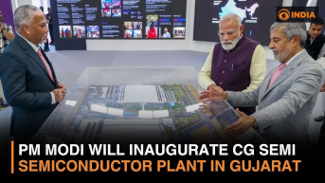
Context: The Prime Minister inaugurated the CG Semi Outsourced Semiconductor Assembly and Test (OSAT) facility in Sanand, Gujarat, built with an investment of over ₹7,500 crore, marking the formal rollout of domestic commercial chip production.
-
- Understanding OSAT: Outsourced Semiconductor Assembly and Test (OSAT) facilities do not fabricate raw silicon wafers; instead, they take fabricated wafers from foundries, cut them, package them into protective housings, and perform rigorous testing before final deployment.
- India Semiconductor Mission (ISM): Launched under the Ministry of Electronics and IT (MeitY), ISM acts as a specialized, nodal business division to drive India’s long-term strategy for building sustainable semiconductor fabrication and packaging ecosystems.
- Financial Incentives: Under the modified Program for Development of Semiconductors and Display Manufacturing Ecosystem in India, the government provides uniform fiscal support of 50% of the project cost for setting up fabs and OSAT units.
- Silicon Value Chain Dominance: Historically, the global chip chain is highly concentrated, with Taiwan (TSMC) dominating advanced fabrication, while assembly and testing (OSAT) have been concentrated heavily in Taiwan, China, and Southeast Asia.
- Target sectors: The annual capacity of 5 billion chips from this facility primarily feeds the supply chains of automotive components, 5G telecommunications equipment, Internet of Things (IoT) sensors, and AI computing hardware.
- Raw material bottlenecks: Semiconductor manufacturing requires specialized critical minerals like ultra-pure Silicon, Gallium, Germanium, and Indium, alongside vast quantities of ultra-pure deionized water.
- Strategic geopolitics: Chips have become a core element of global techno-nationalism. India’s push seeks to build supply chain resilience against supply disruptions similar to the pandemic-era semiconductor crunch.
- Wafer Sorting vs. Packaging: Wafer sorting is the testing process performed while the chips are still on the silicon wafer. Packaging involves wire bonding and encapsulation to shield delicate silicon circuits from moisture and physical shocks.
- Link with Product Linked Incentive (PLI): The semiconductor drive operates in tandem with IT Hardware and Electronics PLI schemes, creating domestic demand for these packaged chips within India.
- Environmental impacts: The production process demands intensive energy and rigorous hazardous waste treatment due to chemical etchants and heavy metal use, highlighting the need for specialized green infrastructure in semiconductor clusters.
(PIB)
Mormugao Port Integrates Quantum Computing Algorithms:
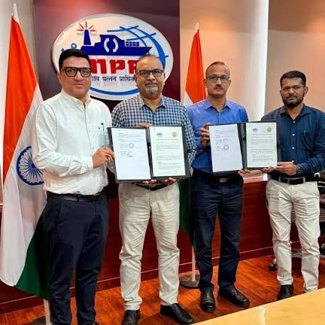
Context: The Mormugao Port Authority (MPA) in Goa signed a Strategic Quantum Technology for Port Innovation Agreement with Egreen Quanta to deploy advanced quantum computing algorithms and AI models to optimize maritime logistics and vessel scheduling.
-
- Quantum Bit (Qubit) Basics: Unlike classical computers that process bits representing either a 0 or a 1, quantum computers utilize qubits, which can exist in multiple states simultaneously due to quantum mechanics principles.
- Superposition Concept: Superposition allows a qubit to hold a linear combination of both 0 and 1 states at the same time, expanding exponential processing power to solve highly complex logistical permutations rapidly.
- Quantum Entanglement: A phenomenon where two or more qubits become deeply interconnected; the state of one qubit instantaneously determines the state of another, regardless of physical distance, enabling fast parallel processing.
- Combinatorial Optimization Problems: Real-world maritime logistics such as routing hundreds of incoming container ships, scheduling gantry cranes, and maximizing berth space are complex combinatorial problems that take classical supercomputers days to solve, but quantum algorithms can resolve them in minutes.
- National Quantum Mission (NQM): Approved by the Union Cabinet, the NQM aims to seed, nurture, and scale up scientific and industrial R&D in Quantum Technology, targeting the development of intermediate-scale quantum computers with 50-1000 physical qubits.
- Major Ports Authority Act, 2020: Mormugao Port operates under this act, which grants increased autonomy and flexibility to India’s 12 major ports, shifting their role from service providers to landlord ports managing operations via private developers.
- Sagarmala Programme: The national port-led development initiative focusing on port modernization, improving port connectivity via rail/road, promoting coastal shipping, and developing port-linked industrial clusters.
- PM GatiShakti Multi-Modal Integration: Integrating port management software with wider railway (CONCOR) and roadway freight data networks ensures container cargo leaving the port faces zero processing delays at inland checkpoints.
- Green Shipping Initiatives: Using quantum math to optimize vessel traffic patterns reduces idle wait times for cargo vessels anchored offshore, directly lowering fuel consumption and greenhouse gas emissions in coastal zones.
- Quantum Cryptography Risk: While quantum computing promises optimization breakthroughs, it simultaneously poses a severe threat to standard public-key encryption standards, driving the development of Post-Quantum Cryptography (PQC).
(PIB)
Internal Security
DAC Approves Major Capital Procurement:
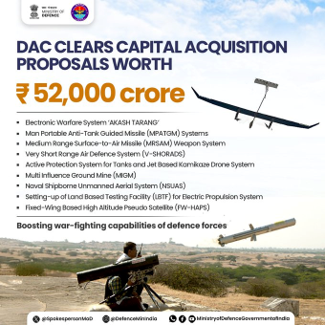
Context: The Defence Acquisition Council (DAC), chaired by the Union Defence Minister, approved major capital acquisition proposals worth ₹52,000 crore to significantly enhance the combat readiness and modernization of the Indian Armed Forces.
-
- The DAC Structure: The Defence Acquisition Council is India’s highest decision-making body on defence procurement, established in 2001 following the recommendations of the Group of Ministers on reforming the National Security System post-Kargil.
- Leadership: The Union Minister of Defence acts as the Chairman of the DAC, ensuring centralized political-military oversight over modernization projects.
- Objective: It facilitates speedy procurement of approved requirements for the three wings (Army, Navy, Air Force) and the Indian Coast Guard by optimizing budgetary resources.
- Defence Procurement Procedure (DPP): The DAC works under the guidelines of the Defence Acquisition Procedure (DAP) 2020, which promotes indigenous design, development, and manufacturing (Aatmanirbhar Bharat).
- Categorization of Capital Procurement: Procurement is prioritized under categories like Buy (Indian-IDDM – Indigenously Designed, Developed and Manufactured), Buy (Indian), and Buy and Make (Indian).
- Defence Offsets Policy: Major foreign defence capital acquisitions include an offset clause (typically 30%), requiring foreign suppliers to invest a portion of the deal value back into India’s domestic defence industry or technology ecosystem.
- The Innovations for Defence Excellence (iDEX): Funded by the Defence Innovation Organisation (DIO), iDEX aims to create an ecosystem fostering innovation and technology development in Defence by engaging R&D institutes, academia, and startups.
- Difference between Revenue and Capital Expenditure: Defence capital expenditure (like this ₹52,000 cr nod) goes into acquiring long-term assets like weaponry, aircraft, and heavy machinery, whereas revenue expenditure funds day-to-day operations, maintenance, and salaries.
- Integration with Chief of Defence Staff (CDS): The CDS is a permanent member of the DAC, facilitating inter-service prioritization and coordination to prevent duplication of hardware across branches.
- The Technology Development Fund (TDF): Executed by DRDO, this fund supports the indigenous development of component-level technologies by MSMEs and startups, bridging gaps flagged during DAC reviews.
(PIB)
Spread the Word