Introduction:
Farm mechanization is critical for enhancing agricultural productivity, timeliness of farm operations and reduction of labour drudgery. To democratize access to modern machinery, particularly for small and marginal farmers, the Sub-Mission on Agricultural Mechanization (SMAM) was launched in 2014–15 with the objective of “reaching the unreached”.
Key Points
-
- ₹9,404.47 crore central assistance provided during 2014–15 to 2025–26.
- 21.61 lakh agricultural machines distributed to individual farmers.
- 27,554 Custom Hiring Centres (CHCs) and 25,608 Farm Machinery Banks (FMBs) established.
- 646 Hi-Tech Hubs established for advanced agricultural equipment.
- 40,928 Kisan Drone demonstrations conducted over 40,918 hectares.
- 30% of total funds earmarked for women farmers.
Institutional Framework:
SMAM is a Centrally Sponsored Scheme under Rashtriya Krishi Vikas Yojana (RKVY). It focuses on small and marginal farmers, women, SC/ST communities, FPOs, SHGs and rural entrepreneurs.
-
- Extends modern farm machinery to farmers and regions with low farm-power availability.
- Addresses small landholdings and high cost of individual machinery ownership.
- Provides enhanced assistance to the North-Eastern Region (NER).
- Centre-State sharing is 60:40 for most States, 90:10 for North-Eastern and Himalayan States and 100% Central funding for Union Territories.
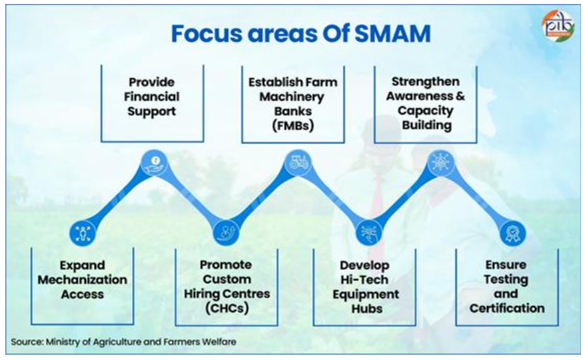
Strategic pillar of SMAM:
1. Custom Hiring and Shared Mechanization:
SMAM promotes a shift from individual machinery ownership towards affordable shared access.
-
- Custom Hiring Centres (CHCs): Provide agricultural machinery and implements on a rental basis to farmers.
- Farm Machinery Banks (FMBs): SHGs, FPOs and local institutions receive 80–90% financial support to acquire machinery.
- Financial Assistance: CHCs receive 40% of project cost for projects up to ₹250 lakh, while FMBs receive 80% support for projects up to ₹30 lakh.
- Hi-Tech Hubs: Provide advanced and high-capacity equipment for crop-specific and high-value farm operations.
The Parliamentary Standing Committee observed that a well-established CHC can provide mechanization services to about 100–200 farmers, making shared machinery particularly important for small farmers.
2. Financial Support for Farm Machinery:
SMAM provides subsidy support for individual machinery ownership through the Direct Benefit Transfer (DBT) system.
-
- General Beneficiaries: 40% of machine cost.
- SC/ST and Small & Marginal Farmers: 50% assistance.
- North-Eastern Region: Up to 100% subsidy for small machinery and 95% assistance for Farm Machinery Banks.
- Mechanized Services: Small and marginal farmers receive ₹2,000 per hectare for mechanized services, including drones, through CHCs, SHGs and FPOs.
3. Training, Testing and Post-Harvest Mechanization:
SMAM combines machinery access with capacity building and technology adoption.
-
- Training and Demonstration: Promotes awareness and practical exposure to modern farm technologies.
- Testing and Certification: Supports performance testing and certification of agricultural machinery.
- Post-Harvest Mechanization: Promotes machinery for processing, storage, value addition and crop residue management.
- IEC Activities: Targeted Information, Education and Communication activities encourage wider adoption among stakeholders.
4. Kisan Drones and Precision Agriculture:
SMAM promotes Kisan Drones for technology-driven and precision agricultural operations.
-
- During 2023–24 to 2025–26, ICAR, State Agricultural Universities and KVKs conducted 40,928 Kisan Drone demonstrations covering 40,918 hectares.
- Drones were demonstrated for application of nutrients, fertilizers and agro-chemicals according to prescribed SOPs.
- ICAR Institutes, KVKs and State Agricultural Universities: 100% assistance up to ₹10 lakh per drone.
- FPOs: Grant assistance up to 75%.
- Drone Service Agencies: Contingency expenditure support of ₹6,000 per hectare.
5. Women-Centric Farm Mechanization:
SMAM earmarks 30% of total funds for women farmers to improve their access to agricultural machinery.
-
- Reduces physical drudgery in labour-intensive agricultural operations.
- Improves women’s participation in mechanized farming systems.
- Supports access to productive technologies and farm machinery.
ICAR has also promoted women SHG-led Custom Hiring Centres, demonstrating the potential of women-led machinery service enterprises.
Challenges
1. The Parliamentary Committee noted that expensive machinery is difficult for small farmers to purchase, while fragmented holdings create adverse economies of scale.
2. Indian Express highlights sharp disparities—97% of paddy households use combine harvesters in Punjab against only 10% in Bihar, indicating uneven access to mechanization.
3. The Parliamentary Committee observed that despite their importance, existing CHCs/FMBs were inadequate relative to India’s large smallholder base and recommended expansion of shared machinery infrastructure.
4. Research on smallholder mechanization identifies limited technical knowledge, inadequate infrastructure and policy gaps as major barriers to effective machinery adoption.
5. FAO stresses that mechanization must improve productivity while minimizing environmental and social impacts; machinery expansion alone does not ensure sustainable agriculture.
Way Forward
-
- The Parliamentary Standing Committee recommended raising India’s farm mechanization level to 75% by 2047, with priority to low farm-power regions.
- Indian Express recommends strengthening FPOs and CHCs through group leasing and platform-based machinery hiring, making equipment available on demand.
- The Parliamentary Committee recommends wider establishment of shared machinery centres so that small farmers can access expensive equipment without individual ownership.
- FAO advocates professionally managed farm machinery hire-service businesses with trained operators, improving both service sustainability and rural livelihoods.
- Machinery strategies should extend across the agricultural value chain and be adapted to smallholders, local farming systems and environmental conditions.
Conclusion:
SMAM marks India’s shift from capital-intensive individual ownership to inclusive and shared farm mechanization by strengthening CHCs, Farm Machinery Banks and precision technologies such as Kisan Drones. India can democratize farm technology and move towards the Parliamentary Committee’s goal of 75% farm mechanization by 2047.
Spread the Word