Introduction:
India’s indirect tax regime completed a critical transformation on 1 July 2026, marking nine years since the implementation of the Goods and Services Tax (GST). This fiscal transition shifted the nation from a fragmented state-level tax framework into “One Nation, One Tax” by replacing cascading taxes.
What is Goods and Services Tax (GST)
The Goods and Services Tax is a comprehensive, multi-stage, destination-based consumption tax levied on the “supply” of goods and services.
-
- Administered under a unique dual structure i.e. comprising Central GST (CGST) and State GST (SGST) for intra-state trades, alongside Integrated GST (IGST) for interstate transactions.
- It completely subsumed 17 fragmented legacy taxes and 13 administrative cesses.
- It functions as a value-added system where tax is collected at the point of final consumption, allowing businesses to claim a continuous Input Tax Credit (ITC) to eliminate cascading “tax on tax” distortions across the internal supply chain.
Key Features of GST:
The structural core of the GST regime is anchored upon distinct operational principles and federal coordination networks designed to achieve market uniformity:
1. Destination-Based Accrual: Unlike origin-based production taxes, the revenue from GST accrues directly to the specific consumption State where the goods or services are finally consumed.
2. The Dual GST Architecture: Operates on a parallel levy template where the Centre and States simultaneously charge CGST and SGST on internal transactions, while the Centre collects IGST on imports and cross-border trades.
3. The GST Council Command: A statutory, federal decision-making body comprising the Union Finance Minister and all State Finance Ministers that drives rate rationalizations, exemptions, and consensus-led legislative updates.
4. The Network Rail (GSTN): A robust common digital public infrastructure (50% Centre, 50% States capital ownership) that facilitates real-time invoice matching, pre-filled return generations, and payment clearances.
5. The Multi-Slab Tariff Grid: Distributes items across a rationalized rate architecture, which has moved primarily toward a dual core (5% and 18% slabs), balanced by exemptions on essentials and a 40% Luxury and Sin Tax layout for high-end commodities.
Recent Developments i.e. The Next-Generation GST 2.0 Reforms
The 56th meeting of the GST Council approved the Next-Gen GST 2.0 reforms, which came into full effect on 22 September 2025 to simplify tax processes and lower household burdens:
-
- Slab Streamlining: The multi-tier tariff structure was compressed primarily into two core slabs of 5% and 18% to reduce classification disputes.
- Social Safety Exemptions: Extended full GST exemptions to health insurance premiums and essential medicines to improve healthcare affordability.
- Anomalies Correction: Corrected historical inverted duty structures on industrial inputs like cement and handicrafts, boosting domestic value addition and micro-enterprise competitiveness.
- Administrative Automation: Introduced automated, low-risk registration paths that allow compliant applicants to receive GST registration within three working days.
Implementation experience: The ground-level impact of the unified tax framework highlights an expansion in industrial formalization, widening consumer relief, and tax revenue growth:
-
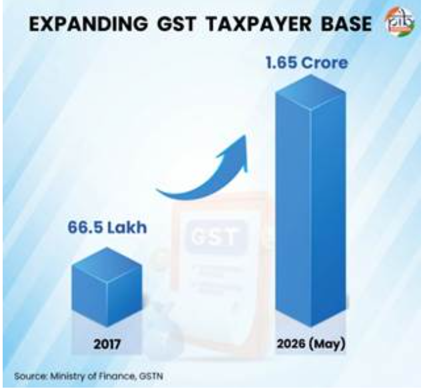
- Taxpayer Base Expansion: Verifiable economic formalization metrics indicate that the total registered taxpayer base expanded from 66.5 lakh in 2017 to 1.65 crore active assesses by May 2026.
- Revenue Trajectory and Buoyancy: Gross annual GST collections surged from ₹7.4 lakh crore in FY 2017–18 to a record ₹22.27 lakh crore in FY 2025–26. This fiscal momentum carried directly into early FY 2026–27, logging ₹4.37 lakh crore during the brief April–May 2026 collection cycle.
- Small-Scale E-Commerce Demarginalization: From October 2023, small micro-taxpayers making intra-state supply of goods through e-commerce operators were exempted from mandatory registration, bringing grassroots artisans into digital storefronts.
- Algorithmic Tax Oversight: Input Tax Credit (ITC) matching has been fully automated through real-time e-invoicing data capture, using machine learning to focus on high-risk taxpayers while easing compliance for honest assessees.
Challenges
-
- The continuous exclusion of petroleum crude, diesel, and petrol from the dual-GST pool prevents input tax credit mapping, leaving logistics networks burdened with cascading fuel taxes.
- Automated machine learning audits frequently freeze valid Input Tax Credits for small workshops over minor supplier invoice-upload delays, triggering unexpected cash-flow crunches.
- The post-transition expiry of the guaranteed 14% state compensation cess has strained manufacturing-heavy states, creating localized revenue shortfalls.
- Transferring anti-profiteering mandates to the Competition Commission of India has not cleared the extensive corporate litigation backlog, causing prolonged pricing uncertainty for retail sectors.
- Despite advanced network analytics within the GSTN, fraud syndicates still exploit gaps in first-mile physical address verification to deploy shell accounts and claim fraudulent ITCs.
Way Forward
-
- The GST Council should pass a statutory timeline to bring transport fuels under the dual-GST net with a uniform, revenue-neutral cap to unlock logistic tax credits.
- Financial regulators should introduce a provisional grace period for low-risk micro-enterprises, allowing automated credit clearances despite short-term vendor delays.
- Deploying independent state-level mediation cells to resolve minor algorithmic accounting mismatches without resorting to immediate bank-account freezes.
- Setting up regional benches of the GST Appellate Tribunal near major industrial clusters to fast-track corporate anti-profiteering dispute resolutions.
Conclusion:
The structural transformation under GST 2.0 highlights India’s successful evolution into an automated, data-driven indirect tax powerhouse. Resolving petroleum inclusion deadlocks and refining input credit safety limits will ensure that this unified tax matrix remains a resilient foundation for Viksit Bharat @2047.
Spread the Word