Topic-1: ASEAN-India Economic Integration & Free Trade Agreement Review
GS Paper 2: Bilateral, regional and global groupings and agreements involving India and/or affecting India’s interests; Effect of policies of developed/developing countries on India’s economy.
GS Paper 3: Indian Economy (International Trade, Free Trade Agreements, Rules of Origin, and Customs Rationalization).
Context: India hosted the 13th ASEAN-India Trade in Goods Agreement (AITIGA) Joint Committee Meeting at Vanijya Bhawan, New Delhi (July 6–10, 2026). The high-level hybrid summit focused on fast-tracking the ongoing review of the 2009 trade pact to make it more user-friendly, modern, and trade-facilitative for domestic industries.
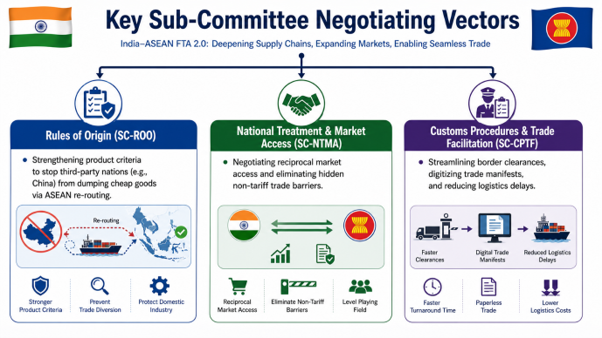
The Need for the AITIGA Review: The original AITIGA entered into force in January 2010. Over the years, India’s trade deficit with ASEAN widened significantly, creating structural imbalances. The review aims to fix these issues by addressing tariff asymmetries, preventing the routing of third-party goods through ASEAN ports, and removing non-tariff barriers that block Indian exports.
Core Focus of the Sub-Committees: During the 13th Joint Committee round, three crucial sub-committees met to resolve outstanding chapters:
Bilateral Trade Profile & Strategic Weight: The strategic importance of ASEAN in India’s foreign trade architecture remains high:
-
- The Trade Share: The 10-nation ASEAN bloc is one of India’s top institutional trading pillars, accounting for 11% of India’s global trade volume.
- The 2026 Baseline: Total bilateral trade reached USD 128 billion in FY 2025–26, highlighting deep economic ties despite persistent market access issues.
- Leadership Node: The 13th session was co-chaired by Shri Nitin Kumar Yadav (Additional Secretary, Department of Commerce, India) and Ms. Mastura Ahmad Mustafa (Deputy Secretary General, Ministry of Investment, Trade and Industry, Malaysia).
UPSC Prelims Fodder: Fact-Check
| Feature | Details |
|---|---|
| Bilateral Summit | 13th ASEAN-India Trade in Goods Agreement (AITIGA) Joint Committee. |
| Host Venue & Timeline | Vanijya Bhawan, New Delhi | July 6–10, 2026. |
| Bilateral Volume | USD 128 Billion achieved during Financial Year 2025–26. |
| Global Trade Weight | ASEAN accounts for 11% of India's total global trade portfolio. |
| Co-Chairing Nations | India (Shri Nitin Kumar Yadav) and Malaysia (Ms. Mastura Ahmad Mustafa). |
| Participating Bloc | All 10 ASEAN members (Brunei, Cambodia, Indonesia, Lao PDR, Malaysia, Myanmar, Philippines, Singapore, Thailand, Viet Nam). |
Conclusion:
The 13th AITIGA Joint Committee meeting marks a critical step toward rebalancing India’s trade ties with Southeast Asia. By setting clear timelines for sub-committees working on Rules of Origin and Market Access, India aims to modernize the decade-old agreement. This update will protect domestic industries from trade routing vulnerabilities while opening up fresh export channels under the Act East policy.
Topic-2: India-Australia Comprehensive Strategic Partnership & Indo-Pacific Security
GS Paper 2: Bilateral, regional and global groupings and agreements involving India and/or affecting India’s interests; Effect of policies and politics of developed/developing countries on India’s interests.
GS Paper 3: Security challenges and their management (Maritime Security, Cyber Security); Infrastructure (Energy Security, Civil Nuclear Energy).
Context: During an official state visit to Australia, the Prime Minister of India finalized a comprehensive list of 18 strategic outcomes spanning defense, civil nuclear energy, critical technology supply chains, and higher education. This visit updates the bilateral architecture to counter emerging geopolitical and supply chain vulnerabilities in the Indo-Pacific region.
Key Strategic and Defense Outcomes
The bilateral summit focused heavily on transforming interoperability and maritime domain awareness between the two Quad partners:
-
- Defense & Maritime Upgrades: The Joint Declaration on Defense and Security Cooperation (JDDSC) updates the 2009 framework, focusing on forces interoperability, cyber defense, and unified approaches to UNCLOS. This is supported by the Maritime Security Collaboration Roadmap (MSCR) for operational coordination.
- Maritime Law Enforcement: A new MoU between the Indian Coast Guard (ICG) and Australia’s Maritime Border Command (MBC) institutionalizes intelligence sharing and border protection.
- Military Integration: Australia announced the deployment of an Indian military instructor to the Australian Defense College for the 2028–29 academic cycle.
Energy Security & Civil Nuclear Operationalisation
-
- Uranium Supply Chain: Both nations finalized the Administrative Arrangement of the India-Australia Civil Nuclear Agreement (originally signed in 2014), clearing the legal path for the direct supply of Australian uranium to power India’s domestic nuclear reactors.
- Rooftop Solar Training Academy: Under the PM Surya Ghar Yojana framework, the Rooftop Solar Training Academy was operationalized at Pandit Deendayal Energy University, Gandhinagar. Partnering with Australia’s DCEEW and ReNEW, the academy will train 2,000 women and youth as solar technicians.
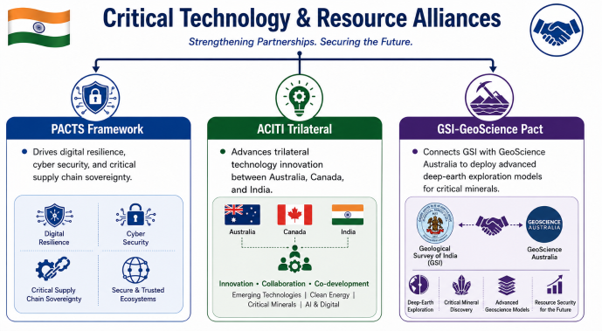
Technology, Supply Chains, and Critical Minerals
Education and Cultural Diplomacy
-
- Foreign University Campuses:
- Flinders University received a Letter of Intent to set up its offshore campus in Bengaluru.
- Victoria University received a formal Letter of Approval to establish its campus in Gurugram.
- Vocational Alignment: The National Council for Vocational Education and Training (NCVET) and the Australian Skills Quality Authority (ASQA) signed a pact to align cross-border occupational standards.
- Repatriation of Antiquities: Australia repatriated three historic Chola-era Indian artifacts from Tamil Nadu: the granite sacred bull Nandi (11th–12th century), a bronze Trident with Auspicious Kali (11th century), and a basalt six-headed Skanda/Karttikeya (12th century).
- Foreign University Campuses:
UPSC Prelims Fodder: Fact-Check
| Feature | Details |
|---|---|
| Bilateral Node | India-Australia Outcomes Framework (July 2026). |
| Nuclear Milestone | Finalization of administrative rules for Uranium Importation. |
| Tech Framework | PACTS (Partnership for Cyber, Critical Technologies, Supply Chains). |
| Trilateral Node | ACITI Partnership (Australia–Canada–India Tech & Innovation). |
| Offshore Education | Flinders University (Bengaluru) & Victoria University (Gurugram). |
| Green Energy Node | Rooftop Solar Training Academy launched at PDEU, Gandhinagar. |
| Artifacts Returned | 3 distinct Chola-era sculptures returned to Tamil Nadu. |
Conclusion:
The 2026 India-Australia outcomes mark a significant shift from diplomatic dialogue to practical security and industrial cooperation. By securing critical mineral exploration, opening paths for uranium supply, and establishing Australian university campuses in India, the partnership strengthens supply chain resilience and security cooperation across the Indo-Pacific.
Spread the Word