
Introduction:
India’s defence ecosystem has undergone a profound structural transformation driven by the mandates of Atmanirbhar Bharat and Make in India. The national security planning has integrated fiscal outlays with advanced research platforms and deep corporate-institutional restructurings.
Key Takeaways
-
- Macro Fiscal Expansion: Total financial allocations for national security surged from ₹2.53 lakh crore in FY 2013–14 to ₹7.85 lakh crore for FY 2026–27, backed by a targeted capitalization expenditure layout of ₹2.19 lakh crore.
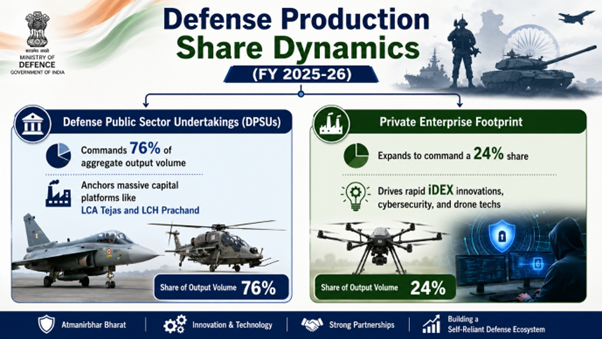
- Defense Production Rebound: Domestically sourced defense production touched a record milestone of ₹1.78 lakh crore in FY 2025–26, marking a 110% increase since FY 2020–21.
- Exponential Export Vectors: Defense hardware exports expanded by over 5,500% over twelve years, climbing to a historic ₹38,424 crore in FY 2025–26 across a transnational consumer footprint of over 80 countries.
- The Procurement Architecture: The implementation of DAP 2020, DPM 2025, and the draft DAP 2026 has established a fast-track, facilitation-led acquisition system, enforcing indigenous content thresholds up to 60%.
Deep-Tech Innovation and Translational Defense Research:
The structural core of technological self-reliance has been re-engineered through a network of collaborative, translational research frameworks that connect startups, academia, and industry:
-
- The Incubator Pipeline: The Innovations for Defence Excellence (iDEX) vertical, supported by the ₹750 crore ADITI Scheme, has onboarded 676 active startups and MSMEs to sign 551 specialized design and development contracts.
- The Production Integration Grid: Backed by an expanded Technology Development Fund (TDF), DRDO’s Development cum Production Partner (DcPP) model leverages more than 2,200 specialized small industries to turn advanced lab concepts into battlefield-ready systems.
- Open-Access Validation: To accelerate prototype testing cycles, the Ministry of Defence has uploaded the advanced equipment of 24 DRDO laboratories onto a centralized, open-access Defence Testing Portal for commercial developers.
- Human Capital Corridors: Talent pipelines have been institutionalized through 15 DRDO Industry-Academia Centres of Excellence (DIA-CoE) steering research across 82 verticals, alongside five specialized Young Scientists Laboratories (DYSLs) to foster deep-tech self-reliance.
Corporate Restructuring and Regional Industrial Corridors:
To eliminate legacy inefficiencies and scale up domestic industrial throughput, the state executed radical structural changes across public and private production nodes:
-
- The Reorganization Mandate: In October 2021, the government dissolved the 200-year-old Ordnance Factory Board (OFB), corporatizing its 41 ordnance factories into seven specialized, independent Defence Public Sector Undertakings (DPSUs) to improve market competitiveness and technological depth.
- Regional Supply Chain Clusters: This public-sector overhaul operates alongside two fast-growing Defence Industrial Corridors in Uttar Pradesh (attracting ₹42,057 crore in commitments) and Tamil Nadu (attracting ₹32,699 crore). These clusters build centralized industrial infrastructure and regional test hubs, expanding active industrial licenses from 258 in 2015 to 834 as of March 2026.
Easing Commercial Entry and Attracting FDI:
Sustaining capital investment into domestic defense manufacturing has relied on a series of procedural rollbacks and systemic legal ease-of-doing-business markers:
-
- License Validity Extensions: Initial validities for defense industrial licenses were expanded from 7 years to 15 years (extendable up to 18 years), while companies operating under the Arms Act are granted lifetime validity once initial facilities are validated.
- Capital Account Liberalization: The Foreign Direct Investment (FDI) threshold was raised to 74% via the automatic route for new licenses and up to 100% through the government channel for niche technologies, drawing ₹6,670.59 crore in cumulative FDI inflows by March 2026 while de-risking co-production ventures with foreign OEMs.
- Digital Integration Hubs: Supply chain tracking has been centralized via the Srijan Defence Portal—indigenizing over 15,700 distinct sub-components—and Srijan DEEP, which assigns a unique reference number (URN) to 41,000 active vendors to manage emergency resource pooling.
Strategic Multilateral Integration and Systems Diplomacy:
India’s expanding hardware and operational depth has reshaped its defense diplomacy, shifting international treaties from basic procurement toward collaborative co-development, combined manufacturing, and net-security provisioning:
-
- The India–US Tech Grid: Guided by foundational pacts (LEMOA, COMCASA, and BECA), bilateral ties scaled up through the TRUST framework (2025), expanding joint exercises and technology sharing across artificial intelligence, space systems, and semiconductors.
- The Euro-Strategic Axis: Anchored by a Comprehensive Security and Defence Partnership with the European Union (2026) and a multi-decade roadmap with France, this framework supports the delivery of Kalvari-class Scorpene submarines built at Mazagon Dock and joint aerospace engine manufacturing with Safran.
- Indo-Pacific and Quad-at-Sea Alignments: Operating under the SAGAR vision and the MAHASAGAR doctrine (2025), the Indian Navy has positioned itself as a primary net security provider in the Indian Ocean Region. This is reinforced by active participation in the Quad-at-Sea Mission and weapon system exports—such as transferring BrahMos supersonic missiles to ASEAN partners like the Philippines.
Challenges
-
- The Hindu (The Private Venture Capital and Prototyping Bottleneck): While deep-tech initiatives like iDEX and TDF provide initial grants, transitioning advanced defense prototypes into full-scale battlefield production is limited by a lack of long-term commercial venture equity and extended wait times at specialized state evaluation centers.
- Indian Express (The Advanced Propulsion and Critical Component Sourcing Gap): Despite achieving significant indigenization across bulk defense parts, India’s defense industrial base remains vulnerable to external disruptions for niche components, such as single-crystal turbine blades, specialized composite alloys, and military-grade semiconductor packaging.
- Observer Research Foundation (The Defense Export Financing and Geopolitical Risks): Reaching the target of ₹50,000 crore in defense exports by 2029 requires competing directly with entrenched global defense consortiums. Securing these contracts demands complex sovereign export-credit financing lines for developing range nations, which exposes state finance houses to international currency fluctuations.
- PRS Legislative Research (Statutory Trial Backlogs and Evaluation Delays): The draft guidelines of DAP 2026 attempt to simplify acquisition categories, but testing pipelines remain slow. The lack of an independent, statutory authority to standardize field evaluation parameters continues to delay the final induction of private sector defense hardware.
- Government Audit Portals (The Personnel Absorption and Skill Alignment Gap): While structural human capital programs like the Agnipath scheme introduce a younger, tech-savvy workforce to the military, a structural mismatch persists between standard university engineering curriculums and the specialized software architectures required by DRDO labs.
Way Forward
-
- Enacting an Omnibus National Defense Production Act (PRS Approach): Parliament should enact a comprehensive legal framework to codify fast-track clearances for private industrial corridors, standardize dual-use commercial technology conversions, and minimize statutory field-trial delays.
- Establishing Sovereign Defense Venture Funds for Advanced Metallurgy (Indian Express Option): To close the core component gap, the Ministry of Defence should set up dedicated, state-backed venture funding lines to assist domestic private consortia in manufacturing single-crystal blades and advanced semiconductors locally.
- Deploying Low-Interest Defense Export Credit Windows (ORF Strategy): To support the ₹50,000 crore global sales target, the government should deploy specialized sovereign credit and currency swap windows through the international financial desks at GIFT City, lowering risk for transnational buyers.
- Creating an Autonomous Defense Testing & Evaluation Authority: In line with the transparency markers set by government portals, establishing an independent validation body will eliminate evaluation backlogs by standardizing testing procedures across all public and private laboratories.
- Scaling Project-Based Postgraduate Defense Technology Verticals: Capitalizing on the 15 existing centers of excellence to structure specialized, project-based postgraduate degrees, building a highly skilled pipeline of private engineers trained for hypersonic and quantum defense projects.
Conclusion:
The transformation of India’s defense architecture over the past decade highlights a fundamental pivot toward high-tech, self-reliant defense capabilities by matching absolute indigenization targets under the Positive Indigenisation Lists with corporate restructurings and strategic multilateral diplomacy.
Spread the Word